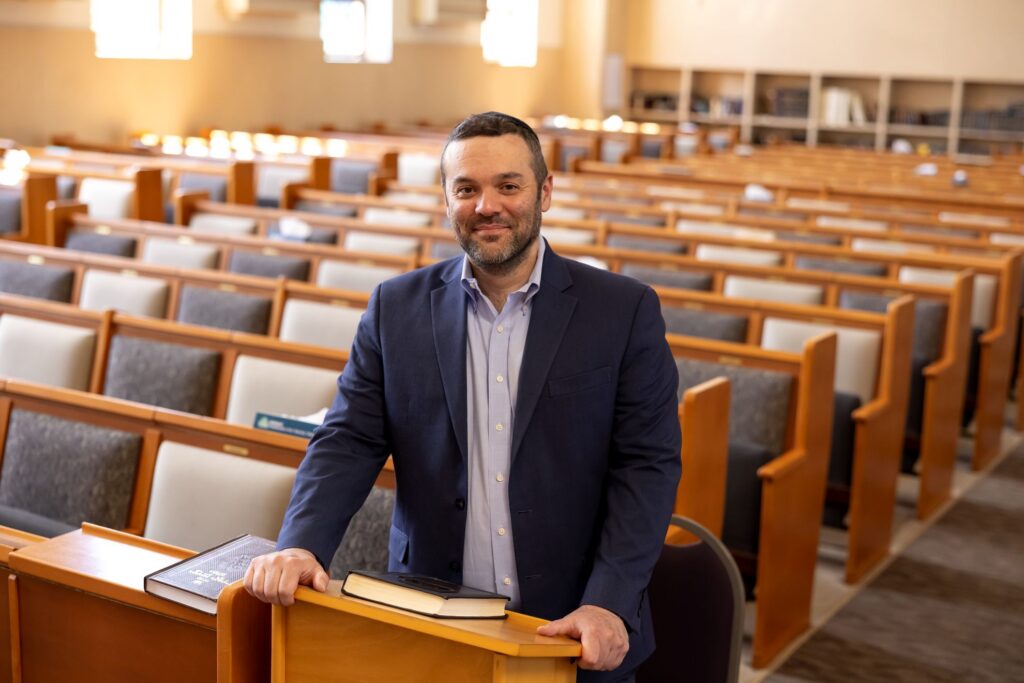

Daniel Grand, an Orthodox Jew, lives in University Heights, Ohio. His faith requires communal prayer with a minyan of at least ten men on the Sabbath. He invited a small group of neighbors to gather for these services in his home.
A neighbor complained. City officials issued a cease-and-desist letter. The letter stated that Grand’s home could not serve as a place of religious assembly in a residential zoning district without a special-use permit. It threatened code enforcement if he continued.
Grand canceled the next service and submitted a permit application. Neighbors filed opposition letters that expressed open hostility to Jewish practice. One writer stated he did not want the neighborhood “labeled as Jewish.” The city held a public hearing marked by similar opposition.
After Grand withdrew the application, Mayor Michael Dylan Brennan declared at the Planning Commission meeting that the cease-and-desist order remained in full force. He told those present: “If you observe such activities, and I hope you do not, but if you do, you may report them to the city, and the city will enforce its laws…” A police lieutenant directed patrol units to conduct frequent drive-bys of the home. The city prosecutor initiated a housing code investigation. An inspector searched the residence with consent from Grand’s wife and found no violations.
Grand sued under the Religious Land Use and Institutionalized Persons Act (RLUIPA), 42 U.S.C. § 2000cc, and the First Amendment. RLUIPA prohibits governments from imposing substantial burdens on religious exercise through land-use rules unless the rules serve a compelling interest by the least restrictive means. It also requires equal treatment of religious assemblies.
The district court dismissed the suit. The United States Court of Appeals for the Sixth Circuit affirmed in November 2025. It held the claims unripe because Grand had not completed the permit process and received a final denial.
Grand petitioned the Supreme Court. His counsel filed a reply brief urging review to resolve a circuit split on when RLUIPA claims ripen. The brief argues that the cease-and-desist order itself caused concrete injury by forcing Grand to halt a core religious practice.
The city treats a small home gathering as equivalent to an institutional synagogue that requires special permitting. Small, informal prayer groups have operated in Jewish and Christian homes for centuries without such licensing.
If the Sixth Circuit approach stands, any city can burden home-based religious exercise by imposing permit requirements and exposing applicants to discretionary hearings and neighbor opposition. Christian house churches, Bible studies, and family prayer gatherings would face the same exposure.
Early believers gathered in homes to pray, teach, and break bread. When authorities later demanded registration or closure of such meetings, Christians appealed to divine law over human commands that contradicted it. Then Peter and the other apostles answered and said, We ought to obey God rather than men. (Acts 5:29, KJV)
The American founders protected religious exercise in private homes and voluntary societies from government oversight or favoritism.
As of June 3, 2026, the petition for a writ of certiorari in Grand v. City of University Heights remains pending. The Court has neither granted review nor issued any decision on the merits.
The Supreme Court should grant review. It should clarify that RLUIPA protects religious exercise from the first moment government coerces a believer to stop or seek permission for it.
The American founders protected religious exercise in private homes and voluntary societies from government permission slips or favoritism. A ruling in Grand’s favor would reaffirm that principle against modern zoning regimes that treat a handful of people praying in a living room as an institutional “place of assembly” requiring special approval.
Even without a Supreme Court decision yet, the case already illustrates how local land-use rules can be weaponized against minority religious practice and how the ripeness doctrine can function as a barrier to judicial review of those burdens.
More:
Alliance Defending Freedom case page
District Court ruling (City of University Heights site)



Comment by David on June 8, 2026 at 8:59 am
Not everything can be done in the name of religious freedom. There are good reasons why places of assembly must have sufficient exits. There have been cases of overcrowding in cellars with but a single stairway for egress.
Comment by Qohelet on June 8, 2026 at 10:11 am
This is a clear cut case of antisemitism. He asked a dozen men to come to his house to pray in a minyan. I think all of us have had a dozen friends over for a Super Bowl or Christmas party. Not to mention Tupperware parties or Pampered Chef. Your neighbors don’t get to veto who you gather with.
Comment by Wilson R. on June 8, 2026 at 2:20 pm
I don’t know that the writeup here gives me enough information to render a judgment on this case, and I strongly suspect that it’s more complicated than the open-and-shut way it’s presented here.
The story quotes one letter from a neighbor that clearly is antisemitic. Is that true of all of the opposition in the neighborhood? Maybe, but it’s hard from this to be sure. I suspect that some of the complaints involve traffic and congestion issues. Some streets in my neighborhood aren’t wide enough to permit two-way traffic if cars are parked on both sides of the road. This guy hosts a weekly gathering for 10 people at his house. What does the street look like when all of them are there and cars presumably parked out front? Maybe that’s the issue–and the fact that it’s weekly. My across-the-street neighbor is Jewish. When her father died, lots of people came for several nights to sit shiva, meaning lots of cars on both sides and in my parking area. We of course were happy to accommodate. But other people not feel that way about having that many cars every week. Lots of people in my neighborhood work from offices at home, as I did for many years. Our city has restrictions on how many cars can be parked in front of homes where businesses operate, and you cannot obtain a business license, with only limited exceptions, if you have clients coming and going. If cars are causing a problem for neighbors and if the guy is in violation of local ordinances, the city wouldn’t have much choice but to enforce their codes. The antisemitic letters are disturbing. But I’m not sure this is all about suppression of religious freedom.
Comment by Qohelet on June 8, 2026 at 4:38 pm
Wilson he’s talking about a minyan of Orthodox Jews on the Sabbath. No cars involved. Only people within walking distance.
I of course felt as you did that there must be more and tried to do some research on the case. There’s really nothing more to it. Apparently he originally asked twelve people.
Comment by Wilson R. on June 8, 2026 at 6:00 pm
Doh, you’re right–I forgot we’re talking about Orthodox Jews, who don’t drive on the Sabbath. There are two synagogues (one Orthodox and one Conservative) within a mile of my house, so we have lots of Jewish neighbors. Even many of the Conservative Jews walk to synagogue.
I still suspect there’s more to the story. Maybe there’s a local ordinance that applies here and would not have been actively enforced except that someone made a complaint. It sounds here like there were multiple complaints. Still, if the gathering wasn’t causing traffic problems or some other disruption, it’s hard to figure a motive for the complaint other than antisemitism. I am especially disturbed the comment that someone didn’t want the area to be labeled as a “Jewish neighborhood.” Dude, if you have 10-12 people from the neighborhood coming to a religious gathering, then to that extent, at least, it is already a Jewish neighborhood. You want to expel them?
Comment by Qohelet on June 8, 2026 at 8:32 pm
Wilson I did a little more reading. He was brought to the attention of authorities by a neighbor upset with his invitation to bring a friend and spread the word. The mayor testified that in the basement of another home based shul, there had been 120 people. But that never happened here.
The district and 6th circuit courts ruled against him because his claims weren’t “ripe.” In other words, he had applied for a special use permit for his property, then withdrew it, and it was never acted on. He then sued the city and that’s the case before the court. The ruling was that he didn’t have standing to sue because no action had been taken against him.
I still stand by my statements that this is an abuse of government power. An informal religious gathering in one’s home should not be subject to jurisdiction until it becomes a problem. I’d have a very different opinion if he was hosting 120 person prayer sessions and there were documented code violations. But I’ve literally invited twelve friends over for beer and hockey and told them to bring a friend if they wanted. That’s not the government’s business and watching the game isn’t even in the first amendment.
Comment by J. on June 10, 2026 at 12:41 pm
Does thi affect a prayer before a family gathering such as Thanksgiving, Christmas, Hannukah, Kwanzaa, or other?
Comment by David Gingrich on June 15, 2026 at 7:25 am
Does the city allow barbecues where 10 or more people attend? Birthday parties? Gender reveal parties?