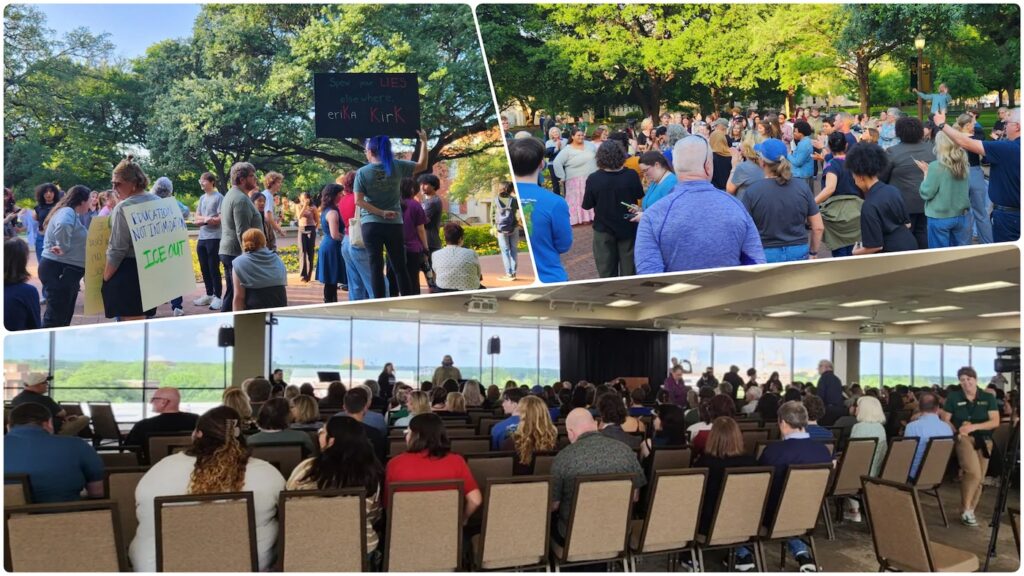
More than 350 Baylor University students, faculty, staff, and alumni attended a student-organized event featuring national LGBTQ+ advocates and intended to counter a Turning Point USA (TPUSA) event held on the Waco, Texas, campus the same night.
The April 22 “All Are Neighbors” event at the Baptist university featured speakers advocating LGBTQ+ affirmation, condemning Trump administration immigration enforcement and lauded religious diversity. Baylor faculty and undergraduate students also spoke.
Baylor University did not endorse either event; both required extensive paperwork and express logistical approval to be held on campus. The respective events had ample security and were required to post an “Expressive Activity Ahead” sign at their entrances.
Throughout “All Are Neighbors,” speakers explained how their Christian backgrounds inspired their political advocacy. Interfaith Alliance President and CEO the Rev. Paul Brandeis Raushenbush spoke on his identities, as a Baptist and as a gay man, as compatible and divinely bestowed.
“My faith teaches that each one of our lives — in all of our complexity and diversity — are divinely and beautifully created,” Raushenbush shared.
In contrast, the weaponization of faith and politics against people in vulnerable communities is the “blasphemy” and “sin” we must stop, the progressive cleric insisted.
The Rev. Susan Hayward, minister for Justice Organizing and Adult Faith Formation at Creekside United Church of Christ (UCC) in Minneapolis, Minnesota, emphasized human diversity as a reflection of God.
“In learning and celebrating our differences, we can understand better a God who is bigger than any one race or culture or nation or religious tradition, a God who does not belong to any one of us, but to whom we all belong,” Hayward proposed.
The UCC pastor challenged the audience to stand in solidarity with immigrants. She described how she and her community in Minneapolis stood against Operation Metro Surge with nothing but whistles and phone cameras, and how the community helped to feed and conceal illegal immigrants from federal officials.
Dr. Greg Garrett, the Carole Ann McDaniel Hanks Chair of Literature and Culture at Baylor’s English department, recalled being named to TPUSA’s Professor Watchlist two years ago.
“They don’t comprehend my deep faith,” Garrett asserted.
Referencing Matthew 25:40, Garrett emphasized that what matters at the end is whether we have served “the least of these.” To then redirect attention away from those on the margins is an affront to the faith, Garrett claimed.
“I am a straight white Christian male, and I am not one of the least of these. Even though some white American Christians claim to be persecuted, or that Christianity is under siege, this is not reality,” Garrett insisted.
Human Rights Campaign President Kelley Robinson told those at the event that her faith is foundational to her work. As a self-identified queer person raised Catholic, Robinson said that church taught her how to build community and to advocate for others. She urged the audience to have a “civic faith” that “together we can bring forward a world that we all deserve.”
“One day, my kids will feel just as safe surrounded by the American flag as they do when they’re surrounded by pride flags,” Robinson predicted.
Robinson praised the “All Are Neighbors” organizers for offering an alternative to the TPUSA event.
“This moment … exists because … the community decided that if harmful ideas were going to have a platform, then by God, the truth would have one, too,” Robinson declared..
“All Are Neighbors” served as Robinson’s chance to remind listeners that “the power of the people is always greater than the people in power.”
Baylor University Director for Pastoral Care Dr. Sara Barton delivered the event’s benediction. She reminded students that the chaplains around Baylor’s campus offer care and support—whether that means sharing snacks or discussing the big questions.
“I’m here on behalf of our office to say especially to the students who are here: we are here for you,” the Baylor Associate Chaplain noted.
In the form of a benedictory poem, Barton highlighted texts from various religions that echoed the idea of loving one’s neighbor. Baylor Spiritual Life did not respond to request for comment.
The shortcomings of the “All Are Neighbors” event highlights the need for true neighborliness. Part of being a true Christian neighbor means engaging with others in a way that promotes Christ’s message of reconciliation through both truth and love.
Despite repeated invocations of love and truth, speakers at “All Are Neighbors” encouraged the audience to unlovingly abandon their neighbors in their sin and lostness. Our neighbors—regardless of their sexual orientation, race, religion, or immigration status—are in dire need of the truth of the Gospel. While hatred of neighbor has no place in the Christian mission, neither do unbiblical, sin-affirming platitudes.
True neighborliness means walking alongside our LGBTQ+ friends in conquering sin. It means treating our illegal immigrant friends with compassion and dignity, even while respecting the laws our government has in place. It means reaching those of other religions with the Gospel, humbly recognizing that it is only by Christ’s blood that any of us can stand in relationship with God.
The “All Are Neighbors” event attests to the cosmic loneliness of our generation. Speakers were correct in identifying an unloving divisiveness too often tolerated by conservative Christians. Believers should have little patience for vitriolic, dehumanizing insult-lobbing, such as right-wing political commentator Benny Johnson at the TPUSA event also occurring on Baylor’s campus referring to “deal with” liberal women the same as cows and pigs.
However, the antidote to alienation is not affirmation but atonement. Affirmation of sin praises that which separates us from God and neighbor. Only by faith in Christ’s atoning sacrifice can we conquer that sin and reconcile with both God and neighbor.
True neighborliness is imbued with loving and truthful humility. It’s true neighborliness that empowers the Apostle Paul to declare, “Therefore, we are ambassadors for Christ, God making his appeal through us. We implore you on behalf of Christ, be reconciled to God. For our sake he made him to be sin who knew no sin, so that in him we might become the righteousness of God.”
A version of this article was published at The Standard at Baylor University. Read the original here.
More from IRD:
Baylor University Receives Grant to Study LGBTQ+ Inclusion in the Church
Baylor Reverses Course on LGBTQ+ Grant



Comment by Wilson R. on May 2, 2026 at 12:19 am
I am, in this order, a Christian, a Texan, and a Baylor graduate. Because I am those three things, I am compelled to call out this writer and this website for their spiritual blindness.
As I read the first half of this piece, I kept waiting in vain for evidence that this counter-event failed, as the headline claimed, to exhibit true neighborliness. Standing in solidarity with immigrants? Affirming that each of us, in our diversity, is cherished by God? Holding ourselves accountable, as Jesus said we would be held, for serving “the least of these?” Surely, Ms. Beebe was not suggesting that these were un-neighborly?
Finally, she came round to her indictment: The group was guilty of “sin-affirming platitudes,” while, by contrast, “true neighborliness means walking alongside our LGBTQ+ friends in conquering sin.”
That sentence broke my industrial-strength Iron-o-Meter.
I’m familiar enough with Turning Point USA. I read what the TPUSA speakers said at Baylor. It’s not unfair to call it a hate group. They promote the racist claim that there is an organized plot to replace white people with non-white immigrants who will destroy the character of America. Charlie Kirk presented stoning as the correct punishment for LGBT people. He demeaned successful black people as owing their positions to affirmative action rather than competence; he said the Civil Rights Act should never have been passed.
I could go on. There isn’t much that is neighborly about this organization. But it’s not until near the end that Ms. Beebe notes, in passing, the “unloving divisiveness” tolerated by conservative Christians who attended the TPUSA event. I didn’t see a call for atonement by TPUSA like the one issued here to LGBT people and those who attended the counter-event.
Maybe focus on taking the log out of your own eye before you call out the speck in someone else’s. When you condemn the students who supported the TPUSA event for affirming the sin of those who called liberal women cows and pigs, I will take you a little more seriously.
Comment by John on May 2, 2026 at 10:24 am
I think the author of this article should acknowledge the fact for progressive Christians homosexuality and being transgender are not sins. I realize the IRD disagrees very strongly with that viewpoint and that’s fine, but this article implies that such views are held universally by Christians today and even among all those who attended the Neighborliness event. Not true. Baylor has a very active LGBTQ advocacy group and its chaplains and religious faculty have long expressed progressive views on this issue. Again, you don’t have agree with them on this, but you should at least acknowledge that these are the beliefs they hold. I feel like this should also be balanced by a detailed critique of the TPUSA event to give readers greater context. It frustrates me when the IRD reacts to reactions without addressing the initial event that triggered a response, such as the Trump AI image or the War in Iran. It just feels like avoidance.
Comment by Gary Bebop on May 2, 2026 at 3:39 pm
Let’s also acknowledge that blasts of negativity are modus operandi for the commentariat on the Left. Their squeals of displeasure or censure are routine dispatches from that sect. They play the same closed-loop tunes in pious devotion to their sophistries. By contrast, the young and gifted writers in the IRD stable are consistently vindicated for erudition, nuance, and truth.
Comment by Qohelet on May 2, 2026 at 9:53 pm
Hey Bebop you ever find that part of the Gospel where Jesus says anything about telling your gay friends they’re going to hell is important?
Or literally anything about homosexuality at all?
It’s just that in this world where people act against the will of Jesus constantly… I think you’re focused on the wrong problem.
Comment by Different Steve on May 3, 2026 at 8:03 am
I’m always at a loss to understand what Qohelet might have in common with their namesake.
If the commenter chose “Qohelet” intentionally, it’s an interesting contrast because Ecclesiastes (traditionally associated with Qohelet, “the Teacher” or “Preacher”) is marked by:
ambiguity,
melancholy,
humility about human understanding,
and skepticism toward human certainty.
The biblical Qohelet constantly undercuts simplistic moral triumphalism. He says things like:
wisdom has limits,
humans don’t fully grasp God’s purposes,
everyone dies,
ideological confidence is fragile,
and much human striving is “vanity” or vapor.
The commenter, by contrast, sounds morally certain and rhetorically combative:
“you’re focused on the wrong problem.”
That’s much more prophetic-internet-debater energy than Ecclesiastes-style existential reflection.
A genuinely “Qohelet-like” comment might have sounded more like:
caution against self-righteousness,
recognition of human hypocrisy across factions,
or uncertainty about how divine judgment truly works.
Something closer to:
“Perhaps we should be careful about confidence in condemning others when our own age is full of injustice and vanity.”
Instead, the comment is concise and accusatory — effective rhetorically, but not especially Ecclesiastian in tone.
Of course, online handles are often aspirational rather than descriptive. People choose names from philosophers, saints, or biblical figures because they admire them, not because they emulate them.
If they have little in common with a character how do they end up assuming the name?
Usually because people identify with a piece of the figure rather than the whole personality or worldview.
Someone choosing “Qohelet” might connect with:
the book’s reputation for wisdom,
its outsider tone,
its critique of hypocrisy,
its philosophical flavor,
or simply its literary prestige.
But most people don’t internalize an entire character or text in a deep, coherent way. Human self-identification is selective. We latch onto:
an aesthetic,
a mood,
a few memorable lines,
or a role we imagine ourselves playing.
There’s also a common phenomenon where people adopt names symbolically aspirationally:
someone calling themselves “Socrates” may not be especially questioning,
“Augustine” may not be humble,
“Nietzsche” may not be disciplined,
“Qohelet” may not be contemplative.
Sometimes the name reflects how they wish to be seen:
thoughtful,
wise,
detached,
prophetic,
unconventional.
And internet discourse especially encourages identity performance. A name becomes part of a persona.
Ironically, Ecclesiastes itself might explain this pretty well. Qohelet repeatedly points out that humans are inconsistent creatures:
we overestimate our wisdom,
construct identities,
chase meaning imperfectly,
and rarely live up to our ideals cleanly.
So the gap between the name and the behavior is actually very human — maybe even a little Ecclesiastian in its own way.
Comment by Qohelet on May 3, 2026 at 12:56 pm
I chose Qohelet because I’m old, depressed, and tired of people who are so certain that God hates the same folks they do. I’m tired of them using Jesus’s name to justify cruelty and washing their hands of their responsibility to care for others. And I’m tired of them taking shots at people who are doing their best to do the right thing.
But Steve, I am proud of you that you wrote something yourself instead of having ChatGPT do it for you. It was nice to see the human for once.
Comment by Thomas on May 3, 2026 at 2:44 pm
WilsonR, I am not a fan of Charlie Kirk, but he never said gay people should be stoned to death. He once quoted that from the Old Testament, but never said it was right. You´re repeating the same stuff that novelist Stephen King wrote after he was killed, but later retracted.