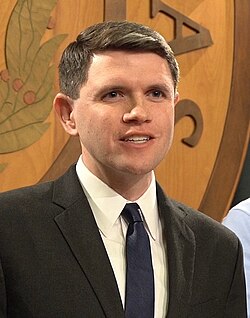
Texas Democratic U.S. senatorial candidate James Talarico excited controversy with his theological statements. He called God “nonbinary.” And he surmised that the Virgin Mary, at the divine announcement of her pregnancy, was affirming her right to “choose.”
Talarico is a student at Austin Presbyterian Theological Seminary, which is affiliated with the Presbyterian Church (USA). Only a student at a very progressive seminary could think that such statements are politically effective.
Clearly Talarico wants to reach religious voters. But such assertions are likelier to offend than to win favor. Perhaps a political consultant advised him to talk this way. Perhaps his professors talk this way. But few religious people talk or think this way.
In the American political tradition, politicians do not typically make detailed theological statements, like Talarico. American Civil Religion, dating back to our Founding, has kept God and religion in public life, but inclusively. Political speeches, public declarations, inscriptions on monuments, and other aspects of civil life cite God and faith, but typically they avoid specifics.
In American Civil Religion, God blesses America and judges America. God offers America high standards and gives her the tools to reach them. God calls America to justice and righteousness, alongside mercy and understanding. God loves all people and despises evil. God brings people together. God mourns the dead and honors their memory.
Who is God exactly? American Civil Religion does not specifically explain. The listener can decide, informed by his or her religious beliefs and religious traditions. American Civil Religion was mostly developed by American Protestants who came from different traditions. Some of them were Unitarians. So, they kept it vague and elastic. Later, Catholics, Jews and others were able easily to embrace American Civil Religion. But the system entailed avoiding in public life theological specifics.
Over Easter, several U.S. agencies got theologically specific. The Department of Homeland Security and the State Department broadcast on social media: “He is risen.” The Defense Department broadcast: “The tomb is empty. The promise is fulfilled. Through His sacrifice, we are redeemed. We stand firm in faith, courage, and truth.”
In contrast, the Justice Department declared more generally: “Today, as millions of Christians gather in their churches across the nation to celebrate the resurrection of Christ, this Department — is proud to protect and defend religious liberty.” It simply stated that on Easter Christians celebrate Christ’s resurrection without, as a government agency, declaring it as theological truth.
The distinction is important. All citizens of the United States are legally equal no matter their religious beliefs. All pay taxes. Our laws do not privilege Christianity or any other religion. Most Americans identify as Christian. It’s right for official statements to acknowledge this reality and share good wishes. It’s also usually fine for public officials, when clearly speaking for themselves, to share their own faith.
American Civil Religion does not silence theological specifics. Individuals and religious groups can declare what they believe. Government statements, and typically most statements from politicians, should speak more broadly, as they try to speak for the nation, or, politically, to mobilize a wide political coalition.
Free speech and religious freedom of course allow Talarico and everybody else to publicly declare their beliefs. But politicians are wise to keep their language broad and somewhat vague. IRD co-founder Michael Novak, a Catholic philosopher, wrote in his Spirit of Democratic Capitalism:
In a genuinely pluralistic society, there is no one sacred canopy. By intention there is not. At its spiritual core, there is an empty shrine. That shrine is left empty in the knowledge that no one word, image, or symbol is worthy of what all seek there. Its emptiness, therefore, represents the transcendence which is approached by free consciences from a virtually infinite number of directions. (Aquinas once wrote that humans are made in the image of God but that since God is infinite He may be mirrored only through a virtually infinite number of humans. No concept of Him is adequate.) Believer and unbeliever, selfless and selfish, frightened, and bold, naive, and jaded, all participate in an order whose center is not socially imposed.
Novak continues:
But is the center of pluralism in the United States really so empty? Human beings, according to the Declaration of Independence, are endowed with inalienable rights by the Creator. Abraham Lincoln and other presidents have freely reverenced the Almighty. On coins and notes of deposit one reads: “In God we trust.” Is not God at the center? For those who so experience reality, yes. For atheists, no. Official religious expressions are not intended to embarrass or to compromise those who do not believe in God. They have a pluralistic content. No institution, group, or person in the United States is entitled to define for others the content signified by words like “God,” “the Almighty,” and “Creator.” These words are like pointers, which each person must define for himself. Their function is to protect the liberty of conscience of all, by using a symbol which transcends the power of the state and any other earthly power. Such symbols are not quite blank; one may not fill them in with any content at all. They point beyond worldly power. Doing so, they guard the human openness to transcendence.
American Civil Religion in its vagueness protects our freedoms from coercion. But in its citation of God it reminds everyone of a transcendent power that stands over the state and over us all. How we define that transcendent power is up to our beliefs and our own religious traditions. For the state to define God is to give government authority over deciding who God is, which no state should have.
Evangelist Billy Graham wonderfully evinced this understanding when he preached at the National Cathedral service following 9-11. It was an interfaith event, with all prominent state officials present. He clearly shared his own faith:
As a Christian, I have hope, not just for this life, but for heaven and the life to come. And many of those people who died this past week are in heaven now. And they wouldn’t want to come back. It’s so glorious and so wonderful. That is the hope for all of us who put our faith in God. I pray that you will have this hope in your heart.
Note he did not say who made it to heaven. Yet he pointed to the Cross.
Here in this majestic National Cathedral we see all around us the symbol of the cross. For the Christian, the cross tells us that God understands our sin and our suffering, for He took them upon Himself in the Person of Jesus Christ. From the cross God declares, “I love you. I know the heartaches and the sorrows and the pain that you feel. But I love you.”
And Graham concluded:
My prayer today is that we will feel the loving arms of God wrapped around us and that as we trust in Him we will know in our hearts that He will never forsake us. We know also that God will give wisdom and courage and strength to the President and those around him.
There’s no question how Graham identifies God with Christ, Whom he hailed. And yet he spoke for all, to all, at the grim moment in American public life.
President Bush also spoke from the pulpit of National Cathedral that day:
On this national day of prayer and remembrance, we ask almighty God to watch over our nation, and grant us patience and resolve in all that is to come. We pray that He will comfort and console those who now walk in sorrow. We thank Him for each life we now must mourn, and the promise of a life to come. As we have been assured, neither death nor life, nor angels nor principalities nor powers, nor things present nor things to come, nor height nor depth, can separate us from God’s love. May He bless the souls of the departed. May He comfort our own. And may He always guide our country.
Bush avoided theological specifics, for which he deferred to the preacher/evangelist Graham. As president and chief magistrate, he relied more squarely on American Civil Religion, asking God “to watch over our nation.”
Public officials and politicians will serve the nation best by working with American Civil Religion. They are not clergy or theologians. They have no ecclesial authority over the American people. But they should acknowledge that their own authority is not absolute and operates under a greater transcendence. Talarico and many others can learn from this tradition.
More from IRD:
Thirty Years of Michael Novak’s ‘Spirit of Democratic Capitalism’



Comment by Qohelet on April 28, 2026 at 8:06 pm
Hah. After two and a half weeks of silence on church and state, I guess the IRD has something to say after all.
In the meantime, Trump has shared a photo of himself as Jesus, got in a fight with the Pope, and JD Vance tried to debate theology with him. Mike Johnson tried to say the Pope misunderstood the just war doctrine… about a war that was started as an illegal sucker punch and killed hundreds of schoolgirls within the first few minutes. None of that was worth talking about apparently, but man, I guess Talarico crossed the line. Nevermind that Genesis 1:27 says:
So God created mankind in his own image, in the image of God he created them; male and female he created them.
Female is just as much in God’s image as male is, according to scripture.
Either talk about the intersection of religion and democracy honestly or don’t. Every day the numbers of Christians abandoning the right wing hate group that is the Republican party rises. That is something to rejoice about.
Comment by Salvatore Anthony Luiso on April 29, 2026 at 12:56 am
With all due respect to the author, why does he single out State Rep. Talarico for criticism–for example, by saying “Talarico and many others can learn from this tradition”.
Why didn’t he say, for example, “Talarico, Rubio, Hegseth, and many others can learn from this tradition”?
I write as one who disagrees with the author about American Civil Religion. I generally agree with the following remarks of Dr. John Piper, which are quoted in the article “‘Christ Must Be Explicit’: How 9/11 Changed Desiring God”, which is posted on the website of the organization Desiring God:
Since September 11, 2001, I have seen more clearly than ever how essential it is to exult explicitly in the excellence of Christ crucified for sinners and risen from the dead. Christ must be explicit in all our God-talk. It will not do, in this day of pluralism, to talk about the glory of God in vague ways. God without Christ is no God. And a no-God cannot save or satisfy the soul. Following a no-God — whatever his name or whatever his religion — will be a wasted life. God-in-Christ is the only true God and the only path to joy. Everything I have said so far must now be related to Christ.
Comment by Thomas on April 29, 2026 at 3:52 pm
IRD already criticized Douglas Wilson, Peter Hegseth pastor. I agree that they deserve more criticism and that their brand of Christian nationalism is pure nonsense. One thing are religious fundamentalists, other are revisionists, who are now creating a new religion, to suit their political agenda. It sad to think that 40 years ago you could find someone running for Congress as a candidate of the Democratic Party who would be a true, honest Christian.
Comment by Qohelet on April 29, 2026 at 8:22 pm
There are plenty of true honest Christians in the Democratic party. We’re not the ones who abandoned Jesus’s message to care for the least of these.
Joe Biden and Nancy Pelosi are lifelong devout Catholics
Hillary Clinton is a lifelong United Methodist
All y’all are scared of Talarico because you’re the religion of Pontius Pilate and Herod, not that of Jesus. And he’s not afraid to remind you of it.
Comment by Thomas on April 29, 2026 at 11:19 pm
True and honest “Christians”? What a bad taste joke. No person who supports abortion until birth, has the utmost disrespect for unborn human life, supports the LGBT agenda and gender ideology, qualifies as Christian. We have now here a local troll, who keeps on mocking the Christian faith. These people would have been pagans, not Christians, during the Roman Empire persecution. The first Christians were persecuted for their faith, they opposed the radical abortion acceptance and the homosexual lifestyle that the ancient pagans did. This has many similarities with the religious fakes of nowadays. Pray honestly for their conversion, because they have been deceived by the Devil to reject completely Christianity.
Comment by David S. on April 30, 2026 at 5:59 am
“We’re not the ones who abandoned Jesus’s message to care for the least of these.”
And yet, there is only ONE pro-life Democrat member of Congress; the Democrats basically advocate for abortion for any reason including at birth without exception; and the Democrats, including Mr. Talarico, chose the medicalization of gender confused children as a hill on which to die. And the religious leaders on the Christian left do not criticize or express reservations about any of this. If the Democrats truly cared for the least of these, then their leadership at many a level would not take the extreme positions they do on who is among the least of these. “And that is BEFORE we get to whom the least of these in Matthew 25 is referring to…Christians and Christian missionaries, NOT just any one!) The Democrat’s EXTREME positions on abortion and matters pertaining to so-called transgendered children reveal this comment to be the lie for which it is, and God WILL judge the Democrats harshly on this.
Lastly, I would NOT cite Joe Biden or Nancy Pelosi as Catholic Christians in public life as examples of being paragons of Christian virtue. Both are as corrupt and hypocritical as they come.
Comment by John on April 30, 2026 at 10:41 am
Thomas and David S.,
How many women have abortions at the point of birth in this country per year? I mean actual abortions, not unintentional miscarriages. This is something conservatives talk about a lot as if women are deliberately undergoing nine months of being pregnant and waiting until literally the very last-minute when they’re in the delivery room to say, “I want to abort.” Yet for all this rhetoric, I’ve never read about a single instance of this actually happening. Have you? If so, I’d love to see stats or evidence.
Comment by Thomas on April 30, 2026 at 1:02 pm
John, what about the states who have banned any restrictions on abortion and say human life before birth is meaningless, like New York State, Illinois, California? Are you fine with that?
Comment by Qohelet on April 30, 2026 at 6:24 pm
Republicans aren’t anti abortion. They’re pro forced birth. They refuse to acknowledge that abortion is an evil of a sick society, where being an unwed mother might be the thing that dooms you to a life of poverty. They cut the child tax credit, do nothing to help people get healthcare, and cut SNAP benefits to give tax breaks to billionaires. Hillary Clinton’s position on abortion was clear : we need to build a society where young women don’t find themselves in such a horrid position.
I don’t want to hear pro life nonsense from people who drop bombs on children and try to debate the Pope on just war. You want to say a lifelong Catholic like Biden isn’t a Christian? Your defense secretary is quoting Pulp Fiction and thinks it’s in the Bible. Your president is comparing himself to Jesus. Get the beam of wood out of your own eyes.
Comment by Thomas on April 30, 2026 at 7:48 pm
I am not American nor Repubican, so you once again missed. Those who point fingers to others have four fingers pointed back to them. But I am curious to know if you endorse the radical pro-abortion policies of the Democratic Party who aim to abolish all the restrictions on abortion, which unfortunately they already did in some states. I already criticized the current Secretary of State of Defense. His religion is really a joke, and I am perplex how he was nominated in the first place or how come he didn`t resigned yet.
Comment by Different Steve on April 30, 2026 at 8:03 pm
Fact sheet by the USCCB Committee on Pro-Life Activities
The Catechism of the Catholic Church states: “Since the first century the Church has affirmed the moral evil of every procured abortion. This teaching has not changed and remains unchangeable. Direct abortion, that is to say, abortion willed either as an end or a means, is gravely contrary to the moral law” (No. 2271).
In response to those who say this teaching has changed or is of recent origin, here are the facts:
From earliest times, Christians sharply distinguished themselves from surrounding pagan cultures by rejecting abortion and infanticide. The earliest widely used documents of Christian teaching and practice after the New Testament in the 1st and 2nd centuries, the Didache (Teaching of the Twelve Apostles) and Letter of Barnabas, condemned both practices, as did early regional and particular Church councils.
To be sure, knowledge of human embryology was very limited until recent times. Many Christian thinkers accepted the biological theories of their time, based on the writings of Aristotle (4th century BC) and other philosophers. Aristotle assumed a process was needed over time to turn the matter from a woman’s womb into a being that could receive a specifically human form or soul. The active formative power for this process was thought to come entirely from the man – the existence of the human ovum (egg), like so much of basic biology, was unknown.
However, such mistaken biological theories never changed the Church’s common conviction that abortion is gravely wrong at every stage. At the very least, early abortion was seen as attacking a being with a human destiny, being prepared by God to receive an immortal soul (cf. Jeremiah 1:5: “Before I formed you in the womb, I knew you”).
In the 5th century AD this rejection of abortion at every stage was affirmed by the great bishop-theologian St. Augustine. He knew of theories about the human soul not being present until some weeks into pregnancy. Because he used the Greek Septuagint translation of the Old Testament, he also thought the ancient Israelites had imposed a more severe penalty for accidentally causing a miscarriage if the fetus was “fully formed” (Exodus 21: 22-23), language not found in any known Hebrew version of this passage. But he also held that human knowledge of biology was very limited, and he wisely warned against misusing such theories to risk committing homicide. He added that God has the power to make up all human deficiencies or lack of development in the Resurrection, so we cannot assume that the earliest aborted children will be excluded from enjoying eternal life with God.
In the 13th century, St. Thomas Aquinas made extensive use of Aristotle’s thought, including his theory that the rational human soul is not present in the first few weeks of pregnancy. But he also rejected abortion as gravely wrong at every stage, observing that it is a sin “against nature” to reject God’s gift of a new life.
During these centuries, theories derived from Aristotle and others influenced the grading of penalties for abortion in Church law. Some canonical penalties were more severe for a direct abortion after the stage when the human soul was thought to be present. However, abortion at all stages continued to be seen as a grave moral evil.
From the 13th to 19th centuries, some theologians speculated about rare and difficult cases where they thought an abortion before “formation” or “ensoulment” might be morally justified. But these theories were discussed and then always rejected, as the Church refined and reaffirmed its understanding of abortion as an intrinsically evil act that can never be morally right.
In 1827, with the discovery of the human ovum, the mistaken biology of Aristotle was discredited. Scientists increasingly understood that the union of sperm and egg at conception produces a new living being that is distinct from both mother and father. Modern genetics demonstrated that this individual is, at the outset, distinctively human, with the inherent and active potential to mature into a human fetus, infant, child and adult. From 1869 onward the obsolete distinction between the “ensouled” and “unensouled” fetus was permanently removed from canon law on abortion.
Secular laws against abortion were being reformed at the same time and in the same way, based on secular medical experts’ realization that “no other doctrine appears to be consonant with reason or physiology but that which admits the embryo to possess vitality from the very moment of conception” (American Medical Association, Report on Criminal Abortion, 1871).
Thus modern science has not changed the Church’s constant teaching against abortion, but has underscored how important and reasonable it is, by confirming that the life of each individual of the human species begins with the earliest embryo.
Given the scientific fact that a human life begins at conception, the only moral norm needed to understand the Church’s opposition to abortion is the principle that each and every human life has inherent dignity, and thus must be treated with the respect due to a human person. This is the foundation for the Church’s social doctrine, including its teachings on war, the use of capital punishment, euthanasia, health care, poverty and immigration. Conversely, to claim that some live human beings do not deserve respect or should not be treated as “persons” (based on changeable factors such as age, condition, location, or lack of mental or physical abilities) is to deny the very idea of inherent human rights. Such a claim undermines respect for the lives of many vulnerable people before and after birth.
https://www.usccb.org/issues-and-action/human-life-and-dignity/abortion/respect-for-unborn-human-life
Comment by Different Steve on April 30, 2026 at 10:51 pm
Based on available data as of early 2026, the number of abortions far exceeds the number of combat-related deaths in any single major war involving Iran in recent history. Abortions (United States) Recent Numbers: In 2024, there were an estimated 1.14 million clinician-provided abortions in the United States. Long-Term Context: Since the legalization of abortion in 1973, over 64 million abortions have occurred in the US. People Killed in Iran-Related Conflicts Iran-Iraq War (1980–1988): Estimates of the total dead range widely, but generally include roughly 500,000 to 1,000,000+ total deaths (combatants and civilians combined) over eight years. Systematic Review: One study estimated 188,015 to 217,489 Iranians were killed. 2026 Conflict (Iran-Israel): Early reporting (as of April 2026) suggests that in a new 12-day war, over 1,000 people were killed in Iran. Other Conflicts (Iraq 2003–2011): Independent studies estimate that around 150,000 to 500,000 people died as a result of the war and occupation, including both direct violence and indirect causes. ComparisonThe annual number of abortions in the US alone (~1.1 million) in 2024 exceeded the estimated total death toll of the 8-year Iran-Iraq war. Pro-life organizations have estimated that abortion numbers are over 47 times the total number of American battle deaths in all major U.S. wars combined since 1776.
Comment by Qohelet on May 1, 2026 at 2:45 pm
I don’t believe right-wing Christians want abortion to end at all, because then you wouldn’t have anything to gloat over how much more morally superior you are.
If you’re serious about ending abortion, make sure every kid has enough food. Make sure paid family leave is avaliable in every job. Stop centering your theology around sexual purity so your pregnant teenagers feel loved instead of mortified. Make sure every mother has access to good healthcare and drug treatment if appropriate. Make good childcare accessible to all families and make sure kids know about birth control and family planning before they start having sex.
On all of those issues, Democrats lead. We’re not perfect, but we care.
Comment by Different Steve on May 1, 2026 at 6:04 pm
Nearly 40,000 Iranians were murdered by the Iranian regime during protests in January alone.
Comment by Wilson R. on May 2, 2026 at 12:25 am
I take pro-life arguments seriously. That includes one made by Pope Leo, who said that if you oppose abortion but support the death penalty, you are not pro-life. If you oppose abortion but support withholding food aid for starving people around the world, you are not pro-life. Being pro-life means supporting a consistent ethic of life. If you don’t support that, then you should not label yourself as pro-life but only as anti-abortion.” There is a difference.
Comment by Different Steve on May 2, 2026 at 2:51 am
Guilt for thee, not for me. If you don’t restrict yourself my version of morality, don’t try and have any. Empathy is only for groups I assign victim status, certainly not to include those that lose their churches to their denomination.
Comment by Mike on May 2, 2026 at 10:47 am
Wilson R.,
“{I}f you oppose abortion but support the death penalty, you are not pro-life.”
I am pro-life; therefore I support the death penalty. The Bible is clear that one who ends another’ life should forfeit his life in return. Without this provision, life loses its sacredness.
If you do not support the death penalty for those who have proven that they deserve it, you are not being Biblical.
Comment by Thomas More on May 2, 2026 at 12:12 pm
A person can be pro-life and support the death penalty. That includes all the saints, martyrs, Doctors of the Church, Protestant reformers, who supported it. If Pope Leo XIV stated that, he is wrong. Then he wouldn`t call pro-life to his predecessors who supported the death penalty. I used to support the consistent life ethic but the concept is so contradictory and passible of multiple interpretations, that I prefer the concept of a culture of life, its universally accept and less confusing.
Comment by Qohelet on May 2, 2026 at 12:22 pm
Pick and choose Christianity from the right. The Old Testament applies when it fits my worldview and who cares that Jesus can bring salvation even to the worst sinner. Or that occasionally of justice system screws up and innocent people end up on death row.
Comment by Wilson R. on May 2, 2026 at 6:21 pm
Really, Mike? The Bible says? Try reading it. In Genesis, God’s response to the first murder is to put a mark on Cain to protect him from being killed for his crime.
Comment by Mike on May 2, 2026 at 6:49 pm
Wilson, read a little farther in Genesis:
“Whoever sheds man’s blood,
By man his blood shall be shed,
For in the image of God
He made man.” Genesis 9:6
Also, this in Exodus:
“He who strikes a man so that he dies shall surely be put to death. Exodus 21:12
Do you really want to argue with God?
Comment by Qohelet on May 2, 2026 at 9:41 pm
No Mike, we’re arguing with you, not God. Why do you think you speak for God?
Comment by Mike on May 3, 2026 at 1:55 pm
I don’t speak for God. He speaks for Himself, and He couldn’t be any clearer.
Why are you arguing?
Comment by Wilson R. on May 3, 2026 at 4:14 pm
Then why did God protect Cain?
Why does God’s word say not to repay evil with evil?
Are you suggesting God speaks out of both sides of God’s mouth?
Or are you just trying to find justification for something you wanted to support all along?
Why, really, are you pro-death?
Comment by Thomas on May 3, 2026 at 6:43 pm
Wilson R, you know Mosaic Law, right? It clearly supports the death penalty for several crimes.
Comment by Mike on May 4, 2026 at 9:01 am
Thomas, it really doesn’t do any good to argue with people such as Wilson or Qoholet. They don’t listen to reason. They can’t see the difference between what the state is commanded to do versus what Christians are encourage to do.
We personally may be admonished to turn the other cheek or to love our neighbor as ourselves, but the state is required to enforce the laws and maintain order in society, not necessarily to show Christian virtue. Forgiveness is a personal virtue. Punishing crime is a governmental necessity. Leftists cannot distinguish between the two.
Comment by Qohelet on May 6, 2026 at 8:26 am
Mike that’s a distinction conservatives make up for why they feel free to ignore Jesus collectively and then ask for salvation individually. What does Isaiah 1 tell us that a nation that has sinned before God is guilty of? The same ignoring of the vulnerable Jesus cautions individuals against doing.
In a democracy, your vote is an important personal action. You can’t vote to take away food assistance to the poor and then drop a few cans off at a food drive and pretend you’re following Jesus.