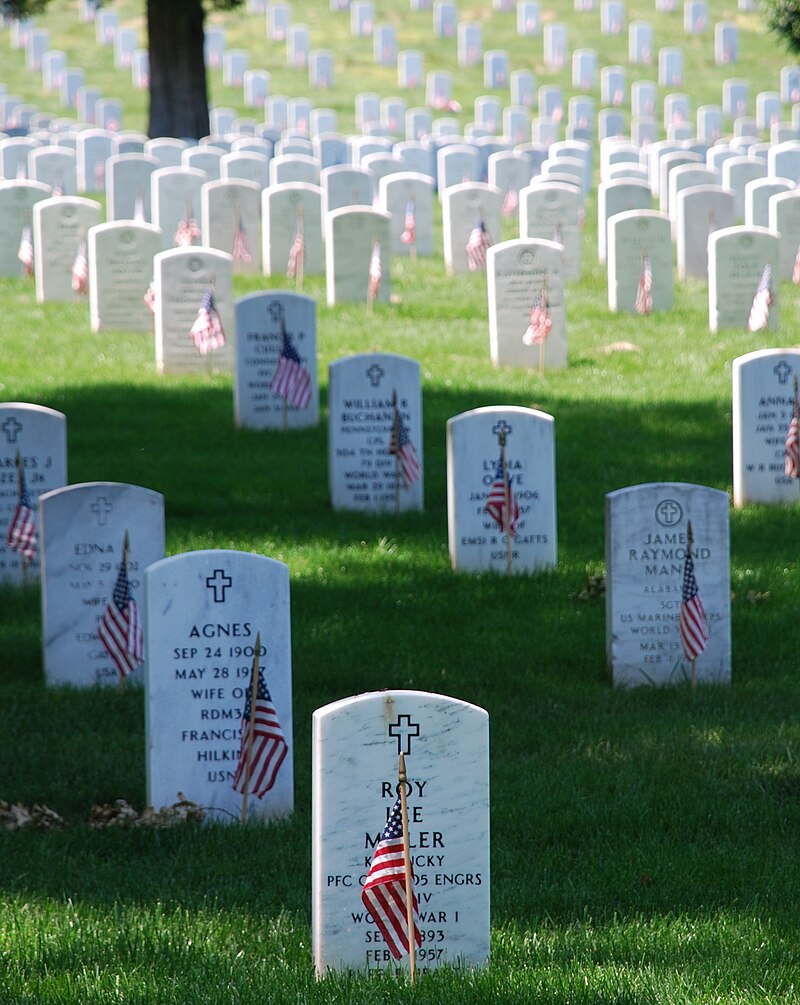
Memorial Day emerged from the Civil War to honor the dead who numbered in the hundreds of thousands. After World War I, it honored not just the Civil War’s dead but all who fell in the service of their country in war.
It’s not specifically a religious holiday but it is a temporal holy day for America’s civil religion, perhaps its most somber.
America’s civil religion organically emerged from America’s founding as a pan-Protestant inclusive way to keep religion in public life without unnecessary division. George Washington was especially expert in citing the Deity while avoiding theological controversy. The tradition worked so well that as more Catholics and Jews came to America, the civil religion not only endured but thrived.
Abraham Lincoln became the high priest of American civil religion, expressed especially through his Gettysburg Address and Second Inaugural Address. In this tradition, God ordained America to be the “last best hope on earth” that also was under divine judgement for the sin of slavery.
Perhaps FDR was another high priest of civil religion, as he wove his Episcopal prayer book language into his speeches, most powerfully in his D-Day prayer. Eisenhower and Reagan also excelled at the craft of civil religion, the latter maybe most famously in his reaction to the Challenger disaster. But nearly all presidents have served as votaries of American civil religion.
Some Christians have criticized American civil religion as a diluted alternative to Gospel Christianity, with America replacing the church. But the advent of Christian nationalism, whose claims are far more aggressive, has persuaded some critics and skeptics that civil religion was far preferable. The latter fosters social harmony and national unity, while the former weaponizes religion into a permanent and unquenchable crusade.
Mainline Protestant churches from the very start were stewards of American civil religion, whose rites and liturgies mirrored historic American Protestantism. Much as Roman Catholicism had during much of Christendom, U.S. Mainline Protestantism understood itself as the spiritual shepherd of American democracy. None of its denominations were large enough to claim domination. But collectively, they could enact a benign political and religious regime that honored the republic and conferred dignity on all its citizens.
American civil religion’s holidays include, besides Memorial Day, the 4th of July, Veterans Day, and Thanksgiving. Columbus Day has become controversial for some. And Washington’s Birthday has been diluted into an anodyne “Presidents’ Day” bereft of substance.
Memorial Day is for civil religion maybe the equivalent of Good Friday and Easter. The dead who gave their lives for the republic are remembered and honored. Thanks to their sacrifice, the republic lives.
Civil religion has to be careful not to be too ambitious. It’s not a substitute for Christianity or for any historic religion. For Christians, only Christ through the church offers eternal redemption. But the Mainline Protestants, like Roman Catholics, understood that the church has a political vocation to serve, harmonize and ennoble civil society. In American civil religion, all citizens have a sacred calling of service, perpetuating our democracy and Founding ideals. Some have been called to die sacrificially. Most are called to live gratefully.
The Battle Hymn of the Republic is arguably civil religion’s chief hymn. “As He died to make men holy, let us die to make men free,” are its famous words, sometimes adapted to “let us live to make men free.” The adaptation and the original words are both appropriate. Citizens are sometimes called to die but mostly their calling is to live better and more responsibly.
As formal religious affiliation declines in America, there’s the question as to civil religion’s durability. For all its high-minded vague spirituality, civil religion likely requires the underlying assumptions of more specific religious dogma. Or does it? And if so, what dogma?
For most of America’s history, the Mainline Protestants offered a providential hope that God was working through American democracy to better the world. But Mainline Protestantism has been declining for at least 60 years. Institutionally it may no longer exist in the near future. Can other religious traditions replace its role in American civil religion? Or can our civil religion coast forward indefinitely?
America’s largest religious group now is evangelicalism, which is increasingly if not already firmly post-denominational. It’s not moored specifically to institutions but to evolving individualistic attitudes. And while Mainline Protestantism saw itself as the spiritual steward of America, evangelicalism sees itself more as a scorching wind against the corruptions of a sinful nation.
No matter how numerous in number or politically influential, the evangelical zeitgeist is not disposed to national stewardship. It’s an unending crusade, almost always on the edge of apocalypse. Some Evangelicals have often disdained civil religion, and some are drawn to Christian nationalism, because the former is too inclusive, too broad, too patient.
Crusades are often needed to purge and reform. But the heat burns out, often leaving exhaustion and disenchantment. And crusades are rarely if ever unifying. America is not built around ethnicity or tribe. It requires its civil creeds. And those creeds must include and honor all citizens, not spiritually demonize part of the nation as the target of the nation’s supposedly holy segment.
American civil religion is deeply embedded in the American conscience. It will not fade easily. But it will at some point need renewal and fresh articulation. Who will speak for it?




Comment by David on May 27, 2025 at 10:19 am
I do not think any discussion of American Civil Religion is complete without mention of the Freemasons. While their members are required to believe in a higher power or deity of the member’s choosing, there are no religious dogmas. Indeed, discussion of religion and politics are prohibited at lodge meetings as they are divisive and contrary to the aim of uniting members. As is well-known, several of the Founders such as Washington and Franklin were active members of the fraternity.
Comment by Brett Best on May 27, 2025 at 12:36 pm
This article is a well-written introduction to civil religion. Your questions are worth exploring. Thank you. I am a bit concerned about the dismissive gestures you use to try to make Christian nationalism (a convenient Liberal bogeyman) and evangelicalism. In both cases, individual responses to civil religion vary. In my opinion, the broad, tar-soaked brush applied to them isn’t quite up to your usual level of accuracy. The Church in America has more to fear from the malingering effects of cultural Progressivism that preoccupies the minds of the “Captain Smiths” who are sailing the historic denominations into the ice fields of irrelevancy and bankruptcy.
Comment by Salvatore Anthony Luiso on May 27, 2025 at 1:48 pm
Regarding “Evangelicals have often disdained civil religion, and some are drawn to Christian nationalism, because the former is too inclusive, too broad, too patient”: It isn’t only evangelicals who have disdained civil religion. All Christians have good reason to disdain it. Why? Because it is confusing, deceitful, and a rival of Christianity. It is a religion which can look, sound, and feel much like Christianity, but is without Christ. Although it may regard Jesus as a good man and a wise teacher of ethics, it does not regard Him as the only begotten Son of God, the Lord of all, and the Savior of the world. It uses the cross as a symbol, but without the distinctive meaning which it has in Christianity.
So, in answer to the question “Who will speak for it?”, I say: A Christian should neither support, defend, nor promote a religion without Christ.
Note: I am not drawn to Christian nationalism.