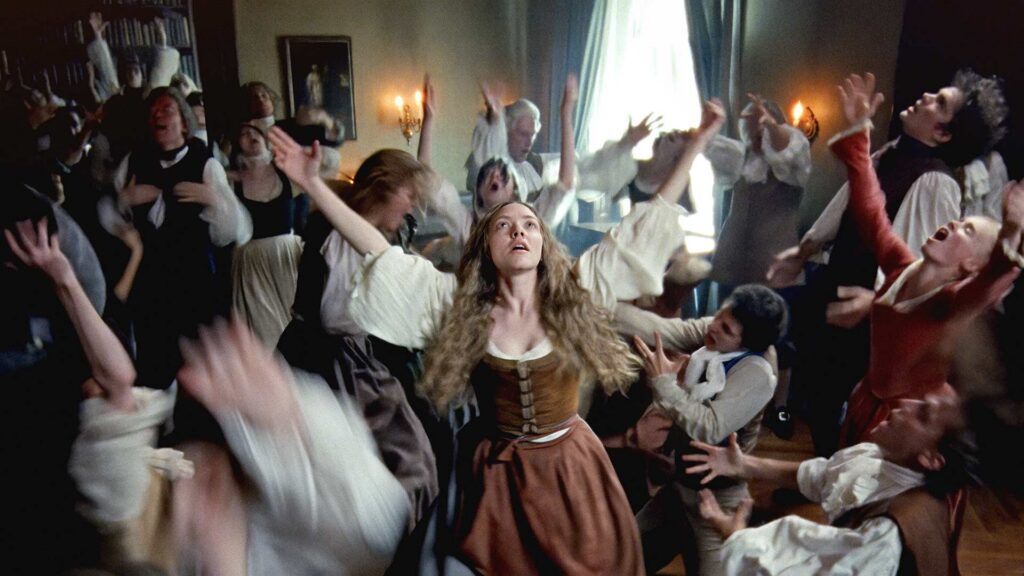

Contemporary films about Christianity often leave me conflicted. Hollywood’s approach to faith rarely rises above Bill Maher-esque jabs, easily dismissed as shallow as teenage atheism. On the other hand, films made for Christian audiences too often veer into sentimentality, resulting in stories that are sweet yet overwrought. Amid these extremes, Mona Fastvold’s The Testament of Ann Lee stands out, offering a fascinating and sensational account of a period of Christian history through a visually captivating, deeply moving depiction of the Shaker faith.
As it says on the tin, the film follows Ann Lee, the Mancunian mystic who founded the United Society of Believers in Christ’s Second Appearing, or the Shakers, in 1747. This insular sect would eventually settle in upstate New York. The Shakers required celibacy, believed the end times were near, and saw their founder as a female expression of Christ. Their worship, which inspired their name, featured repetitive, dance-like movements and simple, melodious hymns. The hymn Lord of the Dance, an anthem of the ecumenical movement, is based on the Shaker tune Simple Gifts.
The exoticism of the Shaker faith naturally lends itself to a certain portrayal, as a doomsday cult around a charismatic and potentially insane founder, a colonial Manson Family. Yet Fastvold’s film entirely avoids this trope. Certainly, the eccentricities of the Shaker religion are not papered over. The extreme weight of mandatory celibacy and its impact on the family is recurring in the film, and it is undeniable that Shakerism rent loving families apart and demanded immense sacrifice for a deeply heterodox faith. Still, the film refuses to condemn the Shakers.
From the start, Ann Lee is shown as a sympathetic person. When her first vision about the need for celibacy appears while in prison, she sings, “I hunger and thirst, I hunger and thirst, I hunger and thirst after true righteousness.” The loss of her young children and her sadness over a world that does not know God make Ann someone who carries Christ’s love and longs for a redeemer.
When her community reached the New World after being expelled from England, Ann’s relentless pursuit of Christian living did not flag. Her husband abandons her because of her pursuit of celibacy, yet she holds fast to her testimony. Even as her community grows, Ann remains a humble and simple woman, drawn by her relationship with Christ to an ecstatic love.
In the film’s conclusion, Ann dies and is mourned by her followers, who dance and sing the hymn Beautiful Treasures, composed for the film. As the credits note, the Shaker movement continued after the death of Ann Lee until the present, where it now counts only two devotees.
Despite my fondness for the film, I do not advocate for conversion to the Shaker faith, and I deny that Ann Lee was Jesus Christ. The film has a special value for contemporary Christians because of the Shakers’ strangeness. The dance scenes, where Ann’s followers contort their bodies as the Spirit moves them, are simultaneously unnerving and deeply beautiful. In this way, all Christians can relate to the Shaker story.
Too often, we are forced to give a “reason for the hope” that is in us, while ignoring that our faith is a “confoundment for the Greeks and a stumbling block for the Jews.” We, as is natural, shirk at being considered unreasonable or “weird” by the world. Yet if we can learn anything from the Shakers, it is to pursue our faith boldly and without shame, even when the world does not understand.
Surely, we can hope to have more prudence than the followers of Ann Lee, but we should envy the steadfastness of their witness and zeal for Christ. As the hymn goes, “’Tis the gift to be simple, ’tis the gift to be free,” and The Testament of Ann Lee movingly shows a flawed community that dearly sought that simple freedom in Christ.




Comment by Gary Bebop on April 23, 2026 at 11:36 am
Thank you for elucidating what this film portrays. In a puzzling way, our times have given rise to generational indifference to marriage and child-bearing. The excursions into sexual novelty, licentiousness, and abortion worship are journeys to despair. At the same time there is hungering and thirsting for the satisfactions of being human. The ersatz offerings of AI and other self-inventive projects cannot fill the void. They merely show our dust.
Comment by David on April 23, 2026 at 2:18 pm
The ecstatic dancing of the early Shakers soon gave way to highly organized forms that were rehearsed. Perhaps the strangest aspect of their denomination was a strong belief in spiritualism. The spirits of Columbus, Native American chiefs, and deceased members of the order were believed to attend their ceremonies.
Comment by Wilson R. on April 23, 2026 at 11:18 pm
I saw this film on a streaming service and found it oddly compelling. Like the author, I noticed that the filmmaker resisted the easy temptation to portray Ann Lee and the Shakers purely as cranks, even though some of their practices were certainly eccentric. But the filmmaker also shows us the Shakers’ commitment to radical equality–distinctive for its day–and their desire for a deeply felt spiritual experience (in contrast to the rather sterile Church of England of the mid-18th century).