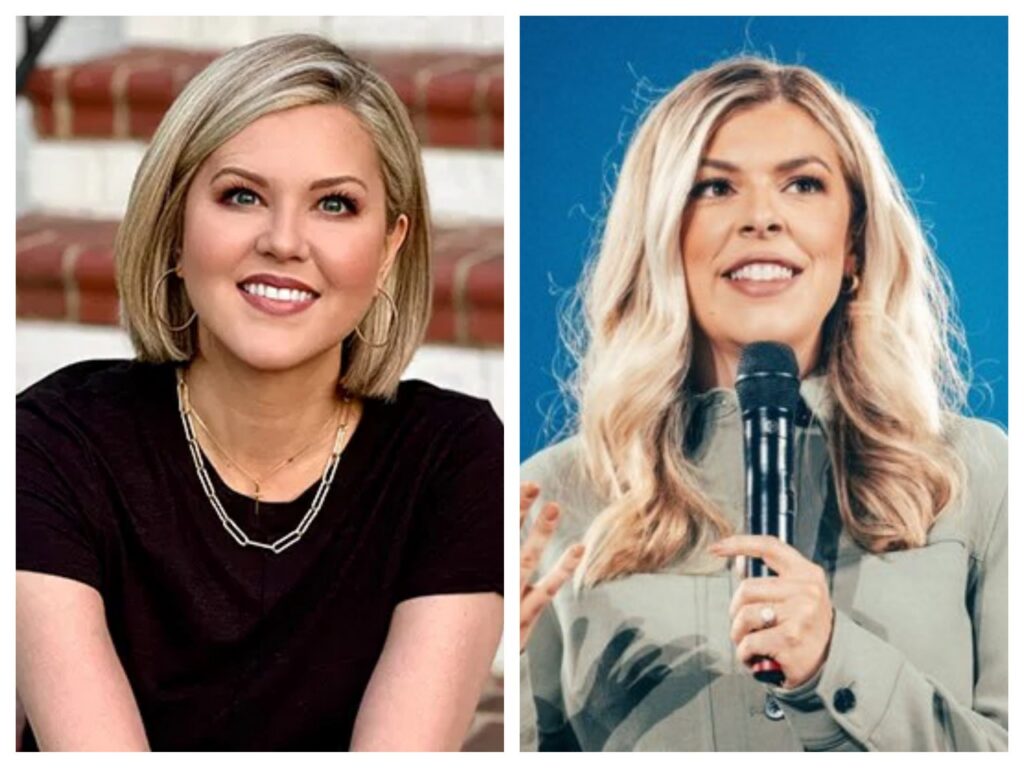
A front-page Washington Post story on President Trump’s “blasphemous” imagery portraying him as a healing Jesus quoted prominent Christian social influencers and no leading clergy or denominational officials. The first and most prominently quoted was online firebrand Megan Basham, a Southern Baptist who wrote Shepherds for Sale: How Evangelical Leaders Traded the Truth for a Leftist Agenda.
As an online influencer, Basham is among the most influential Baptists in America.
The Washington Post quoted her:
“I don’t know if the President thought he was being funny or if he is under the influence of some substance or what possible explanation he could have for this OUTRAGEOUS blasphemy,” wrote Megan Basham, a prominent conservative Protestant Christian writer and commentator. “But he needs to take this down immediately and ask for forgiveness from the American people and then from God.”
A separate Washington Post story about Trump’s criticism of Pope Leo also quoted Basham:
Megan Basham, a conservative evangelical commentator, posted that she agreed with Trump’s criticisms of Leo as “Weak on crime, and terrible for Foreign Policy.” But she assailed his meme as “OUTRAGEOUS blasphemy” and urged Trump to “ask for forgiveness from the American people and then from God.”
The first story quoted two other social influencers but no clergy or church officials. The second post quoted, among others, Christian Nationalist theologian Doug Wilson and a not-well-known Southern Baptist pastor who is running to become his convention’s president. The current Southern Baptist president, although head of America’s largest Protestant denomination, was not quoted. He does not appear frequently in media. And, frankly, I do not even know his name without looking it up.
Assuming Basham is still a Southern Baptist, she is arguably the most prominent voice of her denomination in America and for Baptists overall. She has over 200,000 followers on X, a best-selling book, and writes for The Daily Wire. Nearly every day she pontificates on religious and political issues. Her audience includes evangelicals and conservatives of all stripes. She has a wider following than any officer in her denomination. She has many critics.
Basham’s competition for top Southern Baptist influencer is Allie Beth Stuckey, who has nearly 600,000 followers on X and also has written a best-selling book, Toxic Empathy: How Progressives Exploit Christian Compassion. Stuckey typically has not been as polemical or political, but she is catching up to Basham. On April 3 she was quoted in The Washington Post reacting to Pope Leo’s criticism of the Iran War:
“To say that God is against war per se is flat out false,” declared the conservative American pundit Allie Beth Stuckey on X.
Basham and Stuckey represent the new face of Christianity in America. They do not have church offices and are not seminary trained. Their denomination prohibits female pastors, but Basham and Stuckey are arguably more influential than any pastor. They are savvy polemicists who fire their arrows ferociously, especially Basham. Her critics say she is unfair and inaccurate in her allegations of gospel betrayal by other Christians whom she deems covertly or overtly progressive. Of course, the controversy only builds her influence and expands her reach. She can say what more judicious clergy, church officers, and institutional heads cannot.
Amid widespread distrust of institutions and conventional expertise, we are in the age of social influencers, and Christianity is not exempted. Evangelicalism has never been very institutional and, unsurprisingly, is especially susceptible to social influencers, who set the tempo for much of its public conversation.
In contrast, several decades ago, the leading Christian, including evangelical, voices in America would have been pastors, evangelists, and theologians. Billy Graham dominated post WWII American religious conversation. There were intellectual public thinkers like Reinhold Niebuhr (Protectant but not evangelical) and later, Francis Schaeffer. Television evangelism would include Oral Roberts, Rex Humbard, James Kennedy and more scandalously, Jimmy Swaggart and Jim Bakker. More recently there is Joel Osteen. Pat Robertson excelled as broadcaster and talk show host. Bishop Fulton Sheen and later Mother Angelica were Catholic television personalities. Norman Vincent Peale (Protestant but not evangelical) wrote bestselling books. Later, Rick Warren pastored a megachurch and also wrote bestsellers.
That era is over. Today’s leading Christian personalities podcast, YouTube, Tweet/X, TikTok, Instagram and exert their presence through every form of social media. The audience is less national. There may never be another Billy Graham about whom everybody knows. Today’s influencers may have millions following them but are typically unknown outside their niche.
Everybody, Christian or not, is increasingly siloed. We self-collate, listen to and watch those who entertain us and typically tell us what we want to hear. Of course, the most popular influencers are usually provocative, outrageous, extremist, often hateful. The cerebral, thoughtful, reflective and courteous are less captivating.
Basham, like all successful influencers, has her schtick. Her Shepherds for Sale targets evangelicals who supposedly have betrayed conservative Christianity in favor of leftist dollars or secular approval. Her tweets continue this theme and offer a robust MAGA Christian perspective, hammering non-MAGA Christians as weak sisters or worse. Every day is a new cosmic drama. In this regard, she is very talented.
This pathway to daily attention mostly excludes more staid church officials, pastors and theologians, who have institutions to administer or responsibilities that preclude daily controversy. Their work remains quietly important but away from widespread public attention. They may write serious books, but those books likely will not be widely read unless addressed by the social influencers. Accordingly, Christian public opinion and public conversations, as in the non-religious world, are ruled by the online influencers.
Whatever you think of their messaging, Basham and Stuckey are social influencers par excellence and represent the public face of American evangelicalism. And they are arguably the most influential Baptists in America.
More from IRD:
Toxic Empathy: How Progressives Exploit Christian Compassion
Outside Money Liberalized United Methodism?




Comment by Glenn Wheeler on April 16, 2026 at 12:31 am
The prefix on the Greek word for antichrist can mean against or opposed to, but it can also mean instead of or in place of.
Seems like, with Trump’s AI-generated image of himself as Jesus, that he has identified himself as antichrist. He was nice enough to confirm what we already knew.
Give someone enough rope, and they’ll hang themself.
Comment by Salvatore Anthony Luiso on April 16, 2026 at 12:58 am
Thank you for this article. I will tell someone else about it.
Regarding who was quoted: One who does not speak cannot be quoted. Basham spoke, so she could be quoted. Wilson spoke, so he could be quoted. Likewise with other prominent Christians who spoke.
Could it be that “no leading clergy or denominational officials” were quoted because none of them spoke? I don’t know, but I think it’s possible.
At first, I was not seeing any mention of Franklin Graham in connection with Trump’s foolish meme, and I wondered why. If I’m not mistaken, it seems to me that it was because he hadn’t said anything about it. Then he did say something about it, and it was widely reported. (Could he be the most influential Baptist in America? Or maybe Speaker of the House Mike Johnson?)
Notice that the reactions of prominent supporters of Trump are particularly newsworthy. People want to know whether Trump’s has said or done something which has weakened or even lost their support.
Notice also that Catholic clergy were quoted about the conflict between Trump and the pope–not just Catholic commentators and influencers.
Regarding “Basham and Stuckey are social influencers par excellence”: That may be true if all one measures is influence, as opposed to, say, knowledge, wisdom, and truthfulness.
And regarding the notion that they “represent the public face of American evangelicalism”: Not Franklin Graham? Nor Joel Osteen? Nor Robert Jeffress? Nor Donald Trump?
Sorry to say, but the definition of an evangelical which many Americans have is “someone who strongly believes in and loves Donald Trump”.
So it’s quite understandable if, for them, Trump is the face of American evangelicalism. (It should be Jesus.)
Comment by John on April 16, 2026 at 11:54 am
Let the record show that Tooley (who is not clergy mind you, but a still a “trusted” voice within conservative Christian circles) has also not spoken publicly about the AI image, nor have any of the clergymen who frequently contribute to this blog done so on behalf of the IRD. The quotations around the word blasphemous might lead to assume that Tooley feels that the response to the image has been overblown or that the issue is unworthy of his time.
Of course, we only speculate since the IRD has remained silent as to its own thoughts on the matter up until now. Yet clearly the issue has become serious enough to where the IRD is having to reference its existence in articles on other topics without directly addressing it.
This muted response today stands in sharp contrast to two years ago during the opening for the Summer Olympics when the entire evangelical world was up in arms over an image of a bunch of drag queens standing in front of a table, which they claimed they was “blasphemous” of the Last Supper. The IRD had several articles on that controversy during which they clearly took the side of those outraged at the display. Tooley himself wrote this, “A drag queen caricature of The Last Supper does not exemplify the best of France. Instead, it conveyed disrespect and unseriousness. The Olympics entail discipline, focus, respect, diligence, honor, and good sportsmanship. The opening ceremony, in contrast, conveyed arrogance and decadence.”
One might think that the IRD’s lack of outrage at the Trump as Jesus image compared to the table image is hypocritical or shows that their responses are selective based on what they see as the mood of their audience. You might very well think that; I couldn’t possibly comment.
Comment by Salvatore Anthony Luiso on April 16, 2026 at 2:53 pm
John’s remarks which begin “Let the record show” contain good points worthy of consideration.
I suggest the IRD do the following regarding the Trump-as-Jesus AI-generated image:
1. Publish an official statement about it and Trump’s excuse that he thought it was a picture of him as a doctor
2. Publish a compilation of remarks by “leading clergy” and “denominational officials” about it and Trump’s excuse that he thought it was a picture of him as a doctor
When Trump said he thought that the image was not of him as Jesus, but him as a doctor, it showed his contempt for his Christian supporters. I thought that all of them should consider his explanation to be an insult to their intelligence. How stupid does he think they are?
Sad to say, but since then I’ve learned that some of his Christian supporters do actually believe his contemptuous, insulting, and ridiculous excuse, including a man who may be the most famous evangelist in America and the world.
Comment by CM on April 16, 2026 at 3:29 pm
What a bizarre screed. You do not identify anything you actually disagree with in the quotes from the two pundits and just repeat ad hominems against them. Basham is the main target obviously, and the way Stuckey just gets dragged along for the ride suggests an underlying bias. I will be more charitable than you were and assume it is regarding their lack of credentials rather than their sex, but it is not flattering either way. Perhaps you can clarify for the audience which of the quoted comments from Basham and Stuckey you actually disagree with, Mr. Tooley. Do you endorse Trump’s post as a miracle performing Jesus? Do you think Pope Leo is great on foreign policy? You just seem to take it as given that they are beyond the pale. It is ad hominem and it should be beneath you and this site.
If you think it is a time for choosing of sorts between what I see as the fearless witness of Stuckey/Basham or your resigned surrender (as evidenced in your article about continuing to support the UMC when you were one of the most prominent chroniclers of its departure from Biblical doctrine) I will choose the ladies every time.
Comment by Gary Bebop on April 16, 2026 at 5:02 pm
As predictable, the dopamine addicted flock around this story because they respond to titillation and are easily beguiled. Mark Tooley rightly treats this ruckus as an argument in a laundry mat. It has all the “dog bites man” story appeal. The IRD should NOT puff this piece as anything more than a comic tangent in a lawless world.
Comment by John on April 16, 2026 at 5:56 pm
Gary Bebop,
But that’s the irony. If Tooley really wants to believe the Trump as Jesus image isn’t worth his time then why reference it in this piece at all? He could focused solely on the critiques of Pope or I’m picked some other issue in which these two influencers have asserted himself. He’s clearly recognizing that this has taken hold and is driving conversations within the evangelical world in such a way that even he can’t entirely ignore it, yet he is still afraid to give his own opinion. If he didn’t want to talk about it, then don’t bring it up at all. By trying to dance around it in this rather pathetic fashion he’s opened himself up to critique.
Comment by Glenn Wheeler on April 16, 2026 at 7:23 pm
John,
Although I couldn’t possibly comment one way or another, one could reasonably think that IRD receives significant financial support from Zionist sources, both Christian and non-Christian. That would include financial support from Crusader Evangelicals, which would explain their demonization of Christian Nationalism while supporting Jewish Nationalism (Jewish meaning ethnicity, not religion).
Comment by Wilson R. on April 16, 2026 at 7:30 pm
“Fearless witness?” Stuckey is an enemy of the gospel.
Comment by Gary Bebop on April 16, 2026 at 8:32 pm
Mark Tooley is not checking with the comment claque for affirmation. It’s absurd tp think he wallows in the psychology of the troubled souls revealed in their posts here. Mark has far better critics.
Comment by Mark on April 16, 2026 at 10:46 pm
The pontiff and the pontificators
Comment by Cal on April 19, 2026 at 4:27 pm
If the men, or the most prominent men, don’t have the boldness to speak out, the women will. I don’t see a problem in this.
Comment by Skipper on April 22, 2026 at 9:50 am
If Allie Beth Stuckey is one of the most influential Baptists that is a good thing! You might want to mention her on topics other than this.
Comment by Jay Westfall on April 22, 2026 at 9:43 pm
Until today, I didn’t even know Allie Beth Stuckey was a Baptist.