
Last week an Alabama judge denied the Alabama-West Florida Conference of the United Methodist Church’s (UMC) claim to own Harvest Church, a Dothan megachurch that broke away from the denomination (read coverage from AL.com here). The case is among several weighing if the UMC trust clause is binding.
Similar cases are still active in state courts involving local churches that sought to both disaffiliate from the UMC and retain their historic properties, among them a number of West Virginia churches that my colleague Sarah Stewart has reported on here.
While the vast majority of disaffiliating congregations were able to avoid litigation, that wasn’t the case everywhere. Some formerly UMC local churches are undergoing what former Episcopal churches earlier experienced as they navigated litigation amidst their own departures for the Anglican Church in North America (ACNA).
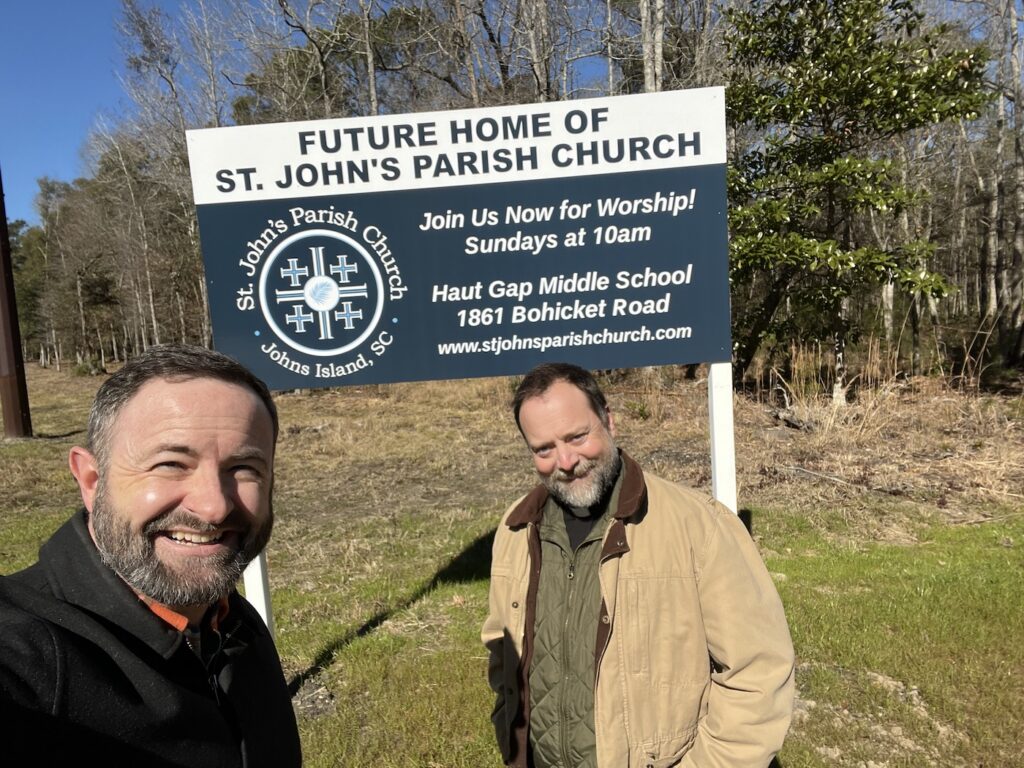
This past January following the Mere Anglicanism conference in Charleston, South Carolina, I was able to meet one-on-one with a number of Anglican clergy to informally chat about their diocesan and parish ministries. Among these was St. John’s Parish Church Rector Jeremy Shelton, who kindly toured with me the parcel of land on Johns Island that the church has obtained and will develop into its new campus.
St. John’s is among seven South Carolina congregations displaced after losing its historic property in litigation with the Episcopal Church (an eighth lost in court but was able to purchase the disputed property back from the Episcopal Church). A majority of the 36 departing South Carolina churches involved in litigation were able to retain ownership, but I wanted to check in on those who were, in some cases, starting nearly from scratch. St. John’s Parish Church is among the older churches in the diocese (founded 1734) and, simultaneously, “the challenges we face are not unlike a church plant,” Shelton reports, noting his congregation has met for worship in a middle school for the past 3 ½ years, with set-up and take-down needs in a facility that is not their own.
More than a few readers of this blog will find that a familiar scenario, including those Methodists who were unable to clear the supermajority disaffiliation threshold and essentially “left the keys on the table” for their former Annual Conference, beginning life anew as congregations planted in the Global Methodist Church.
The new 22 acre site of St. John’s Parish, which the church hopes to occupy in a first phase of construction by Christmas of 2027, was fittingly once part of the church’s historic glebe (land historically assigned to a parish church, often used for farming or rented out for income). In an unusual case, this local church retained its name and intellectual property as St. John’s Parish Church while having to give up most of its physical property to the Episcopal Church.
This month the Anglican Diocese of South Carolina met for its annual convention in Myrtle Beach and released a video in which the clergy leading those churches which lost property in litigation (dubbed “churches in transition”) give an update on where they are now. I hope that both Anglicans and Methodists will find it of interest and encouragement, and will be inspired to pray for one of these congregations.
“We have challenges just like everyone else, and challenges that are unique to those seven churches that lost their property,” notes Christ Church Mount Pleasant Rector Ted Duval. “We don’t want to be forgotten, we would love to be remembered in your prayers. I think we’ve done so well under God’s grace that when people come up to me, they mostly just say, ‘we hear you’re doing so great,’ and pat me on the back and move on with a smile on their face. And I’m grateful for that support, but I want them to know too that it’s not been easy and, we have our challenges and we’d love to be remembered and remembered with petitions for God’s blessing.”
Watch the full video below on The Anglican Diocese of South Carolina Vimeo channel here:
More from IRD:
‘We’ve Always Made It Work’: Displaced South Carolina Anglicans Adapt Amid Moves
Final Resolution Reached in South Carolina Episcopal Case



Comment by Wilson R. on March 31, 2026 at 1:38 pm
I clicked the link to read about the Alabama case involving the UMC. Both parties agree that the UM conference contributed $275,000 for the purchase of land to build this church. The judge seemed to think that leaders of the congregation did not know what the UM Book of Discipline says about property ownership. If that were true–and I highly doubt it is–then it represents extraordinary negligence on the part of that congregation’s trustees (as well as on the part of pastors who failed to make members aware of what the Discipline specifies). They surely knew. If the judge is suggesting that rules governing church organization have no weight, then this sets a dangerous precedent for all denominations.
But there is also a moral consideration here. Because they received the money to buy the land while they were willingly part of the UMC and thus willingly subjecting themselves to the Book of Discipline, then this congregation at the very least should repay that money. Otherwise, they have essentially stolen $275,000 from the conference.
Comment by Corvus Corax on March 31, 2026 at 3:11 pm
The Alabama case is a matter of public record and easily found with a quick google search. None need rely on a journalist’s dubious paraphrase.
The problem for the UMC was that Harvest Church owned the property in fee simple, with no reference to the UMC or any “trust” in the deed. Lacking such language, there would need to have been a written agreement between the parties evincing that the UMC was a trust beneficiary of the $275,000 sum. Any oral or implied agreement is void in matters involving real estate or a period of more than one year (Statute of Frauds).
The judge also notes the protean nature of the UMC book of discipline, which is of course a routinely amended set of internal bylaws. He could have gone further and drawn attention to the UMC’s history of selective enforcement (or outright disregard) of these bylaws. In any event, no contract exists without a meeting of the minds. If the UMC or any church would like its members to be legally bound to its internal agreements, then it would be wise to obtain a signed writing to that effect.
Comment by Wilson R. on March 31, 2026 at 8:38 pm
Had the roles in this case been reversed—that is, had the aggrieved plaintiffs been a liberal religious group and the defendants been religious conservatives—the IRD would doubtless have taken a dramatically different position. I’m just tired of the dishonesty.
Comment by Different Steve on April 2, 2026 at 1:04 pm
Here’s a critique of Wilson R.’s two comments, focusing on reasoning, assumptions, and rhetorical quality rather than the broader church politics.
First Comment (1:38 pm)
Core claims
Wilson R. argues that:
The congregation must have known about the UMC property rules.
If they didn’t, that would be serious negligence.
Ignoring denominational rules sets a dangerous precedent.
Morally, the church should repay $275,000, otherwise it’s “stealing.”
Strengths
Raises a legitimate governance issue
The idea that internal denominational rules (like the Book of Discipline) should matter is a serious and widely debated legal question. Courts do sometimes weigh hierarchical church structures in property disputes.
Introduces a moral lens, not just legal
Separating legal ownership from moral obligation is fair. Even if a court rules one way, ethical expectations can differ.
Weaknesses
Speculative assumption (“they surely knew”)
This is asserted without evidence. It’s plausible—but not proven. He builds much of his argument on that assumption.
False dilemma (knew vs. negligent)
He frames only two possibilities:
They knew → culpable
They didn’t → negligent
This ignores other realistic scenarios:
They misunderstood legal enforceability
They relied on counsel
They believed civil law would override denominational rules
Conflates internal rules with civil law
The biggest flaw: he treats the Book of Discipline as if it should automatically carry legal force.
But courts often require:
deeds
trusts
written agreements
Internal bylaws alone don’t always bind property ownership under civil law.
Overreach in calling it “theft”
This is rhetorically strong but logically weak:
Theft requires unlawful taking
If a court ruled in favor of the congregation, then legally it’s not theft
A better framing would be “unjust enrichment” or “breach of trust,” not criminal language.
Bottom line on first comment
It raises fair concerns but is undermined by assumptions and legal oversimplification, and escalates too quickly into moral condemnation.
Second Comment (8:38 pm)
Core claim
Wilson R. alleges that the publisher (IRD) is politically biased and hypocritical, implying they would reverse their stance if ideological roles were flipped.
Strengths
Calls attention to potential bias
Media bias—especially in religious/political contexts—is a legitimate concern.
Uses a hypothetical reversal test
This is a common and sometimes useful way to expose inconsistency.
Weaknesses
No evidence provided
He doesn’t cite:
past IRD articles
contradictory positions
specific examples
Without that, the claim is mere assertion.
Ad hominem tone (“dishonesty”)
Instead of critiquing the argument, he attacks the integrity of the outlet. That weakens credibility.
Mind-reading fallacy
He claims to know what IRD would do in a hypothetical scenario—this is speculative and unfalsifiable.
Shift from argument to grievance
This comment doesn’t engage the legal or moral issue at all—it pivots into frustration, which reduces analytical value.
Bottom line on second comment
It’s rhetorically punchy but argumentatively thin, relying on accusation rather than demonstration.
Overall Assessment of Wilson R.
Across both comments:
Strengths
Engages seriously with institutional accountability
Brings in both legal and moral considerations
Raises questions about consistency and fairness
Weaknesses
Leans heavily on assumptions instead of evidence
Blurs legal and moral categories
Uses overstated language (“theft,” “dishonesty”)
Shifts from reasoning → frustration-driven rhetoric
Final Take
Wilson R. is asking reasonable questions—but in a way that weakens his own case.
If he:
replaced assumptions with evidence,
softened absolute claims,
and separated legal analysis from moral judgment,
his critique would be much more persuasive and harder to dismiss.