

Christian clergy and laity need to prepare their local churches to address the ethical ramifications of conceiving children outside of the womb, according to an Anglican laywoman and leading expert on bioethical issues.
The most important question today is anthropological, according to Policy Analyst Emma Waters of the Center for Technology and the Human Person at the Heritage Foundation.
“What does it mean to be human?” Waters asked, speaking at a January 22-23, 2026 forum sponsored by Anglicans for Life and held at The Falls Church Anglican in Falls Church, Virginia outside of Washington, D.C., home to a local chapter of the nonprofit parachurch ministry dedicated to upholding the sanctity of life. As an accessory to the National March for Life, the Life Forum focused heavily on bioethics and the current status of sanctity of life issues, both in the legal and religious spheres.
Waters offered a keynote address and participated on a panel alongside bioethicist Elaine Petty of the Pellegrino Center for Clinical Bioethics at Georgetown University to discuss fertility-related issues with a specific focus on in vitro fertilization (IVF).
A shift in the March for Life movement began with the overturning of Roe vs. Wade, Waters explained, highlighting a focus upon not just the unborn inside the womb, but embryos conceived outside the womb as well.
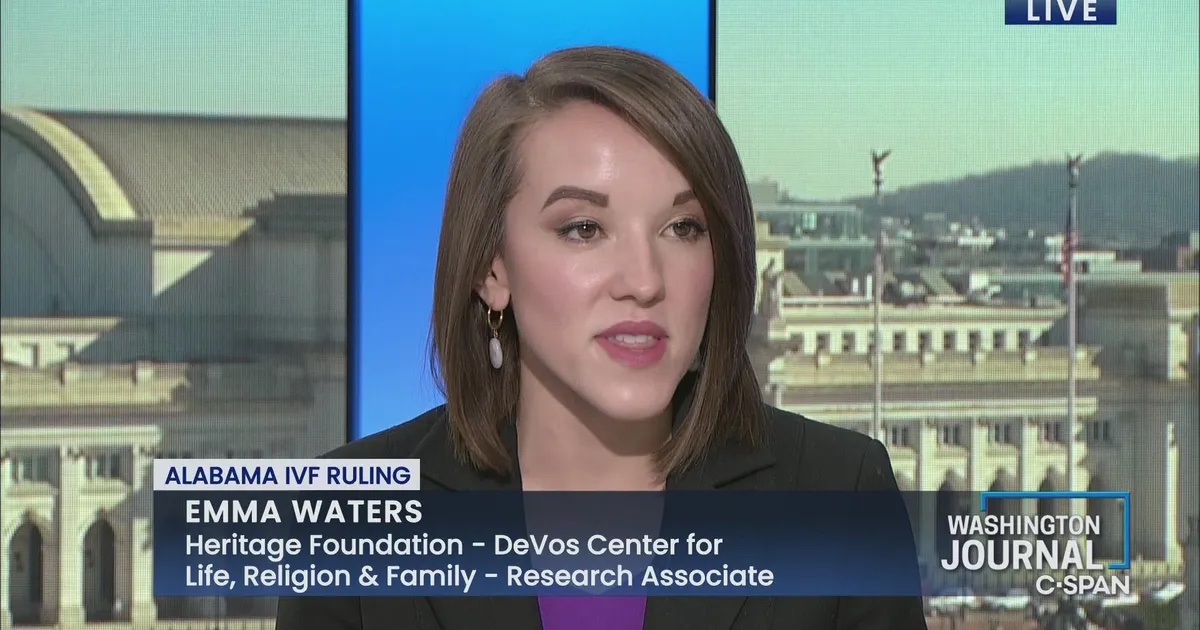
What Waters described as a “wake-up call” towards embryos being recognized as human life began with a landmark Alabama Supreme Court decision in February 2024. Three couples who had undergone IVF and had remaining unimplanted embryos frozen brought a lawsuit against the hospital for allowing a patient to enter a freezer, accidentally destroying them. The case was appealed to the state supreme court, which ruled that the embryos were regarded as “extrauterine children.”
With this decision, growing interest has latched onto the rights and identity of embryonic human life. Many Christians – those at Anglicans for Life included – declare embryos to be children, consistent with the Anglican Church in North America’s Canon 8 that states church members and clergy are “called to promote and respect the sanctity of every human life from conception to natural death.” Just as abortion laws have sparked debates about when human life truly begins, the popularization of IVF has done the same.
In discussing the religious aspect of IVF, Waters emphasized what she described as the “package deal of marriage, sex, and procreation.” All three should be linked, Waters maintained; should any of the links be broken, there is a risk of sin entering into the relationship.
According to Waters, this risk is common, often appearing as an idolatrous attempt to control what she believes only God controls: the creation of human life. This impulse appears all across the Bible, from Abraham and Sarah using Hagar as a surrogate, to the Israelites’ worship of Canaanite fertility goddess Asherah.
Waters does not view IVF as inherently wrong, but she cautioned that it could easily lead towards idolatry. Because of the low probability of success, IVF often starts with the conception of multiple embryos in the hopes that one will embed and begin pregnancy. Should more succeed than the couple is ready – or willing – to give birth to, the embryos will remain frozen indefinitely. She cited the statistic that in the U.S. alone, over a million frozen embryos have gone unused. That number continues to rise.
Additionally, IVF opens the door for gene modification and gene testing of embryos, where prospective parents can pay a fee for a pre-implantation test of all the embryos for things such as genetic disabilities, gender, or potential IQ. Parents can then choose which embryo they prefer to implant. Waters stated that these tests are often inaccurate, and that parents should be willing to raise a child no matter its genetics.
The way IVF is approached in America also leaves much to be desired within the medical field, especially in regards to women’s reproductive health, Waters added.
“Infertility is not a disease,” Waters insisted, but a “symptom of underlying reproductive health issues.” Most fertility clinics do not have a standard initial diagnostic test for those struggling to conceive, which can make doctors turn to IVF before exploring other viable options to help a couple conceive naturally.
The following panel with Waters and Petty expounded upon the aforementioned ideas.
Throughout the forum, speakers encouraged clergy and congregants to participate actively in sanctity of life issues. Specially emphasized was the importance of clergy being able to speak on these issues in order to better guide congregants. A cited survey showed that many congregants do not approach clergy about these issues because they do not believe clergy are knowledgeable and able to help them.
Finally, as Anglicans for Life is a parachurch organization, AFL President The Rev. Canon Georgette Forney stressed that their work is most successful when able to aid and encourage local churches to partner with them in starting local chapters. Anglicans passionate about the sanctity of life can read more about AFL’s ministry here.
More from IRD:
‘God’s Word Upholds the Sanctity of Life’ Anglicans Affirm
As Illinois Advances Assisted Suicide, Opponents Warn of Devalued Life
Fifty Years Post-Roe, Anglicans and Episcopalians Diverge on Abortion




Comment by David on February 4, 2026 at 9:38 am
“However, an important biological feature of human embryos has been left out of a lot of ethical and even scientific discussion informing reproductive policy – most human embryos die before anyone, including doctors, even know they exist. This embryo loss typically occurs in the first two months after fertilization, before the clump of cells has developed into a fetus with immature forms of the body’s major organs. Total abortion bans that define personhood at conception mean that full legal rights exist for a 5-day-old blastocyst, a hollow ball of cells roughly 0.008 inches (0.2 millimeters) across with a high likelihood of disintegrating within a few days.
As an evolutionary biologist whose career has focused on how embryos develop in a wide variety of species over the course of evolution, I was struck by the extraordinarily high likelihood that most human embryos die due to random genetic errors. Around 60% of embryos disintegrate before people may even be aware that they are pregnant. Another 10% of pregnancies end in miscarriage, after the person knows they’re pregnant. These losses make clear that the vast majority of human embryos don’t survive to birth.”
Given the above, does God actually believe in the “sanctity of life?”
Comment by Thomas on February 4, 2026 at 10:12 am
“Waters does not view IVF as inherently wrong”. I strongly disagree with her on that. Its always wrong! People shouldn`t try to take the place of the creator.
Comment by Mark on February 4, 2026 at 5:47 pm
Thomas,
I have cousins who were conceived via IVF after their parents struggled for years to have children. You’re never going to convince me those precious children are anything but a miracle God chose to bring about through modern science.
Comment by Thomas on February 5, 2026 at 12:56 pm
These children are innocent of the way they were conceived but nothing can change the truth that humans have no right to take the place of God in the way human life is meant to come into existence. Period.
Comment by Mark on February 5, 2026 at 2:46 pm
Thomas,
The same arguments have been made before about all forms of contraception, child incubators, fertility medications, and other tools that have made pregnancy safer and less complicated throughout history. I wouldn’t be surprised if there was even someone around who claimed the doctor who performed the first ever caesarian was “playing God.” My uncle and aunt couldn’t have children through conventional methods. Modern medicine helped them find a way. Today they are proud parents of wonderful children. They don’t owe you or society any apology for that.
Comment by Thomas on February 6, 2026 at 12:09 am
They do perhaps own an apology to God.
Comment by Thomas on February 6, 2026 at 10:02 pm
Mark, please go troll somewhere. Your lack of Christian charity in your “ad hominem” attack shows how you are blinded by the Devil. I ask people to pray for you.
Comment by Glenn Wheeler on February 7, 2026 at 4:30 pm
Modern medicine has raised a number of issues with moral implications. These are issues that Christianity never had to think about in the past, and they are issues on which the scriptures are silent (since of course modern medicine did not exist back then.)
On issues such as this, one might think that the scriptures would give general principles which could be applied to derive “Christian” positions on those issues. That, though, in actual practice is not as straightforward as it might seem. Just witness the Christians arguing about abortion, for example. All sides have scriptures they point to which they are sure prove that their position is “the” Christian position and don’t understand why all sides don’t see it that way.
Maybe a little humility regarding these issues is in order. There may be a definite Christian position on all these issues, but at this point it is not clear what that position is. But of course each side believes it has already discovered it…and there lies the problem.
Comment by Thomas on February 9, 2026 at 9:55 pm
The fact that some “progressive” Christian denominations have rejected the sanctity of unborn human life, and came to support abortion, can be considered as an apostasy of the Christian faith. We can ask, when did Jesus life begin, and why He was born like any of us? Judaism and Christianity both strongly condemned abortion at the time of Jesus and the early Christians. “If you’ve ever wanted to know what the early church thought about abortion and how it responded, the book to read is Michael J. Gorman’s Abortion and the Early Church: Christian, Jewish and Pagan Attitudes in the Greco-Roman World./ Abortion was rampant, especially in ancient Rome, and the early Christians, like the Jews, consistently opposed it./ First-Century Judaism Condemned Abortion/ For example, the Sentences of Pseudo-Phocylides 184–186 (c. 50 B.C.–A.D. 50) says that “a woman should not destroy the unborn in her belly, nor after its birth throw it before the dogs and vultures as a prey.”/ Included among those who do evil in the apocalyptic Sibylline Oracles were women who “aborted what they carried in the womb” (2.281–282)./ Similarly, the apocryphal book 1 Enoch (2nd or 1st century B.C.) declares that an evil angel taught humans how to “smash the embryo in the womb” (69.12)./ Finally, the first-century Jewish historian Josephus wrote that “the law orders all the offspring to be brought up, and forbids women either to cause abortion or to make away with the fetus” (Against Apion 2.202)./ Early Christian Literature Condemned Abortion/ Against the bleak backdrop of Roman culture, the Hebrew “sanctity of human life” ethic provided the moral framework for early Christian condemnation of abortion and infanticide./ For instance, the Didache 2.2 (c. A.D. 85–110) commands, “thou shalt not murder a child by abortion nor kill them when born.”/ Another noncanonical early Christian text, the Letter of Barnabas 19.5 (c. A.D. 130), said: “You shall not abort a child nor, again, commit infanticide.”/ There are numerous other examples of Christian condemnation of both infanticide and abortion. In fact, some biblical scholars have argued that the silence of the NT on abortion per se is due to the fact that it was simply assumed to be beyond the pale of early Christian practice. Nevertheless, Luke (a physician) points to fetal personhood when he observes that the unborn John the Baptist “leaped for joy” in his mother’s womb when Elizabeth came into the presence of Mary, who was pregnant with Jesus at the time (Luke 1:44).” (From The Gospel Coalition)
Comment by Glenn Wheeler on February 10, 2026 at 5:15 pm
Thomas,
1. Please provide the scriptural reference that says the author of the Gospel of Luke was a physician. Please provide the scriptural reference that says the author was named Luke.
2. Stop and think for a minute about the idea that the silence of scripture on an issue is an explicit condemnation of it. If you’re going to take that position, what allows you to limit that to just abortion? Why could it not be applied to all issues on which scripture is silent?
3. Just as you can come up with a selection of quotes, including biblical passages, to support your position, so can people on the other side come up with their list of quotes to support their position.
4. No matter if your biblical “scholars” assure you that they know what the biblical authors meant to say that they didn’t write, the fact is that the scriptures do not give direct, explicit guidance on the issue you are obsessed with.
Comment by Thomas on February 12, 2026 at 11:26 am
Glenn Wheeler, you have obviously an anti-Christian agenda. You claim I am “obsessed” with these issues, while I am not. I was just providing information to your attempt to illude people at pretending that the Christian stance on the sanctity of human life, from conception to natural death, can be confused with the post-Christian stance. I could quote plenty of saints, theologians, protestant reformers that believe that life begins and should be protected by law since conception.