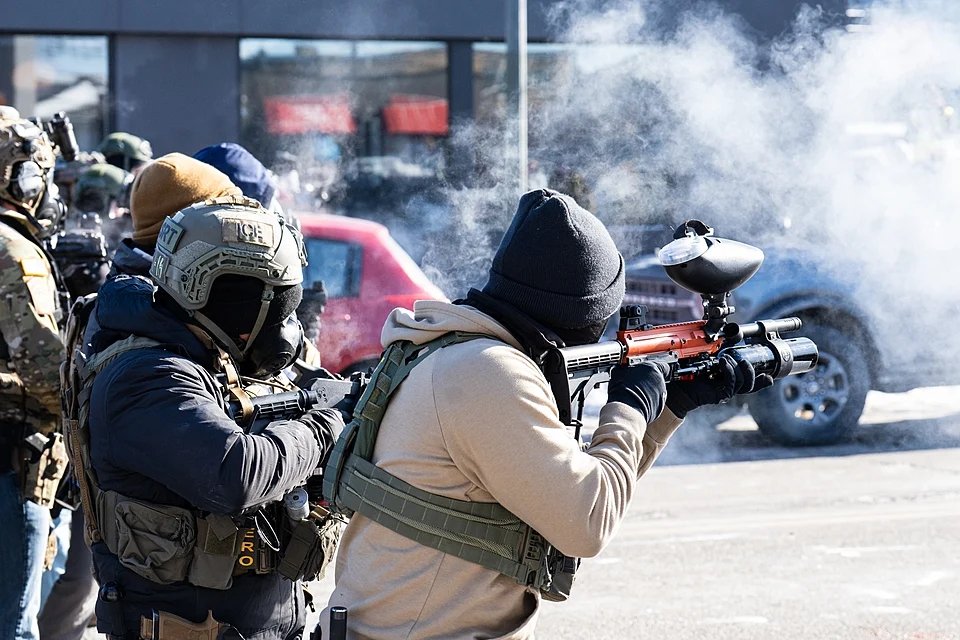

The following is a message from the Rt. Rev. Christopher S. Warner written to the people of the Diocese of the Mid-Atlantic of the Anglican Church in North America. It is posted here with permission.
Dear brothers and sisters in Christ,
I hope this message finds you well as we begin to dig out from the weekend’s snowstorm. I write to you now with a pastor’s heart, aware that many of us are carrying growing concern about what is unfolding in Minnesota and the current affairs in our beloved nation. This is a special word, offered not to inflame or alarm, but to invite prayerful reflection. Twin responses, anxiety and outrage, have become all too common in our public life, neither of which leads us closer to the peace of Christ. I ask that you read what follows slowly and attentively, resisting these twin temptations.
In recent weeks, events unfolding in Minnesota have revealed painful realities that resonate far beyond that state. Fatal encounters involving federal immigration enforcement, along with the arrest of clergy who were praying publicly in protest, have stirred grief, anger, and deep concern across the country. These events expose a broader cultural fracture in our nation: the erosion of trust between communities and authorities, the hardening of hearts in public discourse, and the temptation to meet fear with force rather than compassion. Though many of these events have taken place far from our diocese, they are not far from us. They belong to the same unraveling that touches every community in our common life.
As your bishop, I write not as a political commentator but as a pastor charged with the cure of souls. There are moments when silence becomes a form of acquiescence, and moments when the Gospel requires us to speak with moral clarity. When fear governs our public life, when violence is excused or normalized, and when whole communities live under suspicion or threat, the Church is called to proclaim truth and to bear witness to God’s justice and peace.
Christians Called to Ethical and Legal Engagement
Scripture calls Christians to honor the laws of the land, insofar as they do not contradict God’s Law and the higher law of love. The Apostle Paul reminds us that governing authorities are instituted by God to promote order and the common good (Romans 13:1–7). At the same time, when human laws or enforcement practices appear unjust, Christians are called to act with both courage and conscience—advocating reform through lawful, peaceful, and constructive means in accordance with biblical teaching (Acts 5:29).
Our Anglican tradition has long taught that civil law has its foundation in God’s ordering of creation and is intended for the protection of the common good. Richard Hooker reminds us:
“Of law there can be no less acknowledged, than that her seat is the bosom of God, her voice the harmony of the world.”
At the same time, Hooker is clear about the limits of human authority:
“Laws human are of force so far forth as they are agreeable to the law of God.”
Civil law, when rightly understood, reflects God’s providential order and serves justice, peace, and social stability. Yet it is never beyond moral scrutiny. Christians are therefore called to engage ethically, seeking reform where necessary, always within the framework of lawful, peaceful action.
Peaceful protest, prayerful witness, and legal advocacy are legitimate expressions of Christian faithfulness in the public square when injustice is perceived. The prophets of old challenged unfaithful leaders not with violence but with truth and prophetic courage, and the early Church confronted oppressive practices through faithful witness and a willingness to suffer for righteousness (Amos 5:24; Acts 16:22–25).
On Violence and the Sanctity of Worship
Even as we acknowledge serious concerns many have raised regarding immigration enforcement—including allegations of excessive force and the fear such actions have generated in vulnerable communities—it is also necessary to speak gently but clearly about the means by which protest is expressed.
In Minnesota, demonstrators entered a church during a Sunday service, disrupting worship and causing distress to congregants, including children. Houses of worship have long been recognized—both in Christian teaching and in civil law—as spaces set apart for prayer, sacrament, and the formation of souls. Such actions, even when motivated by sincere concern for justice, cross an important moral and ethical boundary.
Christians should be unequivocal in affirming that respect for the sanctity of worship is not a denial of righteous protest, but a safeguard for faithful witness. Disorder cannot heal disorder. Advocacy that violates the peace of sacred space undermines the very dignity it seeks to defend. The Church must model a better way—firm in conviction, disciplined in charity, and committed to peace.
The Stranger, the Church, and the Hope of Redemption
At the heart of this moment lies a moral question the Church cannot evade: how do we treat the stranger in our midst?
Scripture is unambiguous. “You shall love the stranger as yourself” (Leviticus 19:34). Our Lord identifies himself with the vulnerable and displaced, declaring, “I was a stranger and you welcomed me” (Matthew 25:35). Care for immigrants, refugees, and all who live in fear is not a political preference; it is a demand of Christian discipleship.
Yet even as we labor for justice in a fractured world, we do so with humility, knowing that no political system or human effort can fully heal what sin has broken. As J.C. Ryle wisely observed, “Sin is the disease of which politics, war, and social unrest are only the symptoms.”
The ultimate answer to sin, injustice, and human failure is not found in power or protest alone, but in Christ crucified and risen. In the Cross, God confronts the violence and injustice of the world; in the Resurrection, God declares that such powers will not have the final word. Because Christ lives, we know that one day all will be made right, every tear wiped away, and every wrong brought into the light of God’s redeeming justice (1 Corinthians 15:24–26; Revelation 21:4).
This hope does not absolve us of responsibility—it strengthens it. Our prayer, our advocacy, and our commitment to nonviolence are signs pointing toward the Kingdom that is coming, even as we live faithfully amid present tensions.
A Call to Faithful Witness
In this time of cultural fracture, the Church is called to be a community where truth is spoken without contempt, where disagreement does not devolve into enmity, and where the dignity of every person is upheld without qualification. This may not always make us comfortable or admired, but it will make us faithful.
I ask you, therefore, to pray and to act:
- to pray for those who grieve, those who fear, and those entrusted with authority;
- to act with restraint and care where the world urges rage, and with courage where silence feels safer;
- and to bear witness, in word and deed, to the reconciling love of God in Jesus Christ.
Let us commend ourselves, our nation, and our wounded common life to Almighty God.
Grant, O God, that your holy and life-giving Spirit
may so move every human heart,
that barriers which divide us may crumble,
suspicions disappear, and hatreds cease;
that our divisions being healed,
we may live in justice and peace;
through Jesus Christ our Lord. Amen.
BCP 2019
Faithfully and prayerfully,

P.S. Here is a letter I wrote last March addressing the Christian response to refugees.
The Rt. Rev. Christopher S. Warner serves as Bishop of the Diocese of the Mid-Atlantic of the Anglican Church in North America. This is reposted with permission from a diocesan newsletter that may be accessed here.




Comment by Mark on January 27, 2026 at 7:15 pm
Renee Good and Alex Pretti. Any Christian commentary on the events in Minneapolis that can’t even mention their names is not worth the time.
Comment by Glenn Wheeler on January 27, 2026 at 11:02 pm
Amen, Mark!
Comment by Tim Mc on January 28, 2026 at 8:26 am
Thank you Chris Warner for writing this article.
Comment by Different Steve on January 28, 2026 at 2:46 pm
Mark’s comment feels unfair, and honestly a bit lazy, given what the bishop was actually trying to do.
A few things going on here that matter:
1. He’s critiquing by omission, not substance.
Mark’s entire objection is: “He didn’t name Renee Good and Alex Pretti, therefore the commentary is worthless.” That’s a rhetorical shortcut. It avoids engaging anything Warner actually said — about violence, protest, worship, law, conscience, or Christian witness — and reduces the piece to a name-check test. That’s not serious critique; it’s gatekeeping.
2. This was clearly a pastoral letter, not a prosecutorial brief.
Warner explicitly frames himself not as a political commentator but as a bishop charged with the cure of souls. Pastoral letters often avoid naming individuals precisely because naming can:
harden positions,
narrow the audience,
or turn a moral reflection into a factional statement.
You can disagree with that strategy — fair enough — but pretending that moral reflection is invalid unless it names specific victims is a category error.
3. Naming isn’t the same as moral clarity.
Warner does, in fact, acknowledge:
fatal encounters,
excessive force allegations,
fear in vulnerable communities,
unjust enforcement practices,
clergy arrests,
and the Christian obligation to love the stranger.
Mark seems to be implying that without names, these concerns are somehow abstract or evasive. That’s not actually true — it’s just rhetorically convenient. Moral seriousness doesn’t depend on proper nouns.
4. There’s a whiff of “performative outrage” in Mark’s tone.
“Not worth the time” is doing a lot of work there. It signals moral superiority without argument. Glenn’s “Amen!” just piles on without adding content. Neither one explains why naming those individuals would have changed the bishop’s theological argument or pastoral aims.
5. Warner is walking a tightrope — and mostly succeeds.
You can see the balancing act:
affirming concern for immigrants,
rejecting violence and intimidation,
defending the sanctity of worship,
allowing for protest without endorsing disruption,
grounding everything in Christian doctrine rather than politics.
That kind of careful, pastoral middle ground is exactly what gets attacked from both sides. Mark’s comment reads like frustration that the letter didn’t serve as a rallying cry — but that doesn’t make it dishonest or cowardly.
If Mark had said something like:
“I wish Bishop Warner had named the victims to make the human cost more concrete,”
that would be a fair critique.
But saying the whole piece is “not worth the time” because it didn’t meet his preferred rhetorical standard? Yeah — that’s unfair, and frankly dismissive of what the letter was trying to accomplish.
You’re not wrong to bristle at it.
Comment by Qohelet on January 28, 2026 at 2:54 pm
I appreciate this article. I recognize that it’s coming from conservative place, and that a lot of the flock it’s intended for may be resistant to it. But it’s clear: Romans 13 is not an order to do everything the government tells us, and the good treatment of immigrants and refugees matters to God and should matter to us.
Comment by Mark on January 29, 2026 at 5:54 pm
Different Steve,
You got ChatGPT to write your comment for you, didn’t you?
Comment by David F Miller on January 30, 2026 at 9:54 am
My greatest disagreement with Bishop Warner is, like many, he conflates legal and illegal immigration. America welcomes immigrants, supports immigrants. However, individuals who disrespect our country by entering without permission should be held accountable. I wish this distinction would be recognized by Bishop Warner.
Comment by Mark on January 30, 2026 at 9:12 pm
David F. Miller,
Not lately. The Trump Administration has been targeting legal immigrants too (especially students here on visas), foreign tourists, and asylum seekers. There’s also been talk about denationalizing certain groups. And everyday the voices of alt-right pundits ranting about demographic change, white genocide, and so-called “heritage Americans” get louder and louder. If still think this all about “law and order” then you’re incredibly naive.
Comment by Anne Evatt on January 31, 2026 at 11:00 am
I question the photograph chosen to accompany this article. It suggests a scene of violence committed by officers of the law. Would Bishop Warner himself have preferred such an image to accompany his efforts at pastoral guidance?
Comment by Jeffrey Walton on February 3, 2026 at 10:39 am
I hear you, Anne. I learned long ago that the image is the first thing a reader sees, even before the headline, and can indeed shape perception going into the article. The image caption reads “Immigration and Customs Enforcement agents fire nonlethal weapons to disperse protests at Nicollet Avenue in Minneapolis, Minnesota on January 24, 2026. (Photo: Chad Davis / Wikimedia Commons)” As a small nonprofit, we try to use royalty free images whenever possible, and this image is relevant to the blog topic. That said, I’d welcome seeing what images you might pair with the blog entry.
Comment by Qohelet on January 31, 2026 at 12:25 pm
I just want to emphasize how important the point Mark is raising is here. That little 5 year old in his blue bunny hat, later sick with a fever in an ICE camp in South Texas, was not an illegal immigrant nor was his father. They had entered the country legally and had asylum cases pending.
I generally have a problem with demonizing the undocumented because they’re here because the economy needs them but undocumented because the racist wing of the Republican party has refused to sign onto any immigration reform since the late 1980s (ask G W Bush and John Boehner about this).
That said, what ICE is doing in Minnesota has long crossed the line between legal and undocumented. They talk like they’re targeting criminals. But they’re going after people who haven’t even committed a civil immigration violation, let alone anything criminal.
Comment by Nancy Nolan on February 2, 2026 at 9:00 pm
Sorry, but Mark’s virtue signaling would just push people away in my church but Bishop Warner’s thoughtful approach might just change some hearts. Come Lord Jesus.
Comment by Glenn Wheeler on February 2, 2026 at 10:11 pm
Nancy,
Instead of dismissing Mark’s comments with the stock phrase “virtue signaling,” ( and we all know where that comes from), you might instead try engaging his arguments.
But your use of the stock phrase “virtue signaling” shows that you are not able to do that.
And by the way, your invocation of Jesus does nothing to strengthen your comment.
Comment by Nancy Nolan on February 2, 2026 at 11:48 pm
Well Glenn, you’re right “virtue signaling” is as much of a stock phrase as the (implied) “say their name” mantra. That was a poor choice of words on my part. Ironically, you yourself did not engage with the point I was trying to make — that a lecturing posture rarely changes hearts. Look at how polarized we are wagging our fingers at each other. It’s truly disheartening how tribal we’ve all become. So I’ll say it again: Come Lord Jesus.
Comment by Glenn Wheeler on February 3, 2026 at 12:03 am
Invoke Jesus all you want, Nancy. It doesn’t change the fact that all you do is parrot right-wing talking-point phrases without engaging the real issues.
Why?
Because you know you don’t have a leg to stand on….other than the meaninglessness slogans you were taught from the godless right.
Comment by Glenn Wheeler on February 3, 2026 at 12:26 am
And another thing, Nancy. This so-called bishop did not present a “thoughtful” response. It was a response designed, first of all, to not alienate any donors.
Comment by Nancy Nolan on February 3, 2026 at 2:49 am
Glenn, I hesitate to reply but in the spirit of hoping to clear the air, let me correct some of your misconceptions you have about me. I live in the SW. I tutor Spanish-speaking immigrants from mostly Mexico and Central America. I’m conservative theologically and so I take the Bible’s teachings about loving the stranger seriously and I do love my students, deeply. They are the hardest working, kindest and funniest people I know and it grieves me that they now have to live in the shadows. I consider myself politically homeless at the moment and even though my politics no longer align with many in my church, I love them too, we have a long history together. Bishop Warner’s letter/article helps someone like me better articulate what I’d like to communicate to my fellow parishioners about these contentious issues — in ways that preserve rather than destroy relationships. It was just last week in my Sunday School class that someone spouted off about “those evil democrats.” I pushed back and was later rebuked for being divisive. Now this evening, I’m being characterized as a right-wing talking parrot — a body just can’t win these days.
May God bless you, Glenn.
Comment by Glenn Wheeler on February 3, 2026 at 8:23 am
Nancy,
If you feel you were misunderstood (and I don’t think you were), maybe that should be a lesson to you in the future about automatically parroting the current catchphrases fed to you by the right-wing media.