

The February 29, 1704 (old calendar) attack on Deerfield, Massachusetts, was the October 7 and September 11 of colonial New England. Three hundred native warriors, with French officers, ordered by French Canada’s governor, surprised the frontier Puritan village at night, in the middle of Winter. The snow drifts carried them over the stockade, the night guard apparently asleep or distracted.
At least forty seven of 300 villagers (including African slaves) were slaughtered, mostly children, and 112, half of them under age 18, twelve of them under age five, were force marched 300 miles across two months towards Quebec, of whom 89 survived, two thirds of whom would eventually return home, the remainder staying with their new native “families.”
The raid was part of Queen Anne’s War, a global conflict involving Britain, France, and Spain. And it was prompted by the French governor’s wanting a valuable New England captive to exchange for Britain’s capture of a high-profile French privateer who had raided New England ports. Natives were motivated by taking hostages who could be redeemed for treasure, or who could be “adopted” as replacements for their own lost family members.
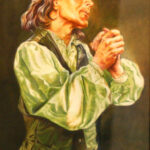
That valuable captive the French wanted was Harvard educated 37-year-old Deerfield Congregationalist pastor John Williams, in-law to the famous Mather clergy dynasty. During the attack, Williams and his wife Eunice suffered great loss, as the natives crushed the skulls of their six-year-old and infant sons, plus their African slave woman. Husband and wife with their remaining on site three children (and older son was at Harvard) were herded into the forced march through snow and forest.
On the march, natives killed Eunice with a hatchet after she had tripped crossing the river. The well-organized raiders brought snowshoes for their captives and sometimes carried children, including a young daughter of Williams, little Eunice, whom Williams recalled was “looked after with a great deal of tenderness.” Children were especially valuable to them as potential adoptees. But the native captors were ruthless with any hostage, typically very young or older, who slowed their travel. Several suckling babies were killed.
Thanks to the subsequent memoir by Pastor Williams, The Redeemed Captive Returning to Zion, we know quite a bit about the raid, the forced march, the captivity in Quebec, and the subsequent prolonged and complicated release of most captives. Thirty captives, “adopted” by the natives, ostensibly refused to leave Canada, or at least the French refused to extract them, including the Williams’s daughter Eunice, captured at age seven, and who later married a native, with whom she had three children, forgot her native English language, and foreswore her parents’ Puritan faith in favor of Catholicism.
James Swanson, who sadly died last year and is best known for Manhunt: The 12-Day Chase for Lincoln’s Killer, recalls Deerfield’s story in The Deerfield Massacre: A Surprise Attack, a Forced March, and the Fight for Survival in Early America. He notes the attack, and the “captivity narratives” like the memoir by Williams and other accounts from native attack survivors up and down the colonies, shaped the psyche of colonial America.
But also notable is the contrast in civilizations, political and religious, revealed in the Deerfield attack. French Canada was Catholic, with Jesuits often exercising authority, including oversight of hostages, whose conversions to Catholicism they hoped to extract, and negotiations for their release. New England was Puritan and viewed French Canada and its native allies as cosmic enemies. Pastor Williams recounted Jesuit pressure for his conversion, which would have been a propaganda coup.
Central to The Redeemed Captive, besides Williams’ survival of native barbarities, was his fidelity to the Puritan faith. He saw the horrific ordeal a great test from the Lord, who would sustain him. Even amid the slaughter of his children and wife, on the long wintry march he comforted other captives with prayer pastoral encouragement. They worshipped together, read their Bibles, which the natives allowed them to retain (though later in Canada many were taken by the French priests, who also forbade their Protestant worship), and sang songs of Zion when bidden by natives wanting entertainment. At night, Williams wrung blood from his socks. But he did not doubt God’s watchfulness. They, or at least most of them, would persevere.
Williams was comfortably housed and fed by the French once in Canada, although separated from his four surviving children. In 1705 he, with three of his children, and many other Deerfield captives, was released, in exchange for the French privateer. But his daughter Eunice, then age 10, whom the natives had carried on the long march, would not be returned, having been irretrievably adopted by a native family, who saw her as replacement for a child lost to smallpox. She became Marguerite, was baptized Catholic, married at age 16 to a 25-year-old native, and her name changed to Kanenstenhawi.
Until his 1729 death, Pastor Williams from afar unsuccessfully urged his daughter to return, after which his son, also a pastor, continued appealing to his sister. She returned, but only for the first of several visits, sometimes with her children, in 1741, to a land she barely if at all remembered, amid language and religion unfamiliar to her. Living until 1785, she was reputedly the last of the Deerfield massacre survivors.
Pastor Williams preached in Boston upon his return, remarried, and published his epic memoir, the most renowned of its genre, and reputedly a source for James Fenimore Cooper’s 1826 The Last of the Mohicans. Dedicated and addressed to the Governor of Massachusetts, who negotiated their release, Williams stresses God’s mercy and judgment in his opening:
THE history I am going to write, proves, that days of fasting and prayer, without reformation, will not avail to turn away the anger of God from a professing people; and yet witnesseth, how very advantageous, gracious supplications are, to prepare particular Christians, patiently to suffer the will of God, in very trying publick calamities.
Even more than the massacre and Winter forced march, the memoir stresses Williams’ refusal to bend to his Jesuit captors, who unsuccessfully implored him to attend mass, insisting they would attend his church if their roles were reversed, if only from curiosity. He replied:
The case was far different, for there was nothing (themselves being judges) as to matter or manner of worship, but what was according to the word of God, in our churches; and therefore it could not be an offence to any man’s conscience. But among them, there were idolatrous superstitions in worship. They said, Come and see, and offer us conviction of what is superstitious in worship. To which I answered, That I was not to do evil that good might come on it; and that forcing in matters of religion was hateful.
The Jesuits, who otherwise were courteous and hosted Williams at their dining table, must have found their captive pastor as much a trial as he did them. Williams later recalled, “All means were used to seduce poor souls.” And he prayed:
And I looked to God in Christ, the great shepherd, to keep his scattered sheep among so many Romish ravenous wolves, and to remember the reproaches wherewith his holy name, ordinances, and servants were daily reproached.
Williams remembered:
I was sometimes told, I might have all my children if I would comply, and must never expect to have them on any other terms. I told them, my children were dearer to me than all the world, but I would not deny Christ and his truths for the having of them with me; I would still put my trust in God, who could perform all things for me.
Yet Williams also credited sympathy and kindness to some of the French, noting: “I am persuaded that the priest of that parish, where I kept, abhorred their sending down the heathen to commit outrages against the English, saying, it was more like committing murders, than managing a war.”
For Williams, his memoir was a warning to the often-ungrateful Puritans of Massachusetts who took for granted their liberties:
Here I thought of my afflictions and trials; my wife and two children killed, and many of my neighbours; and myself, so many of my children and friends in a popish captivity, separated from our children, not capable to come to them to instruct them in the way they ought to go; and cunning, crafty enemies, using all their subtilty to insinuate into young ones such principles as would be pernicious. I thought with myself how happy many others were, in that they had their children with them, under all advantages to bring them up in the nurture and admonition of the Lord; whilst we were separated one from another, and our children in great peril of embracing damnable doctrines. Oh! that all parents, who read this history, would bless God for the advantages they have of educating their children, and faithfully improve it!
The steely faith of Pastor Williams brought his Puritan ancestors across the Atlantic and guided New England for another half century, perhaps culminating in Jonathan Edwards’ famous 1641 sermon “Sinners in the Hands of an Angry God.” Massacres and French Jesuits could not subvert it, but it eventually evolved into streams of American civil religion and exceptionalism. And as with October 7 and September 11, the victims of the Deerfield Massacre and their descendants prevailed and ultimately transcended the civilizational forces that sought their destruction.



Comment by Dan W on January 26, 2026 at 8:12 am
Did Williams forgive his captors? The murderers of his wife and children? I may have to read Swanson’s book to find out. Forgiveness, mercy and reconciliation are what we need in 2026. Christians making war on other Christians, or any of God’s children, leads to bad outcomes most of the time.
Comment by Glenn Wheeler on January 27, 2026 at 12:34 am
Just like Mark Tooley to judaize everything.
Comment by Diane on January 27, 2026 at 5:40 am
I’m not a descendant of any of the Deerfield families. I’ve visited Old Deerfield, though. I descend from the Thomas Tarbell family – three Tarbell children in Massachusetts were kidnapped by Mohawks, I believe that’s the tribe, , and taken to Canada. The little girl was sold to the Catholic convent and never heard from again. The two boys eventually returned home as young men, but could not assimilate back into the colonizer culture. They returned to Canada, married indigenous women, and their descendants live in Canada and are well known as Tarbell Mohawks. That said, my New England ancestors were Mayflower/Plymouth Separatist folks, as well as 1643 Puritans in Charlestown, MA. They participated in the genocidal slaughter of indigenous peoples of the northeast during King Philip’s War. I’ve come to understand my ancestors were thoroughly indoctrinated with white supremacist ideology before arriving here. Their version of Christianity was saturated with white supremacy. Many of the Congregational clergy, including Jonathan Edwards, were enslavers. The Edwards Church in Northampton, my father’s boyhood church and my grandparents’ church, as well as their neighbors’ church, Calvin & Grace Coolidge, has erected a historical sign outside the church that acknowledges Edwards’ slaveholder legacy. I’m also a Salem witch trials descendant. Personally, I believe my ancestors’ Christian faith was corrupted with white supremacy…they were all rather barbaric, in my opinion.
Comment by Wilson R. on January 27, 2026 at 12:10 pm
An earlier book about this same episode is called “The Unredeemed Captive,” with its focus on the minister’s daughter. I read it some years ago, and the author, John Demos, is a well-respected and prize-winning historian whose expertise is in 17th century colonial Massachusetts. Demos presents a somewhat more nuanced picture than it sounds like the new book provides. As I recall, the French did not deter Eunice Williams from returning to her family; at one point, family members even were able to meet and talk with her freely. She simply did not want to come back, partly because she had built a life among the Native people.
Demos focuses on this one case, but it was actually fairly common for captives to choose to remain with the Natives, particularly if they had been taken as children. The Native people didn’t merely love their children; they spoiled and pampered them, and life in the tribes was a stark contrast to the harsh life in the English settlements, where children were put to work at an early age.
Interestingly, you see this same phenomenon in Comanche country in Texas and Oklahoma, 150 years after Deerfield. The most famous example is Cynthia Ann Parker (the John Wayne movie “The Searchers” is loosely based on her story), who was taken as a girl, married to a Comanche war chief, and became mother to the leader Quanah Parker. When she was recaptured, years later, and returned to White society, she was depressed and never adjusted. There are other stories of boys taken by the Comanche who chose later to remain with them; in cases where they were returned to their families, they never adjusted to being back among White settlers. One I read about lived the rest of his life in a cave on a river bluff.
Worth noting that the Eastern tribes also conducted raids and kidnappings against their rivals. Some of the Iroquois nations raided as far south as the Carolinas. Captives could be adopted into the tribes to replace dead warriors, even assuming that person’s identity. Alternatively, they could be ritually tortured and killed over a period of days, which Europeans found especially savage and shocking.