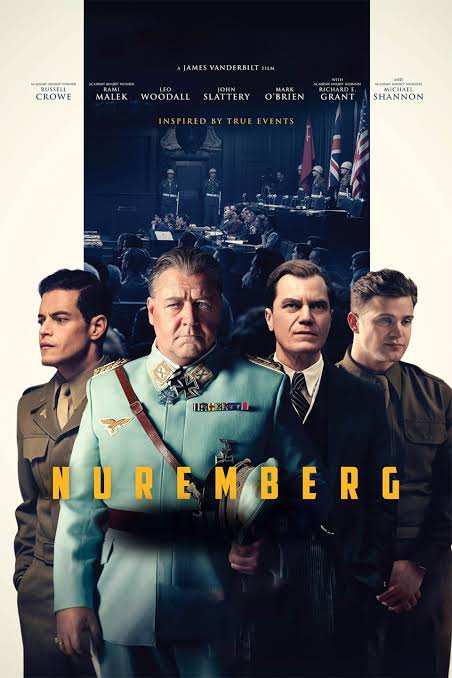

All agree that Russell Crowe is masterful as Hermann Goering in the new film Nuremberg about the famous 1945-1946 trials of leading Nazi henchmen. Crowe is unquestionably the star of this film, just as Goering was the star of the real Nuremburg trial. As “Reichsmarschall” he was number two in the Nazi hierarchy and commander of the air force. Although addled by drugs and losing Hitler’s confidence by war’s end, the obese Goering was still the big fish (literally and figuratively) of the Third Reich.
As the film portrays, Allied prosecutors were concerned that Goering’s large personality might win sympathy, if not in the court itself, then more widely among onlooking Germans and other sympathetic Europeans. It was not yet a foregone conclusion that the Hitler regime would be universally reviled even amid the rubble. Millions of Germans, and millions of other Europeans, had only months before fought for it, many to the death. Goering was indisputably savvy, gregarious, and charming.
There was also the problem that there was no specific international law to justify the Allied prosecution of Nazi war criminals, who, after all, were operating within the perverse laws of the Third Reich. So, in the London Charter of August 8, 1945, the justifying international law was developed to prosecute the Nazis for their crimes against humanity, along with their waging aggressive wars of conquest. The U.S., always the most idealistic of great powers, championed this development against skepticism from the other Allies, some of whom would have heartily approved executing the Nazis without trials. The trials were to record Nazi crimes and to establish legal and political precedent for actions against future regimes who practiced similar crimes.
At Nuremburg, Goering made no effort to disguise or apologize for his central role in overthrowing German democracy in favor of dictatorship, which to his mind the German people had themselves approved. He also had no regrets about conquering neighboring nations, who had, from his view, posed threats to Germany or wanted to join Germany. The law of conquest was the history of humanity, Goering somewhat justifiably believed. He adamantly but unpersuasively claimed he had no knowledge or complicity in the domestic Nazi death machine that murdered millions of Jews and other targets of Nazi wrath. Goering granted he had helped establish the concentration camps, but only for controlling political opponents, not for mass murder.
His claims of course were nonsense, but the film generates drama by the urgency of the prosecution’s need for firm evidence and ideally a direct admission from Goering on the stand. The film’s other major character, as in true life, is a U.S. psychiatrist charged with interviewing and analyzing the twenty-two imprisoned deposed Nazi officials. The young doctor is immediately charmed by Goering even as he has no illusions about Goering’s fundamental amorality. Partly from sympathy and partly to win Goering’s confidence, the doctor even visits Goering’s wife and young daughter in hiding to transmit letters. Mrs. Goering is later arrested for her complicity in her husband’s massive theft of European art, but she is released, as her incarceration looks to the world like punishment for her husband’s crimes.
The film further amplifies its drama with the U.S. prosecutor’s asking the psychiatrist to advise on Goering’s personal vulnerabilities to aid the prosecution. This conversation occurs under cover of darkness in the rubble of the infamous Nuremberg arena that once hosted mammoth Nazi rallies. In the film, the doctor initially cringes at this ostensible violation of patient confidentiality. In reality, surely nobody believed, including Goering, that the psychiatrist was anything other than an agent of the Allied powers. In the film, the psychiatrist, despite his dismissal by the prison commander, talks to a reporter, does at the last help the prosecution. His central insight is that Goering will never publicly repudiate Hitler. The prosecutor is high-minded U.S. Supreme Court Justice Robert Jackson, who is determined that Nuremburg establish new international legal standards for crimes against humanity. He sees not just the court but wider humanity and posterity as his audience.
Warned by the psychiatrist that Goering would “eat him alive,” Jackson at least in the film proceeded judiciously. In reality, he was deemed ineffective in his cross examination, with the British prosecutor coming to his rescue, goading Goering into admitting that even with all facts now available he would still follow Hitler. In the film, this strategy is thanks to the psychiatrist. True to life, helping the psychiatrist as translator was an escaped German Jew who had joined the U.S. Army. His parents exterminated, he saw Nuremberg as his vindication.
Goering escaped hanging by committing suicide. Not shown in the film, with his usual guile, he had tricked a guard into transmitting the tablet to him. The psychiatrist committed suicide in 1958, also by cyanide. Goering’s daughter lived until 2018, a fan and defender of her father to the end, as he had been a kind father to her.
Like many Nazis and countless other monstrous political figures across the centuries, Goering was kind to his intimates but amoral and cruel in his policies. He was fully complicit in the Holocaust and in the tens of millions killed in World War II. His prosecution, and the Nuremburg trials, helped establish international standards of justice for war criminals and gross human rights abusers.
These standards are never and will never be evenly enforced. The International Criminal Court has an arrest warrant for Vladimir Putin, which, barring his overthrow, likely will never be enforced. Ethiopian dictator Mengistu Haile Mariam, infamous for the Red Terror of the 1970s and 1980s that murdered thousands, now age 88, has enjoyed a comfortable exile in Zimbabwe since 1991. Serbian dictator Slobodan Milosevic, charged with war crimes and genocide by the International Criminal Court, was arrested in 2001 and died before his two-year trial concluded in The Hague.
But the standards of international law are still important as reminders that murderous despots and their agents, who operate lawlessly under their own regimes, still potentially face international justice. These standards point to natural and divine law, which no gross criminal will ever ultimately evade, if not in this world, then in the next.
Goering’s little daughter while visiting him in prison said she would see him in heaven, which provoked his tears. But Goering was unrepentant of his crimes, and what he faced after death was likely less than his daughter hoped for.




Comment by Wilson R on January 7, 2026 at 3:52 pm
While I agree with Mark Tooley here, I wish he had developed the point of this paragraph more fully, since it connects to the promise of the headline for this piece:
“But the standards of international law are still important as reminders that murderous despots and their agents, who operate lawlessly under their own regimes, still potentially face international justice. These standards point to natural and divine law, which no gross criminal will ever ultimately evade, if not in this world, then in the next.”
The message for today is that standards matter, even when “murderous despots” like Putin and Xi and the Iranian mullahs seem to operate with impunity.
And, of course, there is an entire dimension that Tooley’s piece sort of hints at but never addresses: How and when do our own leaders get held accountable for summary executions outside our territorial waters, for kidnapping a dictator for alleged drug offenses while pardoning another who was actually convicted of more grievous drug offenses, and for asserting the right to take whatever territory we wish because we have power–in other words, for destroying the international order that Nuremberg was meant to affirm.
Comment by Glenn Wheeler on January 7, 2026 at 4:08 pm
WilsonR,
You’re not supposed to mention the incidents you listed in the second paragraph. They’re different. Don’t you see? “Our side” is always justified in whatever it chooses to do. The “standards” only apply to those we choose to apply them to, and we never choose to apply them to ourselves. That’s what’s so nauseating.
Comment by Glenn Wheeler on January 8, 2026 at 12:08 am
One other comment…,Tooley seems to relish the idea that the Germans went to hell. That’s not surprising because one of the main messages of American Christianity has been “those who are not like us and don’t support us will all burn in hell.” But I’d bet that when we all get to heaven that we’ll be surprised at who all is there. I have no doubt that these holy righteous Pharisees will stand there with their mouths wide open when they see those who they so desperately wanted to be in hell walking the streets of gold.
Comment by Mike on January 8, 2026 at 9:12 am
Glenn Wheeler,
Don’t be surprised if heaven has far fewer citizens than you imagine will be there. Jesus Himself said that not everyone who calls Him Lord will be part of the kingdom of heaven, but only does who truly do the will of His Father. In another Scripture, He says that the road to heaven is narrow and difficult, and few are those who travel it.
In other words, “a whole lot of people are talking about heaven who aren’t going there”.
Comment by David on January 8, 2026 at 9:17 am
The nameless psychiatrist was likely Dr. J. Bruce Spradley who just happened to live across the street from my parents in Yardley, PA.
Comment by Qohelet on January 11, 2026 at 1:31 pm
The Nuremberg trials were important because they were a very public reckoning of the extent of the crimes of the German state. Until our Fox News (and even further right-wing media outlets) induced myopia that facts are simply opinions that you can debate, Nuremberg established crimes had occurred and the public largely acceptes the facts it established as being true.
The problems of Nuremberg are of course that only the losers were put on trial. Those who firebombed Dresden were not investigated. In our comperable trials in Japan, we executed Tasuku Okada for executing American B29 pilots. His argument was that the bombing of Japan had killed so many civilians that the pilots themselves were war criminals. Charles Lightoller of Titanic fame came to the same conclusion in WWI when his ship continued to gun down German sailors from a UB-110 as they swum away from the sinking wreck. In Lightoller’s eyes their crimes against allied merchant marine were so vile that he couldn’t comprehend just accepting their surrender.
So yes, Nuremberg was important for establishing principles of justice and especially for the idea that just following orders is no excuse. But the idea that it established a universal law where we’re treated equally in the eyes of God… Not so much.
Comment by Glenn Wheeler on January 11, 2026 at 10:58 pm
Quhelet,
I was in Dresden on the 50th anniversary of the firebombing. It was one of the biggest crimes against humanity ever perpetrated. Most people in the US have no idea what happened there. They are still under the illusion that the US was a “noble fighting force,” as they are still under the illusion that the US if a force of good in the world. But God knows what happened. And the world also knows. Don’t be mislead by the seeming victories.
Comment by Qohelet on January 12, 2026 at 3:32 pm
I’m comfortable saying the United States during WWII was a force for good. That’s not to say that individual actions can’t be considered war crimes,and I’ve pointed out that the flaw in Nuremberg was that only the war crimes of one side were examined.
All that said though, if there’s ever been a black and white good versus evil war, WWII would be that war. The allies did not have extermination camps and einsatzgrupen.
Comment by Wilson R. on January 12, 2026 at 4:11 pm
Glenn, I remember have an earnest discussion with one of my HS teachers on this very question. I had just read Slaughterhouse Five (now banned in many schools) and was deeply troubled by what I read about Dresden. While I agree with Qohelet that, overall, the US was a force for good in WWII, I argued with my teacher that Dresden (along with the firestorm bombings of other cities, like Hamburg) undermined our moral position at Nuremburg and made it feel like “victor’s justice.” The Nazis certainly were guilty of their crimes. But had we lost the war, our generals might have gone on trial for the crime of Dresden. Americans almost never stop to consider that.
Comment by Qohelet on January 12, 2026 at 6:01 pm
General Curtis LeMay even said (about the firebombing of Tokyo) that “if we lose, we’ll be tried as war criminals.”
May such times never return
Comment by Glenn Wheeler on January 12, 2026 at 10:45 pm
History is propaganda written by the victors (the temporary victors).
Comment by David Gingrich on January 13, 2026 at 8:06 am
I do not trust international courts. They are not responsible to the people.
Comment by WayneW on January 13, 2026 at 8:31 am
David Pawson has the two best teachings on this I have ever heard. In his teaching on Luke 15 and “the prodigal son” he in includes a short writing from a Lutheran army chaplain who was assigned to minister to many of the Nuremberg war criminals, Henry Gerecke. I recommend finding this and reading. Moral of the teaching: How do you feel when war criminals like the Nazi’s become Believers in prison? Because some did. In the “prodigal son” the son who stayed home was the lost one. He was made when his brother “saw right” and came home.
Another teaching by David Pawson is titled “Lessons from the Holocaust for Jews and Christians”. In it he explains Germany, Hitler and how it all happened and what we shoudl take from it. This is one of the best Biblical teachings I have ever heard on anything. You can go to David Pawson’s website and listen to it. It is 3 hours long. But it is worth every minute.