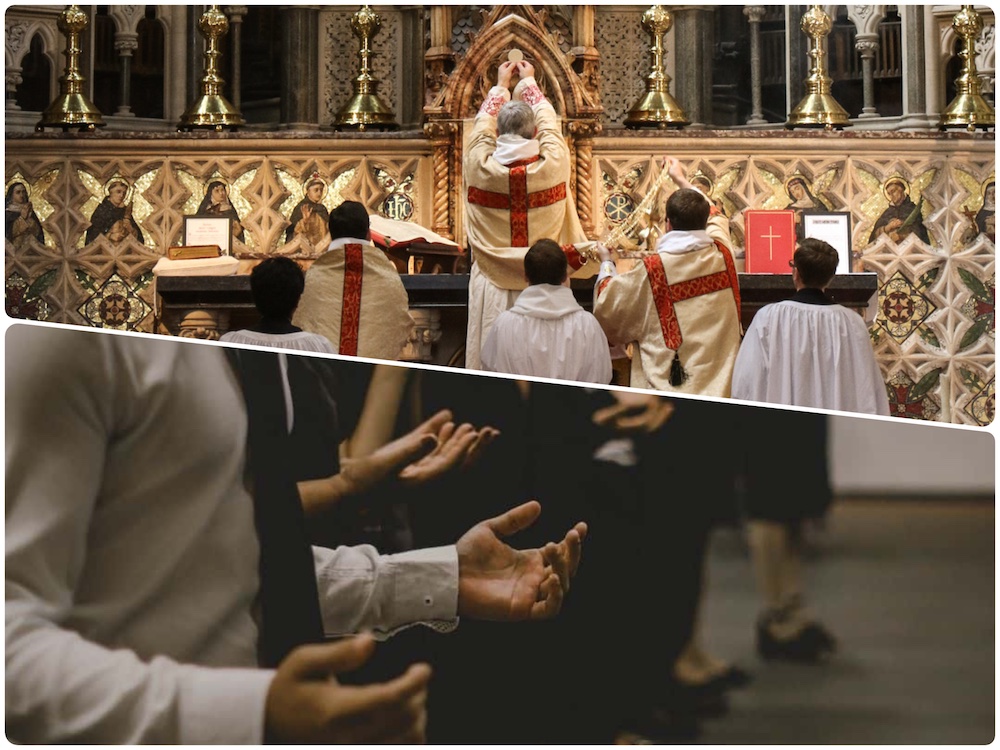

In C.S. Lewis’s The Screwtape Letters, the demon Screwtape’s letters to his nephew on how best to draw a human away from God often focus on the physical nature of humanity. When speaking on the topic of prayer, Screwtape writes: “…they constantly forget, what you must always remember, that they are animals and that whatever their bodies do affects their souls.” This wisdom applies not only to prayer but to every aspect of faith, including worship.
The theology and practice of physicality reveals implicit beliefs about human nature, namely whether humans are primarily spiritual beings or a balance of both physical and spiritual. Denominations with little or no physicality in worship edge towards Gnostic and hyper-rationalist ideas about humans as primarily mind or spirit, rather than body. Denominations that use physicality as a means of guiding and perceiving the spiritual are embracing humanity as both physical and spiritual at once.
While worship is inherently physical no matter the denomination, various sects of Christianity practice that physicality differently.
Churches from the Reformed tradition, which includes some Baptist and nondenominational churches, are often the least physically involved. Other than standing for worship music and walking to receive communion, most of the service leaves congregants seated and silent. Prayer is often spoken to the congregant rather than participated in by the congregant; eyes are fixed solely upon unmoving text rather than vestments or sacred vessels. In many ways, the body passively receives the service rather than actively participates.
Contrast this with more charismatic churches. While the basic structure of services often run parallel to Reformed services, congregants tend to be much more active, jumping and dancing in worship. Some churches also allow congregants to give testimonies, prophesy during the service, and speak in tongues. Congregants still receive teaching by means of a sermon, but also participate physically in a meaningful way. This participation is often emotional and claims to be Spirit-led rather than dictated by the predetermined rules or structures of a liturgy.
Liturgical churches, from Orthodoxy to Catholicism to parts of mainline Protestantism, are physically participatory in different ways. The most traditional and liturgical churches lean fully into physicality; in fact, the more liturgical a church, the more it engages the senses. For instance, only the most traditional of services use incense, making them the sole services which invoke our sense of smell (unless your neighbor happens to not have bathed).
Liturgy involves the body in a myriad of ways. Most liturgical churches have periods of kneeling, especially around corporate confession and the blessing and receiving of Holy Communion. The Catholic corporate confession of sin during Mass involves parishioners pounding their chest with a fist as they proclaim their sins. Different traditions embed various rituals into services, from crossing oneself to bowing. Liturgy also has a call-and-response format for prayers and the reading of scripture, requiring congregants to follow along in real time.
In addition to the physical norms, habits, and customs of each service, the structure of service reveals theological emphases and affects its physicality. Reformed, Baptist, and nondenominational churches historically focus upon proclamation of the Word. The entire service leads up to and prepares the heart and mind for the sermon. While Pentecostal churches share this focus, much of their service includes physical participation in spiritual gifts such as tongues and prophecies. In contrast, the climax of many liturgical services is the physical act of partaking in Holy Communion.
Even certain theological beliefs link to physicality. The theology of Holy Communion serves as a prime example. The memorialist view, held chiefly by Baptist and nondenominational churches, sees Communion as primarily intellectual – a time of remembrance with the bread and wine as physical symbols only. Reformed theology maintains a similarly uninterested view in the physical aspect of the bread and wine, while shifting the focus to spiritual feeding that has sacramental power. Lutherans, Catholics, Orthodox, and some Anglicans view the physicality of the elements as theologically important. To these traditions, it is vital that one feeds on Christ, not just spiritually, but physically.
In both theology and practice, then, Pentecostal and liturgical churches emphasize physicality more than Reformed and Baptist traditions. Of course, generalization is unavoidable. A highly traditional Reformed church or a charismatic nondenominational church might indeed value physicality more than a casual, low-church Anglican congregation.
While certainly not Gnostic in actual doctrine, a Christian tradition that deemphasizes the physical in theology and practice shows similarity to the Gnostic value of spirit over flesh. This contradicts the high view of human physicality shown in the Bible. Biblical descriptions of emotion are innately physical. Exodus describes God’s anger as “burning at the nose.” When the Bible describes Jesus as having compassion, it uses a word that literally means that his “bowels were moved” with pity. Biblical figures feeling intense emotions of contrition, gratitude, joy, anger, or fear do not simply stand still and feel; they rend garments, dance, and tremble.
Given this high view of physicality from the Bible, theology and practice should therefore echo it, not belie it. Pastors and theologians should carefully consider how to guide both doctrine and practice to conform to it.
Miranda Mobley serves at The Falls Church Anglican in the Fellows program, a 9-month spiritual formation and leadership program. Raised in a nondenominational Christian background, she is passionate about ecumenism and loves learning about Christian denominations.
More from IRD:
Who Turned the Lights Off in American Churches?
The Transformation of Christian Worship




Comment by David on December 19, 2025 at 7:54 am
Going to church could be physically demanding as they were not heated until the 19th century and not even commonly provided with seating until perhaps the 17th century. A painting by Pieter Bruegel the Elder from 1559 shows people leaving church carrying the chairs they had brought to the service.
https://upload.wikimedia.org/wikipedia/commons/1/1a/Pieter_Bruegel_d._%C3%84._066.jpg
Comment by David Gingrich on December 23, 2025 at 7:48 am
Was Miranda hard-up for something to write about this week. Should Christians be arguing about this?