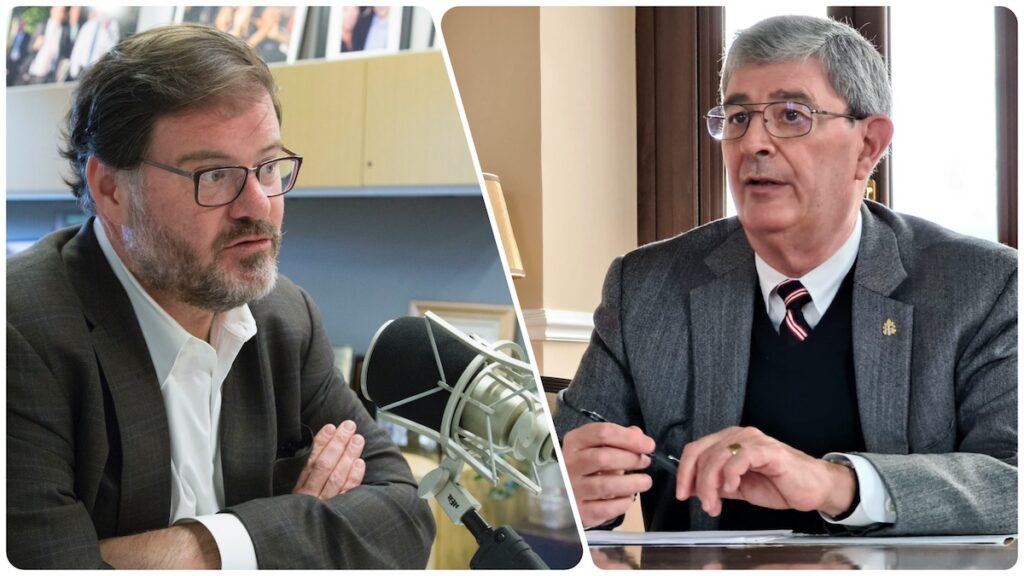

George Weigel’s recent conversation with The Dispatch’s Jonah Goldberg offers a sweeping diagnosis of Catholicism’s internal debates and its relationship to liberal democracy. His central claim is that Catholicism is not merely compatible with democracy but foundational to it, and that the erosion of truth and virtue, what he calls decadence, threatens both Church and policy alike.
Weigel begins with the state of the Catholic Church, insisting that Catholicism in the United States is in “relatively good shape” compared to the collapsing Catholic life in Germany, France, and Belgium. He attributes this decline to the loss of distinct moral and doctrinal identity, as religious communities in those countries attempted to imitate the surrounding culture. By contrast, he argues, churches flourish when they maintain a clear sense of identity as a countercultural proposal. Those that conform to the zeitgeist, he warns, “wither and die.”
His sharpest critique is directed at young “TradCats,” who romanticize a false preconciliar past and blame Vatican II for every perceived decline. For Weigel, the authoritative interpretation of Vatican II lies with John Paul II and Benedict XVI, both of whom embodied its vision. In short, the vitality of the Church rises or falls on the question of identity, and this question is inseparable from contemporary debates about whether Christianity should remain culturally distinct or be politically established.
Building on this theme, Weigel turns to the Church’s relationship with liberal democracy. Integralism, he argues, is a niche distraction or “intellectual game playing” with little relevance to most Catholics. Vatican II’s Declaration on Religious Freedom decisively rejected state establishment, affirming that Caesar has “no place” in the realm of conscience where people encounter God.
As Weigel memorably put it, “there are spheres of human life in which the state — whether that’s Tiberius Caesar or Donald Trump or all the points in between — simply has no competence.” To claim otherwise, he warned, “is to take the first step down the road to totalitarianism.” This rejection of state‑aligned religion directly challenges contemporary movements such as integralism, post‑liberalism, and identity politics that advocate for a confessional state.
This principle, Weigel insists, was not a concession to modern liberalism but a recovery of deep Catholic and biblical tradition: faith must be free, and Caesar’s reach is inherently limited. He stated the principle in general terms: “the state is incompetent in theological matters.” To drive the point home, he added a sharp analogy: “I mean the guys who still can’t fix exit 43 on the Beltway, I do not want them making theological judgments. Come on, they can’t even do the fundamental stuff.” In other words, the state can not and should not generate the moral and theological premises upon which freedom depends.
It is here that Weigel introduces his most urgent warning: decadence and democracy cannot coexist indefinitely. Democracy requires a cultural foundation where a nation’s citizens are formed in a shared virtue. The liberal state depends on premises it cannot generate itself, such as the dignity of the human person. Without these, democracy collapses into relativism, where arguments are settled by power alone, what Benedict XVI called the “dictatorship of relativism.” History offers sobering confirmation. The Weimar Republic, intoxicated by cultural experimentation and political fragmentation, proved unable to sustain democratic order and gave way to totalitarianism. The late Roman Empire, consumed by luxury and the erosion of civic virtue, collapsed under the weight of its own decadence as much as external invasion. Even in more recent times, societies that embraced “everything goes” relativism, such as the moral disintegration of post‑revolutionary Portugal in the 1970s or the cultural exhaustion of late twentieth‑century Spain, saw democratic institutions falter until virtue and stability were restored. In each case, following the spirit of the age without grounding in transcendent truth led not to renewal but to ruin.
This warning about decadence naturally leads into Weigel’s concern about anti‑Semitism. For him, the rise of anti‑Semitism is the infallible indicator of cultural disease. He calls the Judeo‑Christian tradition a “divinely mandated entanglement,” insisting that Catholicism makes no sense without its roots in Israel. Vatican II’s Nostra Aetate explicitly rejected supersessionism, affirming the enduring covenant with the Jewish people. Yet anti‑Semitism is resurging, amplified through the many voices of those with large social media platforms. In response, Weigel argues that certain voices should be shunned as outside the bounds of reasonable conversation. Bishops, he suggests, may even need to initiate heresy investigations against Catholics who promote anti‑Semitic claims, since “anti‑Semitism is a grave sin.” In Weigel’s view, anti‑Semitism reveals a deeper collapse of virtue, which undermines the cultural foundations necessary for democratic order.
That same failure of memory, Weigel insists, also shapes his sharp criticism of young traditional Catholics. In his view, they have bought into a romanticized and false picture of the preconciliar Church, and they blame everything they dislike in Catholicism today on Vatican II. He argues that few have ever wrestled with the Council’s texts themselves, relying instead on sound bites picked up from social media. He warns that this misleads the young with radical claims and ignores the authoritative interpretation of Vatican II offered by John Paul II and Benedict XVI, both of whom were present at the Council. For Weigel, this ignorance is damaging, since it obscures the real issue: the dilemma that liberal democracy depends on moral and theological premises it cannot generate on its own.
Sewn together, these threads form a coherent warning. Weigel’s conversation with Goldberg serves as a rebuke to both integralists and relativists. Integralists err in imagining that the Church can be secured by state power, while relativists err in imagining that the state can survive without truth. Both miss the deeper reality: Christianity and liberal democracy are historically entangled, and the survival of the state depends on the remembrance of that fact. While the term “Christian nationalism” is never used, the entire conversation implicitly explores the tension between classical liberal principles such as limited government and religious freedom, and contemporary movements such as integralism, post‑liberalism, and identity politics that advocate for a state aligned with specific Christian doctrines. Weigel’s warning about decadence underscores the danger of a state that forgets its theological foundations, whether by dissolving into relativism or by wielding religion as mere political power.
The conclusion is obvious. Decadence and the state cannot coexist indefinitely. Ultimately, the endurance of political order depends less on innovation and more on theological memory, on the recognition that the deepest truths of Christianity are the very premises that permit the state to endure. Orthodoxy offers a concrete template. The Cappadocian Fathers proclaimed that faith must be freely embraced to be real, that coerced belief is no belief at all. The Byzantine model of symphonia, though imperfect, established distinct spheres of authority that endured for over a millennium in practice, cementing the principle that without the foundation of a life in Christ Caesar has no competence in matters of conscience. The Orthodox liturgical life, saturated with psalms and prophets, has preserved the virtue entanglement that binds the Church to society. Because democracy rests on truths it cannot produce by itself, it must be sustained by the virtue and theological memory preserved in the life of the Church. As the councils have proclaimed across centuries, the life of the Church is inseparable from the life of society.



Comment by Salvatore Anthony Luiso on December 8, 2025 at 1:16 pm
Thank you for this article. I heartily agree with Weigel that “churches flourish when they maintain a clear sense of identity” as countercultural. I also agree with his point about the importance of truth with respect to politics. “Decadence and the state cannot coexist indefinitely” is a truism. I would add, though: no state can exist indefinitely.
I question the necessity of Christianity for to liberal democracy. Japan has never been a Christian country, and yet it has been a liberal democracy for over seventy years. India has never been a Christian country, and yet it has been the largest democracy in the world for decades, too–although arguable less so or not so since the rise and rule of the BJP.
Compare the United States with the countries of western Europe, Australia, and New Zeland. The United States is commonly considered to be the most religious and the most Christian of them all. Therefore, one might expect it to be the country where liberal democracy is strongest and healthiest. And yet that isn’t so. To the contrary, the rise of illiberalism and authoritarianism in the United States are due in large part to Christians. How is this possible?
It is possible because so many Christians in the United States have rejected truth and virtue, and conformed themselves to the world. Not so much the parts of the world which they call “left”, but the parts which they call “right”.
Lastly, regarding what the author says about Orthodoxy and politics: Have there been any Orthodox countries where liberal democracy has flourished? Have there been any which the author thinks have had a model of superior governance?