Shout for joy to the Lord, all the earth. Worship the Lord with gladness; come before him with joyful songs. (Psalm 100:1-2)
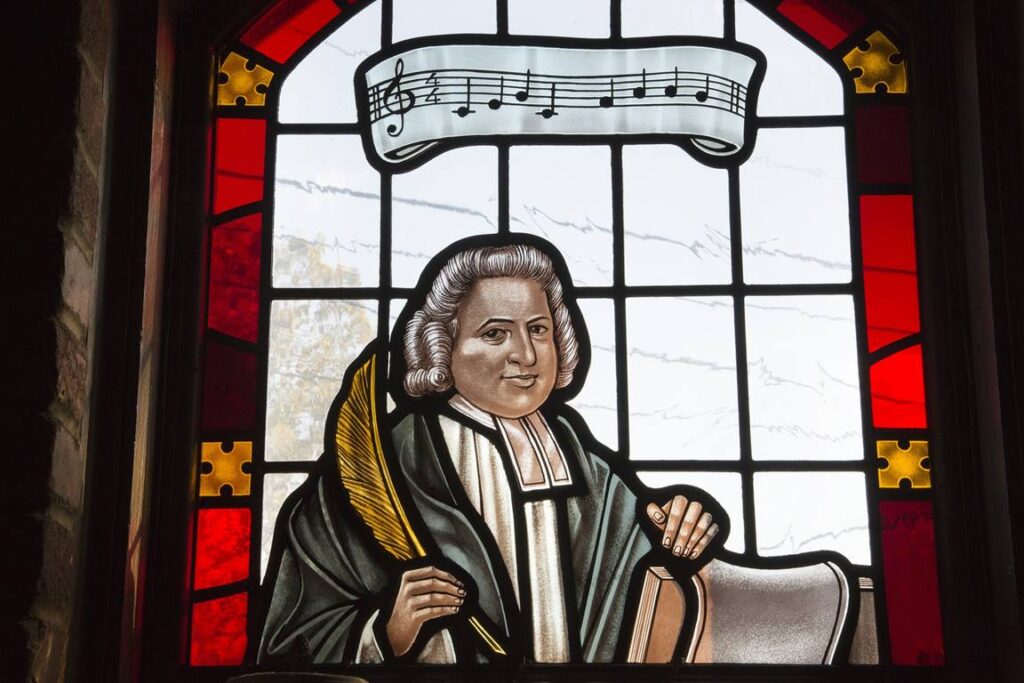
Singing has been part of the Wesleyan movement from its inception. If you read the journals of John and Charles Wesley, you’ll notice how many times they have gatherings—not necessarily church services, but just faithful Christians gathered together—and their meetings ended with a hymn.
Hymns were often sung at Methodist society meetings, times of preaching and hymn singing. And the early Methodists were encouraged to sing hymns at home after attending church services in their local Anglican parish.
Keep in mind that hymn singing was not a regular part of congregational worship until the latter part of the 18th c. In the Church of England, for example, a choir or band might lead the singing of metrical psalms (the book of Psalms was written out in meter just for this and often found at the back of prayer books), but hymns composed outside of the scriptural canon were not regularly used in church services.
The early Methodists were some of the early proponents of hymn singing in English-speaking congregations (we do have some much earlier examples from the broader church such as Luther’s “A Mighty Fortress” or the ancient hymn “Te Deum”) but the hymns of Charles Wesley, Isaac Watts, John Newton, William Cowper, and others set the common use of congregational hymns in motion.
Early American Methodist leaders Francis Asbury and Thomas Coke wrote in 1797, “Few things can be more pleasing to the Lord than a congregation with one heart and one voice, praising His holy name.”
Hymns so often give voice to our Christian witness, to the faithfulness of God, the saving work of Christ, and the experience of believers. And they’re so rich! Just look at the hymn texts of any of the hymn writers I’ve already mentioned and you will find a deep well of poetic theology.
Charles Wesley, for example, should rightly be called an Anglican poetic theologian. He’s in a long line of men and women who used poetry to communicated the depth, the mystery, and the beauty of the Christian faith.
His words also serve as a testimony, and a testimony that we can all share. I’ll leave you with some of his words as a prayer to Christ, a prayer that by grace we can pray, or sing, as we continue to walk with Christ and to be made like him:
I rest upon Thy word,
the promise is for me;
My succour and salvation, Lord,
shall surely come from Thee.
But let me still abide,
nor from my hope remove,
Till thou my patient spirit guide
into Thy perfect love.




Comment by David on October 27, 2025 at 1:58 pm
My favorite hymn from the Methodist Ocean Grove [NJ] Camp Meeting:
A wave is rolling over the land with heavy undertow;
And voices sounding on the strand; the rum saloon shall go.
Shall go, we know, Shall go we know;
A cry is sounding over the land,
The rum saloon shall go.
Comment by David Gingrich on October 28, 2025 at 7:13 am
1 When I survey the wondrous cross
on which the Prince of glory died,
my richest gain I count but loss,
and pour contempt on all my pride.
2 Forbid it, Lord, that I should boast
save in the death of Christ, my God!
All the vain things that charm me most,
I sacrifice them through his blood.
3 See, from his head, his hands, his feet,
sorrow and love flow mingled down.
Did e’er such love and sorrow meet,
or thorns compose so rich a crown?
4 Were the whole realm of nature mine,
that were a present far too small.
Love so amazing, so divine,
demands my soul, my life, my all.
Comment by Alan Beuscher on October 29, 2025 at 1:33 pm
Thank you Ryan for reminding us all again that we as Wesleyans are a people of One Book and many supporting hymns – praise God! As many around the world will again prepare for a Wesley New Year’s Covenant Prayer Service, just wanted to get word out that there is now a beautiful way to sing Wesley’s prayer too. Here is a link to the Asbury Seminary Student Worship Band recently presenting this original piece…
https://youtu.be/_jUt6wmumvM?si=WRPbV27s20OoibE-