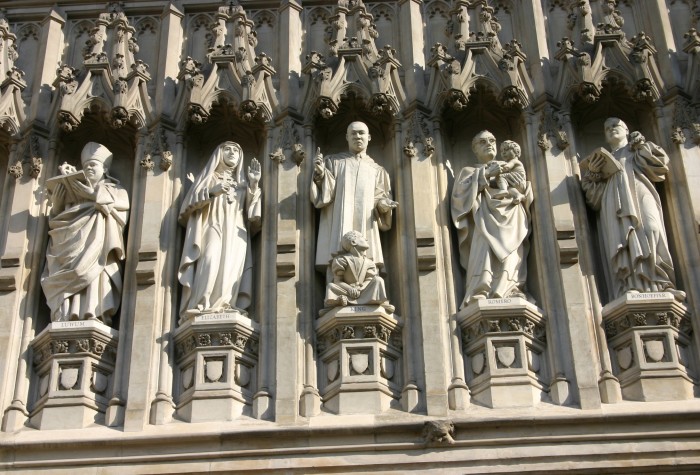

Here in the United States, we have witnessed high-profile murders of fellow Christians. The 2023 Covenant School shooting in Nashville, the recent Annunciation Catholic Church shooting in Minneapolis, and the assassination of Charlie Kirk at Utah Valley University have been brought to the forefront of our hearts, minds, and prayers. Across the nation, Christians of all stripes–including pastors and other Christian leaders–have started to use the “M” word to identify these victims: martyrs.
And, of course, there’s been pushback. While these recent casualties are brethren in Christ, do they qualify for the veneration Christians typically grant martyrs? While we in the Protestant world often lack official institutions and mechanisms for adjudicating such matters, we do recognize martyrs, including those slain in the Protestant Reformations or on the foreign mission field. Do the victims of Nashville, Minneapolis, and Utah fit into this category of honor? What is owed them?
While some of us might be incensed at this skepticism, caution over labeling the killings of Christians as martyrdom is warranted. For one thing, Christians can die in battle or be murdered for reasons having nothing to do with their own confession of faith. A soldier going to war or the victim in a robbery gone wrong aren’t typically martyrs. We can still honor their memory, but martyrdom pivots on something more specific.
And that gets to another important problem: the category for martyrdom has extended in the popular imagination to include all sorts of non-Christians. Many political and social leaders have been assassinated for their stances which may or may not spring from Christian commitments. And the high-profile killings of these leaders ignites a reaction, often fulfilling the dreams and purposes of these slain leaders. Thus we find people talking of martyrs for democracy and human rights. But this is not Christian martyrdom.
In the original Christian sense, a martyr is a Christian who witnesses to Christ in his death at the hands of persecutors. “Martyr” simply means “witness.” The first martyr was St. Stephen the deacon, whose boldness in evangelizing and contending for the faith against nonbelievers cost him his life. The reason that the martyr finds his own life in peril is because of his call to Christian faithfulness. Rather than retract their profession of Christian faith in apostasy or shirk their Christian duty, martyrs sacrifice their lives in the name of Christ. The martyr thus wins the “crown of life” as revealed in James 1:12 and Revelation 2:10. In the liturgy of the heavenly Temple, the martyrs have a unique roll of crying out for judgment as recorded in Revelation 6:9-11–their innocent blood cries out for divine vengeance, which is a theme reaching all the way back to the death–martyrdom?–of righteous Abel (cf. Matthew 23:35, Luke 11:51). And of course we know from history that martyrs inspire all believers to wax bold in the faith, receiving a uniquely high honor and special remembrance from the Christian Church.
But martyrdom is messy. For example, the killers’ motivations might not be clear cut. Some are motivated by vicious racism. The 16th Street Baptist Church bombing and the Charleston church shooting of 2015 come to mind. In those cases, the martyrs were killed by murderers under the influence of deeply sinful error–a hatred that struck out against believers. The killers almost assuredly would not have attacked white-dominated churches. But the victims were killed because they showed up in faith to worship the living God.
Other persecutors are mentally imbalanced (with or without demonic influence). Several houses of worship in America have suffered such attacks. This mental instability can be coupled with anti-Christian bias, as seen in the Sutherland Springs shooting of 2017. Indeed, mass shooters in general often fit a particular profile of mental and spiritual sickness, resulting from sin, especially the curse of the Fall.
Yet others might have simply been violent and killed Christians for being present in the world, particularly the mission field. The Holy Innocents were killed because a homicidal tyrant wished to eliminate a rival claimant to the title “King of the Jews.” Their resemblance to Jesus, particularly in their innocency, cost them their precious lives. St. Boniface and his company were killed by armed robbers. As a friend recently observed, Jim Elliot, Nate Saint, Ed McCully, Peter Fleming, and Roger Youderian were speared to death because the Waorani were violent and hostile to outsiders. The martyrs of “Operation Auca” didn’t get the chance to speak about Jesus. But they were killed because they answered the call of God to the mission field of Ecuador, heeding the Savior’s Great Commission.
To top it all off, not only can a persecutor’s motivations be confused or mixed, but so also can the martyr’s. Oftentimes, religious and political motivations intertwine on the part of the victim. Church history is littered with martyred saints who were implicit in or reacting against things like imperialism, national independence, claims of papal supremacy, and colonialization. Complicating things more are “tribal” martyrs. Was St. Joan of Arc a martyr? Bishop Thomas a Becket? Sir Thomas More? The Oxford Martyrs? They had views of the nation, royal supremacy, clerical immunity to criminal charges, and so forth that plenty of biblical Christians take exception to. As an Anglican, I see Nicholas Ridley, Hugh Latimer, and Thomas Cranmer as heroic martyrs. A Roman Catholic? Not so much. Church history is chock full of similar examples.
Sadly, many Americans toil under a naive historiography, and so they demand martyrs purged of political entanglements. I do not know what to label this impulse–call it pietistic, Radical, or what have you. But, in this view, true martyrs and even true persecutors must be sterilized of political controversy.
This sanitized historiography can combine with a particular rhetorical habit of many evangelicals and Mainliners in the United States. They love to scold their fellow Christians over their prosperity, ease, oversensitivity, and sense of self-entitlement. There’s a certain kind of preacher that thrives on castigating their fellow American Christians for being spoiled and for dishonorably fostering a “martyrdom complex.” Any time an American Christian complains about an infringement of their rights or various moral outrages foisted upon the public, the reply is always the same: “You have nothing to complain about. Christians get killed in XYZ country.”
This brings us to our current question. Were the victims of Nashville, Minneapolis, and Utah martyrs? It certainly challenges the “real persecution doesn’t happen here” trope, doesn’t it? In all three of these stories, we find a theme of what I think is religious or spiritual violence. The killers, while fitting the profile of a public shooter, worked from a radical pro-LGBT worldview, particularly of the noxious “Protect Trans” variety. In this worldview, the worst villains are conservative Christians. And they become the target of lethal violence. At the very heart of this is actually a hatred of God–a hatred of Christ.
In light of this, I think it’s clear that the victims of the Covenant and Annunciation shootings qualify as martyrs. They were targeted because they were Christians, and the shooters hated Christ, so anyone bearing His name and looking like Him was placed in the crosshairs, no matter how helpless.
The Charlie Kirk assassination is much more controversial. Because of his political activism, somehow venerating him as a Christian martyr is perceived as the work of political hacks. Now, there is a real danger here. Too many people cannot seem to delineate between the City of God and the City of Man. They have grown deeply partisan and untethered from a strong confessional identity of theological and moral orthodoxy.
The complaints over this seem strongest in the “orthodox but liberal” crowd. For one thing, they neglect that Charlie Kirk changed over time, growing from a brash bachelor who possibly embodied the “post-Religious Right” to a married family man urging his audience to convert to Christ, get married, raise children, and go to Church. For another, American Christians have seen and heard politicians, service personnel, nextdoor neighbors, and friends celebrate the death of a Christian brother, often summarized with the logic of “he had it coming.” And the ire there isn’t necessarily directed toward things that Kirk said or held to that Christians can disagree on. It’s often against Christian essentials regarding morals and the exclusivity of Christ for salvation. Indeed, it is especially chilling to consider that Kirk was publicly shot while arguing against the problems of the transgender community, all by a man deeply corrupted by digital perversion.
My concern for the “orthodox but liberal” crowd is that their leftist political commitments are a lot stronger than they probably realize. Their distaste for MAGA is so severe that it keeps them from joining in with Christians, identifying persecutors of the Church, and sufficiently honoring a slain brother in Christ. It’s all permanence, catholicity, and solidarity until a low-brow rightwing believer shows up.
And I think the problem of naïve church historiography plays a role. Political concerns will always be entwined with religious or spiritual. We so often try to strip martyrdom of political dimensions, but this fails even the test of the New Testament. As a colleague of mine, Fr. Richard Tarsitano, pointed out in a recent sermon,
“Jesus, by declaring Himself the Messiah, the new Davidic King of Israel, was making a theological statement which carried with it gigantic political ramifications for Judah and the Roman Empire. We see this reality in the words Pontius Pilate wrote over the crucified Jesus: “The King of the Jews”. Every Christian evangelist who followed Him brought Christianity to barbarous peoples who sacrificed humans to their demon gods, and with the Gospel, they brought a peace which cannot help but change a commonwealth, nation, a people. I believe we must look at the totality of Mr. Kirk’s work and see a man who helped bring thousands of young people to trust in Christ and was killed for that effort, and so it is appropriate to mourn Kirk as a martyr.”
I agree with Fr. Tarsitano. As another colleague observed, Kirk was indeed a Christian, and he saw his social advocacy as an outgrowth of that. As such, I personally think Kirk really and truly is an American martyr, joining the ranks of other precious souls whose innocent blood has been spilt on our soil for the sake of the true faith.
How we respond to such martyrdom is a different and very important question altogether. May it include the godly example of St. Stephen, who, when stoned by his opponents, saw the enthroned King of Kings, entrusted his spirit to God, and cried out, “Lord, lay not this sin to their charge.”


Comment by David on September 23, 2025 at 9:05 am
We are fortunate to have freedom of speech, at least for the moment, in this country. In other developed countries, wearing a Nazi uniform or discoursing Nazism can result in serious legal penalties. This is not the case in the US where speech, even of the hateful sort, is allowed. No person should be subject to physical attack or murder for what they say.
I never heard of Kirk until his murder. Since then, various quotes of his have come to my attention which are reprehensible. He apparently felt Blacks were better off under Jim Crow and spoke disparagingly of the Civil Rights Movement. He mentioned Jewish conspiracies to the detriment of whites, though he became a supporter of Israel. He view immigrants adversely. All these were the .positions of the KKK in the 1920s, nearly a century ago. It seems hate never dies.
Comment by Corvus Corax on September 23, 2025 at 12:06 pm
“He apparently felt Blacks were better off under Jim Crow and spoke disparagingly of the Civil Rights Movement. He mentioned Jewish conspiracies to the detriment of whites, though he became a supporter of Israel. He view immigrants adversely. All these were the .positions of the KKK in the 1920s, nearly a century ago. It seems hate never dies.”
Good grief.
Comment by Salvatore Anthony Luiso on September 23, 2025 at 12:56 pm
Regarding “And the ire there isn’t necessarily directed toward things that Kirk said or held to that Christians can disagree on”: But in many cases, it is. For example, Kirk’s remarks related to race, racism, slavery, and civil rights. And it wasn’t just what he said, but how he said it.
I agree with the author that Kirk changed for the better in the last several years, but he was still saying things which were not just offensive, but gratuitously offensive. Such as when he joked about the assault on Paul Pelosi and the absurd rumor that the assailant and Pelosi had a homosexual relationship, He mentioned the idea that “some amazing patriot” could post bail for the assailant and ask him questions to learn if the rumor was true. Note that Kirk did that less than three years ago: after he had married and after he had become religious.
Did he ever apologize for that, or for any of the things he said which were gratuitously offensive?
The sad fact is that his gratuitously offensive remarks are not just a reason why many people disliked him, but why many others–including Christians–liked him.
There are other Christians who promote morals and ethics publicly and do so consistently with love and gentleness, allowing only the truth to offend. If one of them were shot and killed for that, it would be clear to me that he is a martyr.
But, with all due respect, Kirk wasn’t like that. He did not deserve to be killed, but it wasn’t just his Christian beliefs which provoked others to dislike him and regard him as hateful. So, for me, it’s not clear that he’s a martyr for the faith.
Comment by Jadon on September 23, 2025 at 1:52 pm
From my view it seems that those whose martyrdom is not up for debate were largely socio-religious minorities and killed by state sanctioned violence. Of course neither are true in the case of Mr. Kirk. I think he was assassinated because he was a well-known political character whose advocacy was motivated by his faith. I don’t think he was a martyr however, anymore than JFK. It does feel like semantics at a certain point, but I do think it matters.
Comment by Wilson R. on September 23, 2025 at 1:57 pm
I work not far from the Covenant School. From my office window I can see the spire of the church on their campus. The Baptist church that was used as a gathering place for families is within walking distance. We all remember the horror and pain from that day.
But I don’t know that I would classify the 3 children and 3 adults who died as martyrs to the faith, primarily because it’s not clear that religion had anything to do with the shooter’s motivation. The shooter had an unhappy history with this particular school and was emotionally troubled and angry.
None of the political leaders of either party tried to suggest that the Covenant victims were religious martyrs. In fact, none of the Republican leaders (governor, two senators, US House members or state reps) even bothered to show up at a community vigil the day after the shooting. And we all knew why: They didn’t want to face questions about the proliferation of guns, particularly how the question of how an individual with a diagnosis of mental illness was able to legally obtain an arsenal used to kill kids.
Comment by Qohelet on September 23, 2025 at 3:17 pm
It’s interesting the mental calisthenics the author goes through to make this somehow about transgender people. An odd obsession for a self proclaimed Christian, since Scripture says nothing against transgender people and transgender people are rarely associated with violence. In fact I think the author picked the three cases that did involve trans people or those who cared about them and ignored the dozens of other cases.
It’s amazing to me that he thinks he can take three mass shootings out of the broader context of mass shootings in this country and somehow claim that these are the relevant ones in question for determining martyrdom. What about Uvalde, Sandy Hook, Tops Supermarket Buffalo, Las Vegas, Columbine, Wal-Mart San Antonio, New Orleans, the United Healthcare guy, the most recent NY shooting? They weren’t about Christianity so they don’t count? They didn’t involve a trans person so they don’t count?
Of course they’re about Christianity. We worship another God in this country, the second amendment. Jesus tells us to beat our swords into plowshares, but American Evangelicals are silent as second graders get mowed down with AR-15s.
All of these people, including Charlie Kirk, are martyrs. We can wash our hands of it all we want but until we make it difficult for a person with murderous thoughts to acquire a firearm, we are collectively guilty.
Comment by Wilson R. on September 23, 2025 at 4:39 pm
Well, since you brought it up, it’s interesting that the author neglected to mention the victims at the Mother Emanuel AME Church in Charleston, who were engaged in Bible study and guilelessly invited a stranger to join them when they were murdered.
Comment by Gary Bebop on September 23, 2025 at 5:29 pm
It’s indisputable that the assassin of Charlie Kirk wanted to erase his witness, his efficacy as an influencer of young people, and his devotion to the transformative power of staying in conversation with people. There may be other motivations for Kirk’s killer, but silencing Kirk’s voice was the main driver. Jesus warned his own disciples this is the way it would be. And from the Apostle Peter: “do not be surprised at the fiery ordeal that is taking place among you . . . “
Comment by Qohelet on September 23, 2025 at 6:52 pm
Wilson to his credit he did mention the Charleston shooting. It’s in the same paragraph as the 16th st Baptist church and he calls both groups of victims martyrs.
Comment by Thomas on September 23, 2025 at 9:33 pm
Charlie Kirk went from a moderate to a n hardline conservative in recent years. I agreed with him on his strong pro-life views and opposition to the LGBT agenda, but even for many conservatives its shocking that he once claimed that public execution should return and children allowed to watch them. He had also become close to Christian nationalism. I don`t think for the United States the solution is Christian nationalism, which was already criticized at IRD. He certainly was a person who was willing to argue with everyone and is death is a tragedy, but I have many doubts that its more for political than religious reasons that he was killed. Eria Kirk, his widow, is a Roman Catholic, will now lead Turning Point USA, hopefully she will bring a more moderate leadership to it.
Comment by Gary Bebop on September 23, 2025 at 10:30 pm
Too many commenters imagine themselves profound if they waffle and hedge and dodge taking a stand. That’s not courage. But it’s the way this generation expresses itself.
Comment by Glenn Wheeler on September 24, 2025 at 12:26 am
There seems to be something uniquely American about concentrating so much on the death of one person, as if that is the only person who has died over the past days.
Have not those who have died in your proxy war against Russia not also died martyrs’ deaths? Have not those who have died in your ethnic cleansing of Gaza not also died martyrs’ deaths? Maybe not as martyrs to Christianity but certainly as martyrs to neocolonialism. What about the Afghans, the Iraquis, the Libyans, et. al.? Are not all those deaths every bit as much a tragedy as Kirk’s death? Yet you lose not one wink of sleep over them.
It’s really bizarre.
Comment by Robert Lloyd Russell on September 24, 2025 at 7:51 am
Now you can read the transcribed words of Jim Elliot’s spoken messages which he gave before leaving to the mission field! “JIM ELLIOT: Recorded Messages” (available in print, eBook, and Apple audio).
Comment by Td on September 24, 2025 at 10:19 am
Thank you for bringing this topic to attention. Far too many Americans are blind to the escalating violence, and murders, occurring towards christians.
Comment by Qohelet on September 24, 2025 at 11:31 am
That’s the point Td. They’re only occurring “towards Christians” if the only ones you care about are the ones that happen towards Christians. They’re occurring towards literally everyone.