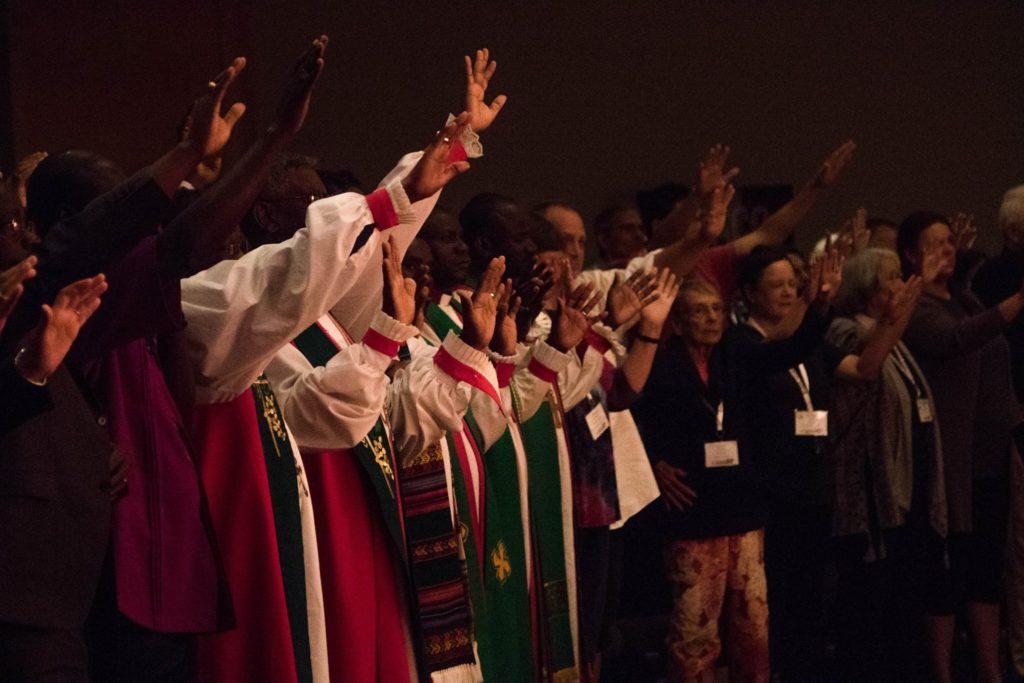
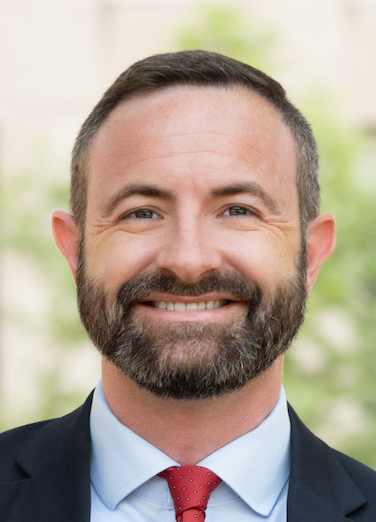
This week I’m outside of Asheville, North Carolina for a series of conferences centered around Anglican global missions. Anglicanism is the third largest Christian community globally, and Anglican Christians are now found in more than 42 national churches spread across 165 countries. While an admittedly small presence in the United States, Anglicans now count nearly 100 million adherents, more than doubling in the past 50 years, the vast majority of whom are in the global south.
New Wineskins for Global Mission is a national gathering of Anglicans sponsored by the New Wineskins Missionary Network (founded three decades ago as the Episcopal Church Missionary Community) that takes place every three years. Despite having no governance component (as a denominational convention would have) and no widely recognizable headline speakers, New Wineskins is among the more consequential gatherings that I cover for IRD. Why? One clergy friend jokingly termed it “Anglican fruit salad”: nearly everyone is here, including mission agencies, relief and development groups, seminaries, clergy and laity.
The conference is expected to draw more than 1,500 registrants to the mountains of western North Carolina, along with a parallel youth event and pre-conferences hosted by various Anglican ministry groups, including Anglican Frontier Missions (AFM), the sending agency that I serve on the board of. We’re hearing from Bishop Yassir Eric, the first bishop of EKKIOS, an Anglican diocese initiated by the Global Anglican Future Conference to reach and minister amongst Muslim-background believers.
Bishop Eric was raised in a conservative religious family in Sudan and, after becoming a Christian, was jailed in solitary confinement. Upon his release, he unexpectedly encountered a Christian who helped him before knowing anything about his conversion.
While not necessarily as dramatic as Bishop Eric’s meeting, those unplanned “God appointments” are among the things that New Wineskins Executive Director Jenny Noyes notes the conference has become known for. At AFM, we encourage prospective “cross cultural workers” to consider their calling to the mission field by visiting here. After three decades, we’ve seen good fruit from the conversations that take place, some in the labyrinthine line entering the dining hall or between conference sessions at the coffee counter.
For “senders” like me, the conference gives a more reliable sense of what is taking place “on the ground” in the wider Anglican Communion – in a way that online conversations cannot. At my pre-conference session Monday, I’ve been given updates on work underway in places like Tunisia, Nepal, and Indonesia, among others. Scotland and Wales are also mission fields with great need and opening doors.
Like many, I see the world from my front porch, which affords an admittedly limited viewpoint. In learning about the growth of churches in Nepal, or amongst Muslim-background Farsi or Fulani language speakers, I can see that the unfolding of God’s plan – and the challenges in spreading the gospel – are further reaching than what I view in my own local context.
Please pray for each of us gathered outside of Asheville this week: not only that the conference will be a success, but also that our eyes and ears will be open to the ways that God’s prevenient grace is moving ahead of us on the mission field. The God who can reach people like Bishop Yassir Eric is indeed full of surprises.
More from IRD:
‘Embrace Risk for God’s Glory’: Amidst Global Persecution, Anglicans Mark Spread of Mission



Comment by Tim Mc on September 16, 2025 at 8:35 am
2 Timothy 3:16 but when a man turns to the Lord the veil is removed.
This is my prayer for all of you.
Comment by Qohelet on September 16, 2025 at 9:37 am
Anglicanism is not a small presence in the US. There are more than 1,500,000 Episcopalians here.
Comment by Jeffrey Walton on September 16, 2025 at 10:59 am
Qohelet, indeed Episcopalians are Anglicans (and I include them here) but that’s a small percentage of the U.S. population (less than half a percent) relative to other groups.
Comment by Qohelet on September 16, 2025 at 2:57 pm
Jeffrey that’s fair.
That’s about the same as the Greek Orthodox church in the US, and a bit more than Jehovah’s Witnesses, American Baptist, PCUSA, or the Churches of Christ. That said, all of these churches have regions of the US where they’re locally very important.