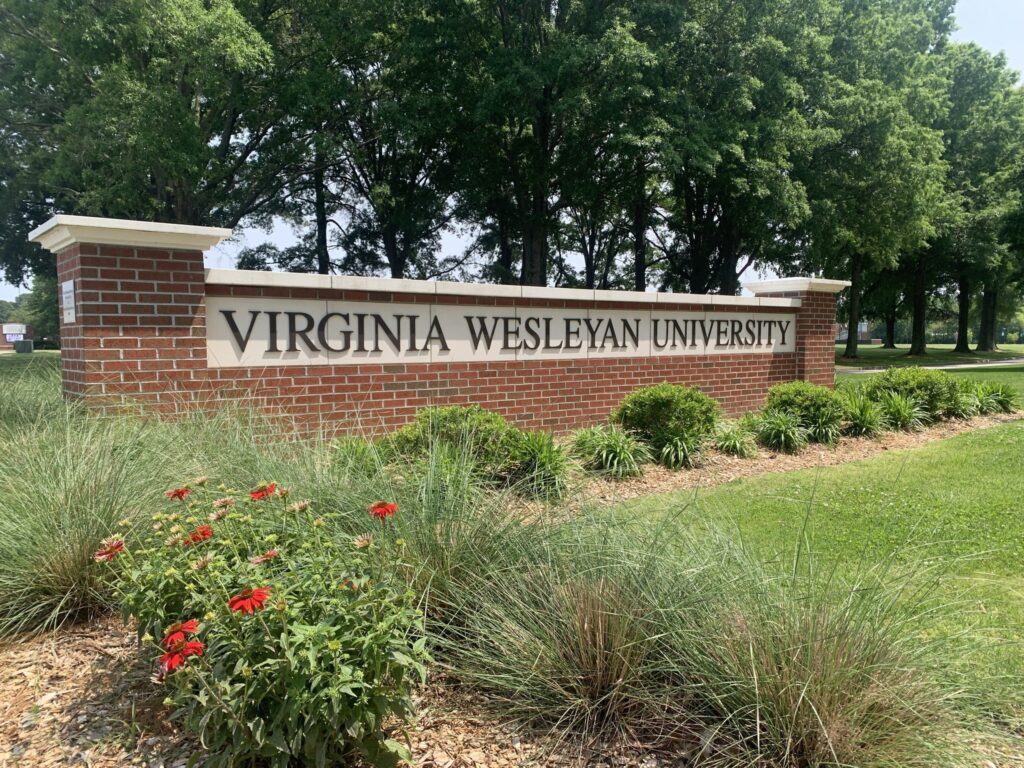
Virginia Wesleyan University is changing its name, deleting “Wesleyan” in favor of honoring a currently living large donor. It will remain associated with the United Methodist Church Virginia Conference, which is endorsing the name change. But the school’s ties are increasingly irrelevant, which explains the name change. The church’s implicitly endorsing the name change just further illustrates Mainline Protestant and United Methodist resignation to their cultural, demographic and ultimately institutional demise.
Some alumni are protesting but likely to little effect.
Interestingly, Virginia Wesleyan was only founded in the 1960s, in Virginia Beach, by a United Methodist pastor. It is one of the more recent Methodist founded schools, of which there are over 100, although declining in number. Few if any of these colleges and universities highly esteem Christianity in their curriculum. Many were founded in the 19th century when Methodism was surging and anxious to educate the country’s middle class in an optimistic Wesleyan ethos.
Methodism’s theological heterodoxy, and its pride in giving the schools autonomy, meant that by mid-20th century few of the Methodist schools prioritized Christian education or church ties. Some of the schools had become prominent and wealthy without regard to the church, such as Boston University, Emory University, Southern Methodist University, Northwestern University, among others. Smaller schools still value the church ties because the churches have provided a reliable stream of students, especially the children of clergy, who often got church scholarships.
This was certainly true of Virginia Wesleyan. I first began attending the Virginia Annual Conference in the 1980s and did so for several decades. The president of Virginia Wesleyan and other United Methodist related schools in Virginia always gave appreciative speeches to the conference of clergy and laity. The school presidents often were elected as delegates to the quadrennial governing United Methodist General Conference. They were typically theological liberals who affirmed the denomination’s overall direction.
The church presence at these schools was typically confined to a United Methodist chaplain, and United Methodist campus ministry, and several board members appointed by the bishop. In the 1990s, the board member of one of these Virginia schools approached me looking for potential United Methodist board candidates, saying the bishop-appointed board members often lacked “gravitas.” It seemed that these appointments were honors typically given to institutional loyalists and not necessarily to Methodist stalwarts interested in maintaining a meaningful Methodist ethos on the campuses.
My pastor of many years who attended a Methodist college in Virginia in the 1950s claimed to me that students hosted regularly scheduled orgies in a campus building when he was there. That story may have just been salacious campus gossip. But it reflected his view, even 70 years ago, that Methodist teachings and standards were not serious considerations at increasingly secular schools.
Many of these schools over the decades, especially if financially comfortable, put increasing distance between themselves and the church. They often insisted that Methodism was just a tradition from which they emerged, that they still respected, but no longer meaningfully were bound to it. After the special 2019 General Conference reaffirmed United Methodism’s traditional stance on sexuality, several United Methodist schools officially disavowed their formal ties to the denomination. The largest among them was Southern Methodist University in Dallas, which also hosts Perkins School of Theology, one of United Methodism’s 13 official seminaries.
United Methodism’s Southwest Central Jurisdiction legally challenged Southern Methodist University’s separation. In June, the Texas Supreme Court ruled that the church may continue with its challenge. “SMU remains proud of its Methodist heritage as we move forward with advancing SMU’s mission and providing enriching education for all students,” a school spokesperson then said. What does pride in “Methodist heritage” mean? Two United Methodist bishops said: “Our desire is to see this matter brought to a peaceful resolution so that our historic connection to the university can be fruitfully maintained for future generations.” But what does this “historic connection” to the church actually mean if the school is not meaningfully Christian or Methodist?
Back in 2019, Southern Methodist University’s president explained that the school was disavowing the church “so that we can continue to educate everybody from all Methodist denominations and from other denominations, and people who don’t believe at all.” But, of course, its United Methodist affiliation had never prevented it from largely doing whatever it wanted to do. And of course, since the denomination, after its schism, has itself disavowed traditional sexual standards, this one difference no longer remains. But the school, financially far more formidable than the church, sees little utility in any further formal connection.
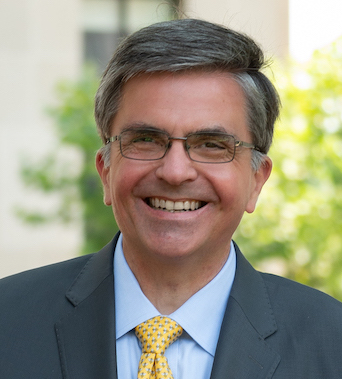
The same is almost certainly true for Virginia Wesleyan, which is renaming itself for the Batten family, longtime large donors. Virginia Wesleyan explained it wanted a “bold” future amid the challenges of declining small colleges, many of which have closed. It also cited “theological turmoil” in the denomination “over LGBTQ+ rights,” with “alumni and friends criticiz[ing] our affiliation, and the turbulence inevitably affected institutions with instantly recognizable connections. While we are proud of our Methodist heritage, it is significant that the Church has supported our name change.”
A news release from the United Methodist Virginia Conference did not specifically affirm the school’s name change. But it insisted that “the relationship between the university and the Virginia Conference of The United Methodist Church strengthened in recent years at a conference, district, and local church level.” It noted that the bishop’s representative serves on the school’s board, that the school collaborates with a local United Methodist church, that that “while the student ministries at VWU are in ministry to all faiths, there is a distinctively Wesleyan emphasis.”
The former Virginia Wesleyan’s affiliation with United Methodism will continue as Batten University, named for Jane Batten and her family. But for how long? And why does it matter? United Methodist higher education no longer meaningfully exists. Wesleyan higher education does exist with affiliation to other more evangelical Wesleyan denominations, like the Free Methodist Church, Wesleyan Church and Church of the Nazarene. But even among them there are challenges, as with other evangelical denominational schools. Eastern Nazarene University in Quincy, Massachusetts, closed in May. The campus is being developed into residential housing.
Mainline Protestantism’s role in higher education meaningfully ended many years ago, with the reality now more directly acknowledged. In this new post denominational age, it is unclear to what extent specific Protestant denominations can maintain their own schools. But there is evidence that, if not denominations, specific Protestant traditions can sustain schools, such as Asbury University, which is nondenominational but tied to the Wesleyan tradition. Its student numbers are strong.
The old denominational age is ending, in higher education and much else. What will replace it?

Comment by Qohelet on September 2, 2025 at 6:39 pm
I mean… the main story here is pretty obvious: at a time when small liberal arts schools seem doomed, Mrs. Batten is putting serious money into saving this one. I think that’s a testament that something is right at this school.
The 1950s gossip is kind of hilarious if not believable. Leave it to Methodists to make sure their orgies are “regularly scheduled.” Anyone who wants to be on the orgy committee it meets on Tuesdays just before the staff parish relations committee.
The sad thing is that both the conference and the university did admit that the United Methodist brand has been damaged by all the fighting. I’m sure that delights a lot of folks who work hard every week to damage that brand as much as possible. But the rest of us will keep using it to do as much good as long as we can wherever we can.
Comment by Angelo on September 3, 2025 at 8:06 am
What an ugly name they chose!
Comment by David Gingrich on September 3, 2025 at 8:21 am
A rich woman, hoping for some kind of immortality, paid to have a university named after her.
Comment by Skipper on September 3, 2025 at 12:01 pm
If it’s no longer Wesleyan, it needed a name change.
Comment by David on September 3, 2025 at 1:20 pm
Catholics and Protestants, in addition to school and colleges, also founded hospitals. In the age before health insurance, these provided their members with care even when indigent. Many of these were small and could not keep up with the great expenses of medical instrumentation. There were closures and mergers into larger institutions.
Comment by Michael E. Gannon on September 3, 2025 at 1:34 pm
I took a master’s degree from Wesleyan in Middletown, CT, where I chose the hardest professors and grew as a thinker and writer. The current president of that Wesleyan has wisely kept the magic of the school and the name. I hope the bumbling president here gets his walking papers.
Comment by David on September 3, 2025 at 6:26 pm
University presidents are largely concerned with finances. I recall a lecture by the then recent dean of the college of medicine where I worked for 40 years. He lamented that he now knew more about donors in Palm Beach than recent advances in his field of medicine.
Comment by Virginia on September 3, 2025 at 10:02 pm
Hi there.
You failed to ask permission to use my photo, which I own the rights to, as well as it having my friends and I in this photo.
Please replace it with another photo not owned by me or with my friends and I in it.
Thank you so much.
PS
If you would like to continue to use it, I will offer you a one time use fee of $2,500.