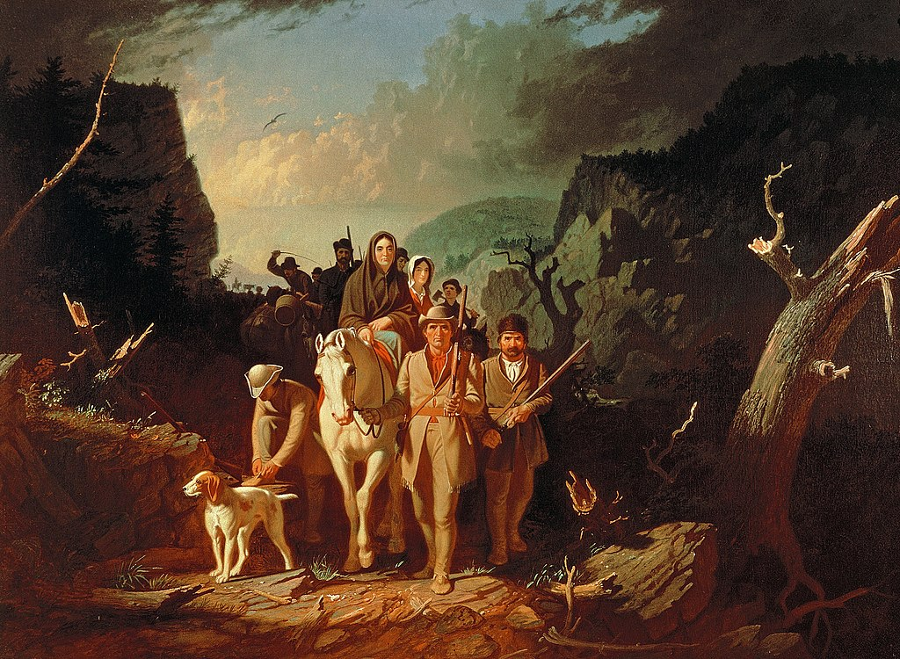

Last week for the first time I visited the Cumberland Gap through which, in early America, Daniel Boone, followed by 300,000 Americans, filed out of Virginia and into Kentucky and westward beyond. Tens of millions of Americans today descend from that migration.
Kentucky during those early years was Ground Zero for the Second Great Awakening. The new state was afire with revivalism, religious ferment and accompanying democratic populism. The migrants through the Cumberland Gap, leaving the old established order of the eastern seaboard, were ripe for revolutionary change. The Second Great Awakening shaped America’s character, making it more democratic, more egalitarian, and fixated on the idea of transformation into new beginnings. The agonizing conversion at a camp meeting led to rebirth into life with Christ. It also entailed escape from past sins and mistakes, empowered to open a completely new chapter. Americans thereafter imagined even more than before they were not bound by the restrictions of the past, of Europe, of the East, of the old politics or economic structures or the old churches or old social expectations. Potentially everything could transform into a new reality.
The Second Great Awakening accelerated America’s dynamism. Even more than before, people were on the move, physically, through the Cumberland Gap and beyond, but also spiritually, politically, economically. Kentucky and what we now call the Midwest were empty wildernesses. But the fires of revivalism, fueled by migration, filled these empty spaces with farms and then great industries, that then would attract even more migrants, not just from the eastern U.S. but also from across the seas.
These revivalistic fires also fueled America’s growing civil society about which Tocqueville, writing not long after, pontificated. Migration and the Second Great Awakening created a nation of doers and organizers. God had potentially anointed everyone to take action in every field of society. Americans did not need hierarchal direction. They were not passive subjects. They were vice regents of God on earth, building His Kingdom, not just through religious institutions but through every field of society, including education, industry, science. The Second Great Awakening created a nation of optimists. We can do better! Centuries and even millennia of human history often passed with little change. But the Second Great Awakening, through the engines of American power, accompanying the industrial and scientific revolutions, exponentially amplified the pace of human change. What previously took centuries thereafter took years, with the expectations of even faster progress.
Ironically, given the global impact of its migration, the Cumberland Gap is a very narrow passage through the Appalachian Mountains, discovered by Europeans in the mid-1700s, who upon transiting it were astonished by the natural riches beyond in what seemed like arcadia. New empires would arise there, both political and spiritual. In the spiritual realm, the new religious movements would take much of America, chiefly the Methodists, Baptists and Restorationists/Campbellites who especially excelled at the often weeks-long camp meetings that so many thousands attended. These new movements were democratic, non-hierarchal, often lay-led, entrepreneurial, focused on growth and pragmatism, confident that God could through them accomplish anything. They founded not just churches but colleges, publishing houses, newspapers, journals, international missions boards, and self-help societies like the temperance movement, to which closely tied were women’s organizations that ultimately sought the franchise and women’s equality in legal and public life. These movements, through their egalitarian perspective, were prone to abolitionism and would, haphazardly but determinedly, enable the pursuit of racial equality. After all, God was no respecter of persons, especially on the sinners bench of a camp meeting.
There are postliberal Christian critics of the Second Great Awakening today who lament its theological, social, and political impact. Egalitarianism, women’s equality, non-hierarchy, constant social change that includes generating new religious movements that can be disruptive. These critics prefer the First Great Awakening of the mid-1700s that mostly occurred through the established mostly Calvinist churches of New England and the eastern seaboard. That awakening seemed safer but only to a certain extent. Its impact was also literally revolutionary, leading to American Independence. The Second Great Awakening overthrew the old religious order, including state churches, demanding equality for all through non-establishment and full religious freedom. The revivalists of the Second Great Awakening liked and voted for Thomas Jefferson and James Madison, who even though not spiritual kindred, supported the free expression of these new spiritualities.
The Second Great Awakening dethroned the “elect” in favor of the masses, irrespective of their religious perspectives. Its ongoing impact on America is a constant churn in which the “elect,” whatever they are, are continuously critiqued, threatened and replaced, as new elites emerge, only for the cycle to continue. We who admire the Second Great Awakening are grateful for this churn, believing it providential, enacting the biblical promise that the last shall be first, and the first shall be last.
On my recent visit, I did not have time to walk the Cumberland Gap, through which so many had trod, including my ancestors. Instead, I drove to a viewing area high above and looked down on the stunning scenery that included three states. The Cumberland Gap looked like an insignificant thread through the woods below. But what a thread! Now remote, it once pulsated with energy, channeling hundreds of thousands into new futures that changed America, Christianity, and the world. Its impact continues, unpredictable, exciting, dangerous, and fully known only by God.




Comment by David on August 29, 2025 at 7:59 am
While Blacks may have been allowed to attend camp meetings, there was segregation. An 1809 diagram of a Methodist camp meeting by architect Benjamin Latrobe showed a specific area where Blacks could erect their tents.
“Behind the [preachers] stand were clustered about 300 Negroes, who, with their black faces and white dresses thrown into partial lights, were a striking object.”
Churches of that era had an “African corner” where seating was available. One church went so far as to paint several pews black to eliminate any confusion.
The various Black denominations eventually held their own camp meetings making the events elsewhere less diverse. The Ocean Grove Camp Meeting on the New Jersey Shore was described in 1893.
“Looking over a large audience from the stand, one of the most significant things to meet the eye is the number of quiet, orderly and devout colored people who take seats among the whites and not elbowed out, or scowled at for their appearance. We would rather see their ebony faces than the flashing diamonds which so many wear nowadays.”
Comment by Gary Bebop on August 29, 2025 at 11:12 am
Thanks, Mark, for another great summative essay. If the cyclical churn continues, the implosion of the (present) mainlines should be regarded in its proper light. There will be new inheritors of the energies of the Spirit. This is a liminal moment, a moment to give thanks and praise to God: “Morning by morning new mercies I see.”
Comment by Diane on August 30, 2025 at 12:12 am
I’d like to see this narrative re-framed through Methodist minister William Apess’ writings. Apess was an indigenous Christian during the Second Great Awakening, a writer who challenged Europeans’ racist ways of dismissing Native peoples, as well as those of African descent, as less than. He was the first to question why European settlers/missionaries insisted on portraying Jesus as White/European. (There’s a reason why older churches in America have white-Jesus stained glass windows, white Jesus on Sunday School walls and in bibles. Apess was observant – the white settler narrative of white supremacy found a depiction of a brown Jesus intolerable). The same folks today who demand biological purity tests for their gender-binary ideology have no problem with a Jesus who’s been biologically transformed from brown skin to fair skin in stained glass windows and pictures on church walls. Apess rejected the European framing of the land as “wilderness, an empty wasteland in need of civilizing”. Those camp meetings? Alexander Campbell was a white supremacist, now admitted to by the Disciples’ Historical Society. Campbell wrote of the white race being superior, he could not see people of African descent and indigenous people as equal to whites. Interracial marriages were banned. Child labor as free, unpaid domestic servitude was still going on everywhere, even where slavery had been abolished. There was no societal change, European settlers-men were in charge. Let’s not white-wash history. Christianity on these shores has always been infected with the attitudes and actions of white supremacy.
Comment by David on August 30, 2025 at 8:22 am
One might also question the common depictions of Jesus with long hair.
“Does not nature itself teach you that if a man wears long hair it is a disgrace for him,”—I Cor. 11:14
Comment by Qohelet on August 30, 2025 at 12:50 pm
Can we say that the Second Great Awakening was when American Christianity shifted strongly towards Arminianism? Is that accurate?
Comment by Salvatore Anthony Luiso on August 30, 2025 at 3:57 pm
Thank you for this article. Every American should know about the Cumberland Gap and the Second Great Awakening because they are so important to American history.
That said: with all due respect, as important as they are, I think the author of this article has attributed far too much importance to them.
From her start, America was “a nation of doers and organizers”–especially in the regions where there was relatively little or no slavery. Since the author mentions de Tocqueville, he may know the passage of his book *Democracy in America* in which the Frenchman compared and contrasted a free state and a slave state separated by a river: Ohio and Kentucky. The following two paragraphs are an excerpt from it:
Upon the left bank of the stream [Kentucky] the population is rare; from time to time one descries a troop of slaves loitering in the half-desert fields; the primeval forest recurs at every turn; society seems to be asleep, man to be idle, and nature alone offers a scene of activity and of life.
From the right bank [Ohio], on the contrary, a confused hum is heard, which proclaims the presence of industry; the fields are covered with abundant harvests; the elegance of the dwellings announces the taste and activity of the labourer; and man appears to be in the enjoyment of that wealth and contentment which are the reward of labour.
The “constant churn” of America predates the Second Great Awakening, although that event furthered it. One might argue that America influenced the character of the awakening, and the awakening influenced the character of America.
Regarding “God had potentially anointed everyone to take action in every field of society” and “They were vice regents of God on earth, building His Kingdom [….]”: Christians believed this for centuries before any of them knew about the Cumberland Gap–especially Lutherans and Calvinists during and after the Reformation.
Regarding “Kentucky and what we now call the Midwest were empty wildernesses”: Except for tribes of American Indians–who knew about the Cumberland Gap before it was “discovered by Europeans in the mid-1700s”.
Two other things:
1. Kentucky is also important to the early history of Catholicism in the United States.
2. In answer the the commenter Qohelet’s two questions: I think so.
Comment by Gary Bebop on September 1, 2025 at 12:07 pm
Mark is subversive here. That’s a good thing. Much of what Mark writes about is directed beyond “the choir” to the smirking, mocking, taunting post-traditional element in the mainlines. He offers a counterpoint to the prevailing woke-progressive narrative. That’s why I read him avidly.
Comment by Wilson R. on September 4, 2025 at 10:47 am
Opening up the trans-Appalachian territories to English settlement was mostly about the desire for land. To a degree, that also made it about freedom from established churches and opportunities to start afresh in a new landscape. But most of that is romanticizing. It was really about grabbing land.
When Daniel Boone’s family moved from Pennsylvania to North Carolina in 1750, the most fertile lands east of the Appalachians were already settled. The Boones landed in the piedmont, not far from present-day Winston-Salem. (Worth noting, by the way, that his family were not leaving the “established” religion of the Anglican Church; the Boones had been Quakers who left Pennsylvania after Daniel’s father had a falling out with the Society of Friends over whether his daughters could marry non-Quakers.)
Daniel Boone leading settlers through the Cumberland Gap in a way epitomized what the American Revolution was really about. Between 1754 and 1763 the British government had devoted enormous resources to a war with the French and their Native allies over defense of their colonies in North America. Financially drained from the war, Parliament decreed that English colonists had to remain east of the Appalachians to avoid any further conflicts with the Indians (whom Parliament also regarded as the king’s subjects). They levied new taxes on the Colonies, on the grounds that they should help defray some of the cost of the armies sent to defend them. By that time, speculators (including George Washington) already were buying land claims in the Ohio country, and they were eager to open these territories beyond the mountains. More than anything else, that desire for land in places like Ohio, Kentucky, and Tennessee brought about the Revolution.
It’s not quite as noble a tale as the one about the Second Great Awakening and religious freedom, but there it is.