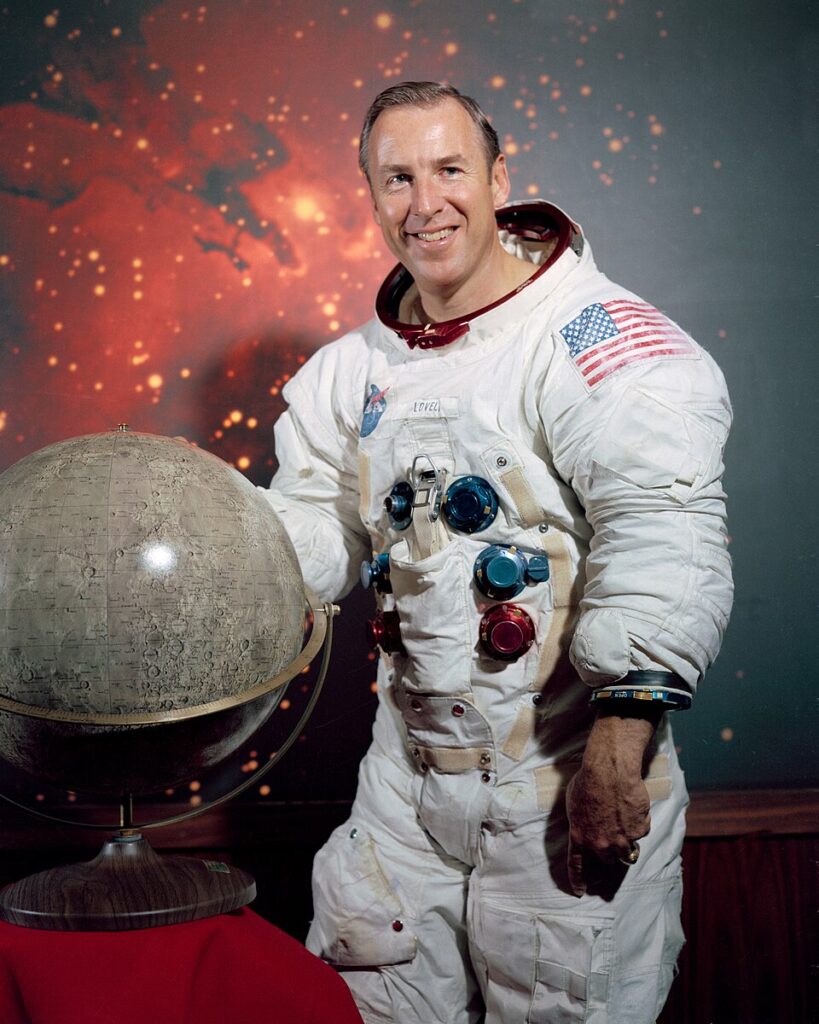

Astronaut Jim Lovell passed away last week. A veteran of both the Gemini and Apollo missions, he leaves behind a historic career of service to his country. His missions were not only critical to America winning the Space Race but, missions Apollo 8 and 13 served to highlight the providence of God at a time when America was locked in the Cold War against the Soviet Union and its commitment to communism and atheism.
A graduate of the Naval Academy in Annapolis, MD, Lovell served on both Gemini 7 and 12 and most notably on Apollo 8 and 13. At the time the four missions made Lovell, “the most experienced man in space flight.”
The role of religion in the lives of the Apollo astronauts is well documented. All 29 belonged to a Christian denomination. Jim Lovell, a Presbyterian, was one of 23 Protestants to fly Apollo missions with the remaining six being Catholic. While Lovell was not orthodox in all of his views, he was a regular churchgoer.
His first space mission would be Gemini 7, which demonstrated that it was possible to stay in space for the length of time required to make it to the moon and back to earth. He followed this with Gemini 12, the final mission of the Gemini program demonstrating that it was possible for two vehicles to dock in space. Both were essential steps in ensuring America would make it to the moon.
These two missions would be followed by Lovell’s Apollo missions. While each Apollo mission served a critical role in making it to the moon, or after Apollo 11 in lunar exploration, Lovell’s two missions were uniquely memorable in the history of the space program and in the imagination of the American people.
Originally, Apollo 8 was scheduled to be a test of the lunar module (LEM), and it was scheduled to take place as an Earth not Lunar orbital mission. But NASA was experiencing delays with LEM and also received information that the Soviet Union might try a lunar orbital mission by the end of the year. So, they made the bold decision to accelerate the mission and send a manned spacecraft into lunar orbit, a feat not yet tested. The mission would now determine if it was possible to bring the spacecraft into lunar orbit and back out again so that it could enter into the sling shot trajectory needed to bring it safely back to Earth.
This would have been significant enough, but there were two other gifts that Apollo 8 gave the American people as it successfully entered lunar orbit on December 24, 1968, carrying the crew of Commander Frank Borman, Jim Lovell, and William Anders. The crew captured the now iconic “Earth Rise” photo. The photo, as the crew explained, showed the beauty of Earth rising up over the desolate looking moon. Lovell called the Earth by contrast, “a grand oasis in the blackness of space.”
It was the Americans, not the Soviets, who had reached lunar orbit first, and on Christmas Eve, the Astronauts prepared a special broadcast. Through the vastness of space, they transmitted back to Earth the words, “In the beginning God created the heavens and the earth.” The crew would continue to read the words of Genesis carefully emphasizing “and God saw that it was good,” and during 1968, a difficult year for the American people, the emphasis shifted from a mission focused on the moon to emphasize the goodness of God in giving us the Earth as our home in the cosmos. The Earth tainted by the fall is still a gift, and even during years of difficulty and hardship, we can look at it and marvel at the goodness of God. The astronauts closed by wishing a Merry Christmas to “all the people on the good Earth.”
Lovell would fly one final mission in the Apollo program, his most notable, Apollo 13. He would serve as commander. The mission which was expected to allow him and Fred Haise to land on the moon while Jack Swaggert would man the command module from lunar orbit. This however was not to be. During a routine stir of the oxygen tank on the second day of the mission, one tank exploded. The service module began rapidly losing power, and rather than land on the moon, the mission instead focused on returning the crew members to Earth.
The odds of a safe return were small. The scenario faced by NASA had not been tested and it required rapid solutions to a myriad of issues facing the craft, including maintaining oxygen, having enough power for the reentry, and staying on the correct return trajectory. NASA experts worked round the clock only able to use the same limited supplies that were with astronauts in the LEM to provide solutions to the various hurdles faced. There was no room for error in any step if they were to return safely.
The achievement of NASA in returning crew to Earth cannot be overstated. But the American people and people around the world intuitively realized that it would not be NASA alone that could ensure the survival of the astronauts. People around the world in church, in parks, in homes, glued to their TV’s spontaneously turned to prayer. There were mass gatherings around the world including Times Square where people gathered in prayer. Prayers were held at the Wailing Wall, and Pope St. Paul VI spoke to large crowds gathered at St. Peter’s Basilica saying, “We will therefore raise a prayer to our Father who is in heaven for those daring men, now in danger, and … to us more brothers than ever.”
Amazingly, the world watched in real time, as despite seemingly insurmountable odds, their prayers were answered, and the hand of providence helped the workers at NASA safely return the crew to Earth. Nixon would declare April 19th as a day of prayer and Thanksgiving.
Of the conflict with the Soviet Union, Whittaker Chambers would write, “Faith is the central problem of this age. The Western world does not know it, but it already possesses the answer to this problem — but only provided that its faith in God and the freedom He enjoins is as great as Communism’s faith in Man.” America would win the space race and eventually the Cold War. Jim Lovell and his space missions played a role in those victories and providentially they played a role in the “central problem of the age.” And for that, we should all be grateful.


Comment by Dan W on August 19, 2025 at 9:37 pm
Lovell and 9 other Apollo astronauts are interviewed in the 2007 film “In the Shadow of the Moon.” The astronauts tell the story of NASA’s crewed Moon missions, accompanied by actual mission footage and contemporary news coverage. Lovell is a great storyteller, but all of the astronauts do a great job.
Comment by Thomas on August 20, 2025 at 8:26 pm
They might not have landed in the Moon but are still the humans that went farthest from Earth. I think like 400 000 Km2.