Vietnam does not bring happy memories to Americans. There a long, interminable war was the first loss for America on the global stage. A period of collectivization of the former South Vietnam begun in 1978 resulted in hundreds of thousands of “boat people” fleeing the country by sea, with an unknown number perishing on the seas. As has happened with other communist regimes, economic liberalization, or “Doi Moi” begun in the late 1980s stabilized the economy. The current new party leader, To Lam, seems intent on substantial administrative reforms in his country.
But as with all communist dictatorships, there cannot be real religious freedom, as the state’s ideology is hostile to religion. The 2024 country report from Open Doors International discloses that religious persecution in Vietnam arises from several sources, in particular from attempts to enforce communist ideology, and from clan oppression (expulsion of Christian converts from rural communities where folk/animist beliefs are strong).
The U.S. State Department designated Vietnam a Country of Particular Concern with respect to religious freedom in September 2004 and then lifted the designation in November 2006. But religious freedom advocates continue to be concerned about the situation there, and the issue was address at the International Religious Freedom Summit in early February of this year.
In initial remarks, U.S. Congressman Derek Tran, whose father fled Vietnam, said that the country continues to have “a dictatorial regime enacting a cruel agenda on innocent people … For decades the Vietnamese government has employed increasingly oppressive measures to control religious expression. Christian, Buddhist, and other religious groups are subjected to surveillance, harassment, and severe restrictions of their religious practices.” Observing that this year marks the fiftieth anniversary of the fall of Saigon, he declared that “we must recognize that the struggle for freedom is not over. It continues for those who still live under the shadow of tyrants.” He said “I’m eager to work with the IRF and organizations like Boat People SOS to support meaningful legislation and solutions that will combat religious persecution in countries like Vietnam.”
The Case of the Montagnards
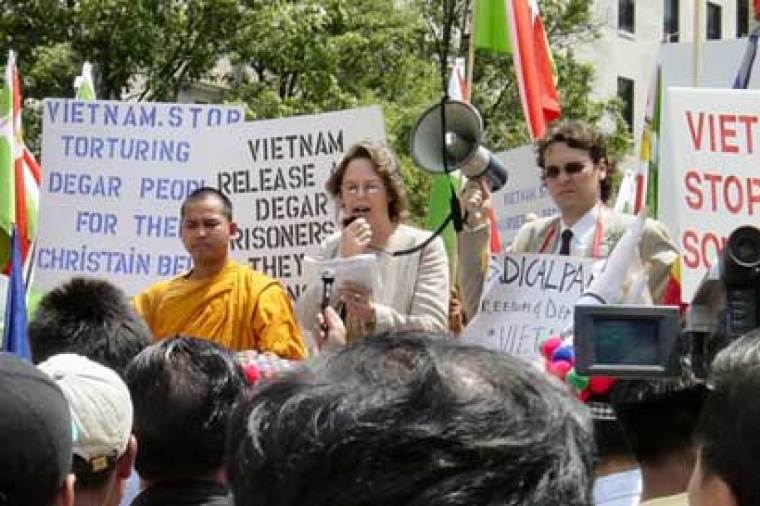
Sarah Colm of the Campaign to Abolish Torture in Vietnam moderated a panel of Vietnamese and American activists. She noted that invited participants to the IRF Summit were prohibited from leaving the country, and “authorities have summoned, threatened, and interrogated Montagnard church activists … Other religious freedom defenders” have been placed under house arrest. The Vietnamese government also tried to restrict Internet coverage in Vietnam of the IRF Summit. She said that this action “makes a mockery of Vietnam’s membership in the U.N. Human Rights Committee.”
All religious organizations in Vietnam must obtain government approval and register with the state. Such justifications as “public security,” or “national unity” can serve as a justification for detention, interrogation, torture, and imprisonment. Critics of government policies are “subject to public criticism, forced renunciation of faith, arrest and detention.” Protestantism, especially among the Hmong and Montagnards the government considers “an American religion.” Their persecution, which involves loss of their ancestral land as well as restriction of religious practice, has been ongoing for many years. Activism among these groups is considered a threat to national security, having an objective “to undermine and ultimately overthrow the communist regime.” Montagnards and Hmong “make up a disproportionate number … of prisoners of conscience.”
Pastor Nglol Rahlan said that his Dao Blung Hlao church has branches in North Carolina, Vietnam, and Thailand. He is a Disciples of Christ pastor. He said that his Montagnard people lived in what is now Vietnam long before the ethnic Vietnamese settled there. His people fought with the Americans against the Viet Cong during the Vietnam War. They are now persecuted by the communists because they will not “say that communism and Ho Chi Minh are more important than God.” He fled Vietnam for Cambodia in 2001 and then went to the U.S. in 2003. In Vietnam he was “hunted for my faith.” At that time there were “protests for freedom of religion and human rights; hundreds of Montagnards were arrested during this time, with more imprisoned after peaceful protests in 2004 and 2008.”
Montagnard Christians “live in constant fear, they are harassed by police and local authorities who pressure them” to “join the state approved religion.” Thus “there is no religious freedom in the central highlands” of Vietnam. “Our people are persecuted because our church is not recognized by the state.” At the present time “threats and arrests are ongoing.” In particular, twelve people in his village were arrested. While nine have been released, three are still in prison. In Dak Lak province in the central highlands, police raided eight villages, fifty people were arrested, of whom 18 “remain in detention” for refusing to join the state-approved church. The Vietnamese government claims that “communism brings happiness, and that there is freedom to practice religion.” Yet people are arrested and tortured.
Rahlan said that “many Montagnards risked their lives fleeing to Thailand to this escape persecution” in Vietnam. Basically the government “seeks to erase our culture and our faith … many people have been imprisoned because of their faith.” Likely due to its association with America, “they label our church ‘foreign religion’ to discredit it.” It is claimed that the Montagnards “worship America, and not God.” The Vietnamese regime has seized Montagnard “land, and destroy[ed] our wildlife, forests, and natural resources.” He also observed that every year at the time of Christian celebrations there are always people who are “persecuted and put in jail.” He appealed to people in the West to do what they can to stop the persecution of the Montagnards.
Colm said that she met Pastor Rahlan in 2001 after “he and hundreds of other Montagnards fled” Vietnam to escape “a government crackdown on unprecedented peaceful protests in Vietnam, calling for religious freedom and return of ancestral lands.” Their faith combines Evangelical Christianity and Montagnard culture. Their activism is concerned with “religious freedom, protection of ancestral lands, and for some, autonomy or self-rule.” Also Montagnard house churches “want to be independent of the government-controlled Protestant organization.” The government claims that the Christian Montagnards and other independent religious groups in Vietnam are really “covers for separatist political activities.’ But the rights being claimed by the Montagnards are “protected by international rights covenants that Vietnam has signed.”
The Khmer Krom in Mekong Delta
Colm then introduced Moni Mau, Vice President of the Khmers Kampuchea Krom Federation. Khmer Krom are the indigenous people who live in the Mekong Delta, and practice Theravada Buddhism. Mau said that all religions in Vietnam operate under state control. The only Buddhist organization recognized by the government is the Vietnam Buddhist Sangha (VBS). Buddhist monks must be ordained under state control. But these may not be “normal Buddhist monk[s],” but “real communists.” The VBS control of Buddhism has “completely contradicted” the Khmer Krom’s Theravada Buddhism. The state has the power to say who is and is not a Buddhist monk. His own independent Buddhist organization therefore cannot operate in Vietnam. They endeavor to educate Khmer Krom via the Internet. Additionally, the state controlled VBS speaks Vietnamese, not Khmer. He pointed to a Buddhist monk who did not accept state authority and was thereafter expelled from his temple. Many activists are imprisoned without “no family visit, or access to legal representation, there’s no lawyer.” Colm added that other religions are persecuted as well, mentioning the Cao Dai, the Hoa Hao, and the Vietnamese Buddhist Church. It is the “more marginalized” groups that are persecuted the most, she said.
Attempted State Control of Religion
Colm then introduced Jean Wu of the U.S. Commission for International Religious Freedom (USCIRF) and asked how the state uses the religious organizations it controls to suppress religious freedom. Wu said that USCIRF has published a report on state-sponsored religion. The Vietnamese Communist Party and government use state sponsored religious organizations to control religion. They have three strategies to target religious groups that are not part of these state-controlled organizations and do not comply with the state’s wishes. These are substitution (substituting a state sponsored organizations – such as the Vietnam Buddhist Sangha (VBS) – for independent religious organizations), co-opting (offering non-compliant groups benefits such as legal protection), and infiltration (sending people deemed loyal to the government into independent religious groups). The Catholic Church is the only legal independent religious organization in Vietnam, and it is subject to infiltration. Religious ideals are subverted to the goals of the state. People who practice a religion independent of the state-controlled groups may face arrest and imprisonment. She said that USCIRF strongly supports the passage of the Vietnam Human Rights Act, and advocates for prisoners of conscience.
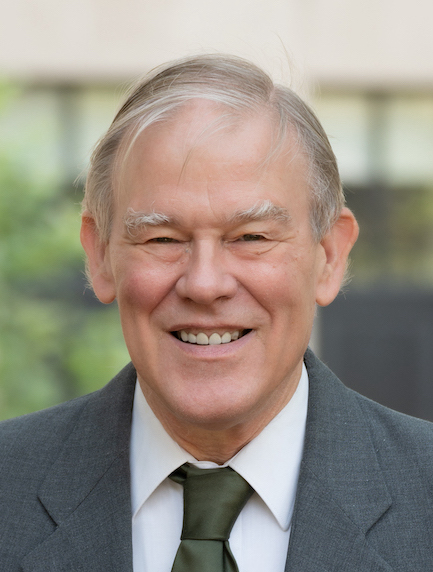
Grover Joseph Rees, a former U.S. ambassador to East Timor and a long-time human rights advocate, then spoke of the attempted state control of religion in Vietnam. This includes organizations specifically for Catholics, Protestants, and Buddhists. The “one size fits all” approach (such as the Catholic Solidarity Association, or “the Protestant church that we invented and where every service begins with veneration of Ho Chi Minh”) leaves many people without an organization to match their conviction. The Khmer Krom of southern Vietnam are Theravada Buddhists, and markedly different from the Mahayana Buddhists of the north. The creation of one Buddhist organization in Vietnam cannot accommodate this. It “not only crushed the largest religious group in the country, the Unified Buddhist Church, but was especially problematic for Theravada Buddhists.” One problem is that the government tries to determine who can be a priest or monk. But also, Theravada Buddhist men normally wish become monks for some period of their lives and would have to have government approval to do that. This really interferes “with the basic tenets of the religion.”
Rees also discussed the use of “trans-national repression” by the Vietnamese Communist Party against religious emigres from Vietnam. He noted that within Vietnam, religious believers are pressured to join religious organizations invented by the regime. But refugees from Vietnam are even “afraid in Bangkok.” Vietnam regards the sheltering of Vietnamese refugees by neighboring countries as “problematic” for the relations of Vietnam with other countries. Since Vietnam, Thailand, and Cambodia are all member of the Association of Southeast Asian Nations (ASEAN), Vietnam can apply pressure through that relation. The Thai government “gets very nervous” when a prominent Montagnard appears in Thailand as a refugee. One claim used by the Vietnamese is to accuse refugees of terrorism. Vietnam can point to a real terrorist incident that occurred. But the Montagnard leader accused of terrorism had nothing to do with the incident. The practice of trans-national repression by the Vietnamese government has been a long-standing policy. Colm added that Vietnamese authorities have entered Cambodia to harass refugees, and one prominent refugee was kidnapped and taken back to Vietnam, where he was tried and sentenced to prison.
What Can Be Done
Wu noted that Vietnam had once been put on the U.S. State Department’s Country of Particular Concern (CPC) list (2004), thus designating the achievement of improved religious freedom in Vietnam an American foreign policy objective. She said that the Vietnamese government responded positively to this, trying to improve the religious freedom situation in Vietnam. The registration of religious groups in Vietnam was made easier, with a shortened time to gain approval. As a result of improvements in religious freedom in Vietnam, the CPC designation was lifted (2006). But “egregious” religious freedom violations have been noted since then. Consequently, USCIRF is recommending restoring Vietnam’s CPC designation. She believes that it would be a powerful tool in dealing with Vietnam, noticing improvements, but also seeing many areas in which there should be improvement.
Colm asked Wu if any of the 15 “restraint measures” provided for in the International Religious Freedom Act of 1998 (see Title IV in link) had been applied to Vietnam. (These include such things as mild as a demarche, or condemnation, to prohibition of U.S. government procurement or suspension of U.S. foreign assistance). Wu said that she was not aware of any restraint measures that had been applied. But she hoped that applying the CPC designation again would encourage the Vietnamese government to continue to improve its religious freedom situation.
Colm then asked Rees about the proposed Vietnam Human Rights Act. Rees said the bill passed the House in 2001 and twice after that, but has never passed the Senate, Vietnam strongly lobbied the Senate not to pass the bill. He thought the bill might have a chance of passing with the recent changes in the U.S. government. Additionally, he said that American representatives engaging another country will “hold their feet to the fire about trade and investment.” He said that “there are going to be consequences” if a foreign country will not treat America equitably in these matters. But for religious freedom violations, the only real consequences for a country such as Vietnam is “a lecture.” There should be real consequences for countries with bad religious freedom situations (such as the use of one or more of the 15 restrictive measures allowed by IRFA). Other countries should know that religious freedom is a high priority with the U.S. government. He suggested that torture victims might be treated as “honorary software.” He also suggested that economic benefits of trade with the United States be a bargaining tool in addressing religious freedom.
Another question concerned how religious freedom advocacy organizations could effectively support persecuted communities in Vietnam. Mau responded that the Khmers Kampuchea Krom Federation raised the issue of the persecution of the Khmers with the U.N. and the U.S. government. When his people are arrested, there are protests around the world “from Geneva to New York.” His organization tries to speak for those who cannot speak for themselves.
A questioner asked Wu if USCIRF could recommend to the Vietnamese government improvement in the religious freedom situation for the Hmong people. Wu said that USCIRF cannot make recommendations directly to a foreign government, but USCIRF does work with colleagues at the State Department to affect situations where religious freedom is commonly violated.
Colm said that hundreds of religious freedom defenders are behind bars in Vietnam. She said that Montagnards, Hmong, and Khmer Krom “make a disproportionate number of Vietnam’s religious prisoners of conscience. They make up 3% of Vietnam’s population, but they are the vast majority of religious prisoners of conscience.” This, she said, should be emphasized with the U.S. State Department.
The real heart of the problem in Vietnam is the regime’s continued adherence to Marxist-Leninist ideology, its atheism and antipathy to all religions. As the speakers’ comments indicate, the regime has at times attempted to be more accommodating to religious belief and practice than communist governments sometimes are, but there cannot be real religious freedom as long as communism persists. Our government should indeed restore Vietnam’s Country of Particular Concern designation to a regime that employes kidnapping, years’ long imprisonment, and torture against its religious citizens. The regime’s behavior should continue to be well publicized. Christians should pray for the relief of people persecuted for their faithfulness to Christ, for justice for everyone, and hope in God for a better future.
No comments yet




Leave a Reply