
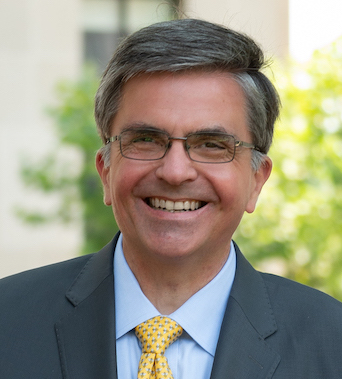
Irreverent Calvinist firebrand Doug Wilson of Moscow, Idaho, has planted a new church on Capitol Hill in Washington, DC. Its first service was Sunday, meeting in the office space of a Trump aligned thinktank. News accounts say about 120 attended, including Defense Secretary Pete Hegseth. The church will feature the leading preachers of Wilson’s movement.
Wilson founded a denomination, a college and a publishing house. He advocates a Christian confessional state established in law. The most famous book from the publishing house he founded is Stephen Wolfe’s The Case for Christian Nationalism. It argues for a Christian confessional state that punishes heresy and treats non-Christians as less than full citizens. Wolfe thinks the state has the power to execute heretics while stressing he prefers other measures of persuasion. Wolfe opposes voting rights for women.
Recently Wilson interviewed Wolfe. Wilson’s new church will be the first unapologetically Christian nationalist church in DC. Expect the church to be successful. Many young men are attracted to high octane old style Calvinism that is intellectual and shuns all accommodation of liberalism, contemporary or classical.
As the president of a Christian thinktank advocating democracy, human rights, and religious freedom, of course I disagree with much of what Wilson and his network advocate. But I admire their dynamism and logistical competence. They have much to teach other Christians looking to influence public life. Wilson’s new DC church is strategically savvy. It also seems to have been organized fairly quickly. Life is short, and Christians should act with urgency.
So it’s very sad that in contrast to Wilson’s network, Wesleyan/Methodist Christianity in America is apparently indifferent to bringing its unique and powerful message to what is arguably the world’s most influential city. Washington, DC has over the last twenty years enjoyed an amazing season of new church plants. There are scores of thriving new churches in the nation’s capital, most of them full of young people. They are nondenominational, Baptist, Anglican, Acts 29, and Presbyterian, among many others. None are Methodist or Wesleyan, except arguably National Community Church, which is loosely tied to the Assemblies of God, a Pentecostal denomination.
The lack of Wesleyan/Methodist interest in reaching Washington, DC evinces a wider aversion to urban church planting. Vital Wesleyan/Methodist Christianity has largely abandoned Americas cities. The historic black Methodist denominations are still in the cities but are largely declining. Presbyterians, Anglicans and others were inspired by Tim Keller’s Redeemer Church model in New York city, specializing in reaching young professionals. There is really no Wesleyan/Methodist equivalent of Tim Keller, although Mark Batterson of the above mentioned National Community Church would be the closest approximation.
Wesleyan/Methodist Christianity has retreated to the suburbs. It is almost entirely white, except for Pentecostals. It shows few signs of dissatisfaction with this situation. More broadly, Wesleyan/Methodist Christianity shows little interest in shaping the public face of American Christianity or of contributing a specifically Wesleyan perspective to Christian intellectual life. If it were interested, it would be planting itself in America’s great cities and in college towns, creating vibrant, intellectually serious campus ministries.
Traditionally, Wesleyan/Methodist Christianity is profoundly focused on shaping culture and civilization. America would not be America without it. Yet now Wesleyan/Methodist Christianity is nearly inconsequential to American culture. American non-Catholic Christianity has become largely Baptist in ethos. Its intellectual life is dominated by Reformed/Calvinist views.
There are many reasons. The largest Wesleyan denomination was United Methodism, which has culturally, demographically, theologically and ecclesiastically imploded. The other Wesleyan denominations have largely been much smaller, evangelical subcultures. The new Global Methodist Church is largely confined to suburbs and small towns of the south and parts of the Midwest. Unlike the Anglican Church in North America, which is much smaller, it seems to lack a strong church planting vision focused on new regions. USA Global Methodism like the United Methodism from which it emerged is largely older white people. Absent aggressive church planting, and focused outreach on younger people and non white people, it lacks a bright future.
Many young people now, especially intellectual young men, are attracted to hardcore, countercultural versions of Christianity with post-liberal, hierarchal politics like what Doug Wilson offers. It offers a vivid, alternative cosmos to secular individualism. More temperate young people want strong communities with clear beliefs and spiritual vitality that are inclusive of young people.
The Wesleyan/Methodist secret sauce is its uniquely optimistic, egalitarian message of divine perfecting grace available to all people. It wants to redeem and empower, not divide and dominate. It seeks personal holiness fully lived out in society. It has a great history of transforming societies, but religious movements don’t thrive based on their past. Rightly understood, Wesleyan, Methodist Christianity is focused on today and planning for the future.
A Christian movement not interested in America’s cities has little spiritual power or authority. The Apostles Peter and Paul went to Rome, despite the prospect of martyrdom. Yet Wesleyan/Methodist Christianity is avoiding Washington, DC. I’ve been searching for a DC church planter for over a year without success and finding little interest. Young people with Methodist backgrounds who come to DC quickly locate to other traditions with vital churches, as they should.
In earlier times, Methodists founded great congregations with majestic sanctuaries in the nation’s capital that attracted national leaders and showcased their movement. Methodism in DC saved souls and changed the world. It could happen again. But will it?




Comment by Gary Bebop on July 17, 2025 at 11:35 am
This was a fascinating read. I’m a little surprised that Mark Tooley writes dismissively of the Global Methodist Church emergence. After all, the GMC is relatively newborn out of the cinders of an old paradigm. The difficulty of finding a church planter for D.C. among faithful Methodists may be answered by the GMC as it finds its footing.
Comment by Corvus Corax on July 17, 2025 at 11:38 am
Good observations, Mark.
In my experience the United Methodist Church has always tried to broaden its appeal by generalizing, adopting a posture of theological “openness,” and decreasing its emphasis on “churchy” stuff like creeds and sacraments. In an effort to appeal to different demographics, the largest Methodist churches near me offer a “traditional” service primarily attended by a handful of the elderly and a “contemporary” service which occurs somewhere else entirely with a completely different set of people. This also reads as an effort to accommodate different flavors of churchmanship at the cost of meaning and shared identity.
Ultimately the church has spent so much time and effort trying to remove barriers to entry that it can no longer differentiate itself from dozens of other competing flavors of vaguely center-left Protestantism. In a pluralistic society where people “church shop,” the failure to establish a coherent brand identity is a death sentence.
Comment by Wilson R. on July 17, 2025 at 1:32 pm
Some elements of this column resonate with me, as a lifelong Methodist/United Methodist. Other parts strike me as ill-considered.
I have felt frustration at the UMC hierarchy for what at times feels like a lack of commitment to urban ministry. At times it seems that they are indeed focusing on the affluent suburbs. And in some ways this is not surprising; as membership (and, thus, giving) decline, they’re focusing on areas of growth and affluence. I’m seeing it in all the mainstream denominations in my area.
I was part of a small but very vibrant urban congregation with a 130-year history in the community. Our UMC Conference closed the congregation because the real estate was more valuable to them than we were. After being in the wilderness for a couple of years, my wife and I joined a historic downtown UMC congregation (my understanding is that it is the oldest Methodist congregation west of the Appalachians). It has strong pastoral leadership, ministers to several thousand people in any given week (most of whom are not formal members), and enjoys strong support from our bishop. The Conference is even pioneering a new model that creates an “urban cohort” of UMC churches within the city core that engage in a number of joint ministries and have a district superintendent dedicated to just 10-12 churches that make up this cohort, rather than the traditional 50 or more. Methodism certainly has not abandoned the city where I live!
I don’t know the landscape in DC, but in many other cities the pattern is different from what Mark Tooley describes. In the Kansas City area, for example, the UMC Church of the Resurrection, a suburban mega-congregation that began in the wealthy suburbs, has planted a downtown congregation across the state line on the Missouri side. I’m familiar with a similar church plant in St. Louis that is attracting new people, in part, because it is NOT a “majestic sanctuary” and a “showcase.” It ministers to people who left churches that appeared more show and majesty than spiritual substance.
And, in a topic that would be interesting for Mr. Tooley to explore, the emphasis on suburbs isn’t purely about membership numbers and money. Adam Hamilton, founding pastor of Church of the Resurrection, tells a story about the day his bishop, Dr. Handy, took him out to the affluent suburbs and told him he wanted him to start a congregation there. “Don’t be fooled by all these rich houses,” Hamilton remembers the bishop telling him. “There’s a lot of poverty out here.”
Addressing the spiritual poverty of our materialistic suburbs benefits our cities, too, as Church of the Resurrection showed. In my city, the biggest suburban UMC is the biggest and wealthiest in the whole conference. In the past several years, they have begun partnering with inner-city churches, including historically Black congregations, to worship and do ministry together in ways that have spiritually enriched everyone involved.
Don’t sell what the UMC is doing in cities short. It may not look like the grand edifices of the denomination’s heyday, but it is much more alive and engaged than is being represented here.
Comment by Salvatore Anthony Luiso on July 17, 2025 at 2:35 pm
Regarding “Wesleyan/Methodist Christianity has retreated to the suburbs. It is almost entirely white, except for Pentecostals.”: If the author is going to include Pentecostals as Wesleyan/Methodist, then he should recognize that Pentecostalism has a strong presence in many cities of America.
Since the GMC is relatively new, I would give it some more time before judging its interest in evangelism, urban ministry, and Washington, D.C..
Regarding “In earlier times, Methodists founded great congregations with majestic sanctuaries in the nation’s capital” etc.: As the author knows, at that time, Methodism was flourishing in America–so much so that the stereotypical Protestant was Methodist. That’s not so now. Time will tell whether it will so thrive again. It may need to flourish before it can plant a new church in Washington–it does not need to plant a church there before it can flourish.
Comment by Robert (Bob) Hardman on July 22, 2025 at 7:52 pm
Mark, I believe I am observed over time your commitment to seeing Methodism expand into DC, you’ve promoted this.
I don’t know you, but I wonder if you’re disappointment in the response you received in terms of your own efforts his skewing your article and your expectations
I reside in California and continue to attend the UMC congregation. I consider myself a Wesleyan Methodist retired clergy person.
I wish there was an alternative in the San Francisco Bay area for me to find her worshiping community with a theology akin to the GMC. I grow weary but not )discouraged! Be of good cheer our Lord Jesus Christ is at work throughout America baptizing his people with his life giving power the Holy Spirit. Perhaps the beginning of a conversation I hold you in my prayers and cover yours.
Comment by Curtis Edsall on July 23, 2025 at 11:07 am
In the meantime, here is the mission statement of Foundary UMC in Washington DC, former church home of US Presidents.
“Foundry’s mission is based on its statement of call to deepen faith through transcendent worship and challenging study, to create engaged community through inclusiveness and caring, and to transform the world through active service and prophetic leadership.”
Not a word about saving souls…
Comment by Norma Gray on July 23, 2025 at 12:08 pm
You didn’t mention the National United Methodist Church in Washington, D.C. with my former Lynn, Ma. pastor Rev. Doug Robinson- Johnson as it’s senior pastor.