
The Foursquare Gospel denomination is a global fast growing Pentecostal church with nearly 9 million members. Its founder was one of America’s most charismatic, flamboyant, successful, and scandalous preachers, perhaps the most influential female preacher in America’s history, or even the world’s.
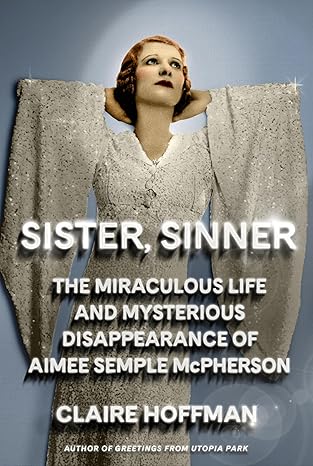
Sister, Sinner: The Miraculous Life and Mysterious Disappearance of Aimee Semple McPherson by Claire Hoffman tells the story.
Aime Semple McPherson was born on a Canadian farm in obscurity. But through raw talent, faith and luck founded America’s first megachurch in the 1920s, the Angelus Temple in Los Angeles, which still thrives, plus the Foursquare Gospel denomination. She was only in her early thirties when she became a national religious star. Her scandal tarnished but did not end her ministerial and entertainment career.
Indeed, McPherson’s scandals in many ways amplified her fame and boosted her career, establishing a familiar pattern in American public life.
Specifically, after founding the constantly filled 5000-seat Angelus Temple, McPherson in 1926 disappeared from a California beach while her secretary looked on. Had she drowned? Was she kidnapped? Did she run away? Her church prayed while the whole nation watched with amazement.
Five weeks later she emerged from a Mexican desert, claiming she had escaped from her kidnappers who had imprisoned her in a nearby shack. Her story was absurd. Neither the shack nor the kidnappers were ever found. Law enforcement and the media discovered she had run away with her church’s former radio broadcast manager, about whom there were already rumors of a romance, to a beachside home. There, she, and her married paramour eagerly read about the nation’s reaction to her disappearance in the newspapers.
McPherson, against all evidence, stuck to her story with magnificent and melodramatic consistency. Her church faithfully believed her, as she preached about her supposed ordeal as a great divine deliverance. Facing prosecution, she compared herself to the apostles of old who also were persecuted by law enforcement. Uncharacteristically playing on prejudice, she noted that the chief prosecutor and his assistant were Roman Catholics, besmirching America’s most famous Protestant pastor.
Although reviled nationwide in the media, McPherson’s tactics worked. Thousands of Los Angelenos supported her, and the city’s prosecutor eventually backed off, although several people had died in attempts to find her. The crowds at Angelus Temple further swelled at the daily services.
Why did McPherson, the divorced mother of two small children, disappear and then reappear? Her steely mother, who managed her career and her finances, almost certainly was a strong factor. Mildred Ona Kennedy was central to McPherson’s vocation and success. Like her daughter, she had no interest in staying on the farm or with her much older, elderly, sedate Methodist husband. Mother was also ambitious and liked attention.
Mother was deeply active in the Salvation Army, even leaving her husband to serve the Army in New York city. Daughter McPherson learned faith, drama, discipline, and music from the Salvation Army. But she converted to Pentecostalism thanks to a young preacher whom she married at age 17. They together left as missionaries in China, where he soon died from illness, leaving a very young, pregnant widow. She returned with help from strangers, demonstrating her talent for sympathy and fundraising.
Returning to America, McPherson became herself a traveling evangelist, driving about the country, living in a tent. Sometimes she left her young child with Mother. Her audiences were amazed by a female preacher, although the Salvation Army and Pentecostals always had them. She exuded spiritual power, humanity, and compassion. McPherson remarried, converting her husband to her Pentecostal faith, having a child with him but eventually discarding him when he lost interest in her itinerant ministry.
Joined by her mother, McPherson and her two young children drove across the country to Los Angeles, the fast-growing city of dreams. She wanted the stability of a church and a home. Tireless, talented, and endlessly patient with people, McPherson’s success as a church planter came almost immediately. William Jennings Bryan warned her that her pace of work would kill her, but she strove onward. Her mother ran the church administratively, while McPherson preached everyday and choreographed the music and extensive costumed dramatic presentations appropriate for a city emerging as America’s entertainment capital. Hollywood stars attended Angelus Temple, sometimes incognito, admiring her stagecraft and magic with her audience.
McPherson believed in the threat of damnation. But unlike other preachers, she stressed divine love and serenity. Her preaching was often anecdotal, personal, and narrative. She dressed in a long white dress as though she was an angel. The crowds loved her. They also came for divine healing, with rows of ambulances parked outside the church, disgorging the ill and lame.
It was all overwhelming, and no human could have maintained the exalted role McPherson had uniquely created for herself. She of course had her critics. Los Angeles Methodist preacher “Fighting Bob” Shuler, with his own megachurch and radio broadcasts, chided her as a witch and a fraud. She and he agreed about nearly everything, theologically, socially, morally, and politically. Both were social reformers and who challenged the legendary corruption of Los Angeles politics and society. But there was barely room in the city for two ambitious preacher personalities.
McPherson apparently broke under the pressure and sought an escape with her church radio expert, who was not Christian but was talented and magnetic. She never for the rest of her life admitted to the affair or confessed that the supposed kidnapping was fraudulent. So, there is no clear account of what her plans were. Did she always plan to return and capitalize on the drama? Or did she genuinely want to escape forever and then abruptly realize that she could not live in obscurity?
Mother, to whom McPherson seems never to have confided her plot, aggressively defended her daughter, paying countless bogus witnesses to defend McPherson’s kidnapping fantasy. But Mother almost certainly never believed the story and lost faith in her daughter. They dramatically broke publicly several years later, with McPherson likely relieved to be free of her. But Mother was also sensible with money and people, while McPherson was not.
McPherson married again, briefly, a baritone singer who performed in her church. But she never found lasting romance. A church administrator for several years virtually controlled her, managing all finances and even her social schedule, until she finally fired him. She envisioned her daughter as heir to the church empire, until she and her daughter became estranged.
McPherson struggled with loneliness and depression. But her magic with people continued. Angelus Temple became a widely acclaimed beacon of charity during the Depression, during which her compassion to people of all backgrounds and races especially shone. She characteristically mentored a teenage Mexican immigrant who performed in her choir and translated when she spoke to Spanish speaking audiences. He later became the actor Anthony Quinn and always admired her.
Even amid her troubles, McPherson’s personality was electric and uplifting. Traveling in Europe, she spontaneously visited film star Charlie Chaplin, who had visited Angelus Temple. Initially irritated by the visit, having no use for Christianity while admiring her theatrics, Chaplin and she dined together for multiple consecutive nights. After his own years of depression, he felt rejuvenated, stimulated by her conversation and optimism.
McPherson’s health was never steady, worsened by her tireless schedule. In 1944 she returned from a national preaching tour to address 10,000 people in Oakland, California. She shared an enjoyable evening at the hotel talking to her son, whom she had anointed her evangelistic heir. He found her near death the next morning, overdosed on sleeping pills. She was only aged 53. Many thousands stood in a half mile line at her funeral at Angelus Temple.
As stable as his mother was flamboyant, Rolf McPherson at age 31 took over Angelus Temple and succeeded her as president of the Foursquare Gospel denomination. In the later role he served forty-four years until 1988. The denomination had 29,000 members and 410 churches in 1944. By 1988 it had 1.2 million members and 19,000 churches globally. Today it has nearly 9 million members.
McPherson’s controversial life makes her a challenging religious icon. Most members of her denomination likely don’t know who she is. This book’s author attended the 100th anniversary celebration of the now multiethnic Angelus Temple and was surprised to find nearly no mention of the founder. The celebrants focused on their current ministry. McPherson enjoyed attention. But presumably she also would enjoy that her legacy is large and global, even if she is not specifically cited. She was a key early figure in a religious movement that now includes hundreds of millions of people. And she undoubtedly was an American original, whose religious entrepreneurship and showmanship helped shape the 20th century.



Comment by David on July 8, 2025 at 9:13 am
McPherson was the inspiration for the perhaps satirical novel, “Elmer Gantry” by Sinclair Lewis in 1927, a year after her “disappearance.” In 1960, the book was made into a film which won three Academy Awards.