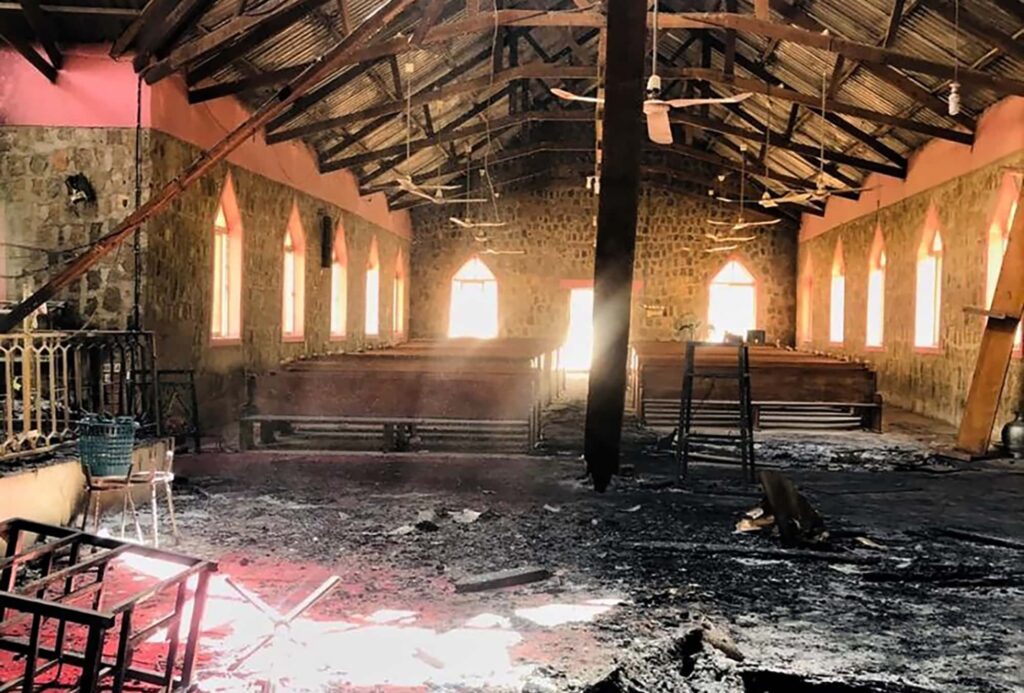
An earlier article reviewed the upsurge of violence in Nigeria this spring, the historical background of the crisis, and the testimony of Bishop Wilfred Chikpa Anagbe of the Catholic Makurdi Diocese in Nigeria regarding the nature and severity of Christian persecution in that country. Extensive documentation of the religious motivation of the violence, targeting above all Christians, but also Muslims who do not conform to the vision of Islam held by terrorist groups, was provided in a report from the Observatory of Religious Freedom in Africa covering the Oct. 2019-Sept. 2023 period.
The Nature and Scope of the Persecution Today
In addition to the very detailed analyses of ORFA, detailed information on violence in Nigeria in recent years is available from Open Doors, International and its Full Country Dossiers. Its most recent report, from March 2024, provides extensive narrative and statistics on the terror which now grips the country. Detailed statistics comparing numbers Christians and Muslims killed in states under particularly violent attack, in some cases listing individuals and what they lost, such as the one for southern Kaduna for May 2016-Sept. 2017 are available at the end of the 2024 Full Country Dossier.
The neutrality of the governing 1999 Constitution is dubious, since it frequently mentions “Sharia,” “Islam,” and “Muslims,” but never “Christ,” “Christianity,” or “Church.” Former President Buhari made a major step in his Islamization objective (noted in the previous article) by appointing mostly Muslims from the north to key positions in the nation’s coercive agencies (army, police, customs, civil defense, prisons, etc.) His successor, Bola Tinubu, has attempted to be more balanced in appointments, but for the first time ran on a Muslim/Muslim ticket, breaking the past precedent of a religiously balanced presidential ticket. Further, his vice-president, Kashima Shettima, is a Fulani believed to have a past association with Boko Haram. This does not bode well for the future. If anything should happen to septuagenarian Tinubu, Shettima would become President.
The killing of Christians is really a nation-wide problem, as was pointed out in a TruthNigeria article. Killers of Muslim northerners in the southern state of Edo were swiftly arrested, but after dozens of Christians were killed in Plateau State, there were no arrests Killing of Christians is extending into the south, as government policies regarding migration and desertification of grazing lands push Fulani southward. Benue State, in the upper part of the southeast, was once considered a southernmost reach of Islamists, but recently, as the linked article shows, it is now a focus of attack. Kyle Abts, head of International Committee on Nigeria has said that “despite the scale of the atrocities, no meaningful arrests have been made.”
The most likely period for attack is the rainy season, which varies depending on how far south one is, but commonly lasts from late spring through early autumn, Open Doors points out. Terrorists often attack during the rain, or at night, when people are in their homes. Farming communities rely on farms for food and income. Once a community has been devastated, they may go to IDP camps, or if it is possible to remain on their land, they will be without food, their crops and homes are destroyed, and they themselves are demoralized and suffering by loss, injury, or capture of loved ones. Women and children have lost their breadwinner and defender, men who have lost wives or daughters to kidnapping are continually tormented by what is happening to them, especially since the possibility of their recovery is unlikely. Open Doors observes that “attacks … are often tactical and targeted, aimed at crippling families and communities in the long-term. When Christian villages are attacked, it is often intended to fatally undermine and destroy the local church … Many flee from their houses and fields. There is constant fear. When night falls, there is always the danger of possible attack, and anxiety about what might happen to oneself and one’s family”
As the previous article noted, Nigeria has vast numbers of IDPs, many of them Christians, and they are not taken care of by the state or international agencies, as Open Doors has noted in its recent report. “Women and children are particularly vulnerable in such circumstances. Children are vulnerable to health issues, and women and girls to abuse and human trafficking. This situation is aggravated by the fact that the Nigerian government does little to assist these IDPs and is not curbing the situation that has created the crisis.”
Open Doors further reports that “Catholic leaders go so far as to claim that Nigerian Christians have become victims of a gradual process of ethnic cleansing at the hands of Fulani Muslims, with the complicity of the state. At a recent online conference, one leader from the diocese of Maiduguri ‘expressed frustration when he hears people refer to ‘clashes’ or ‘conflicts’ between opposing groups. ‘It is not a clash; it is a slow genocide. To displace people from their ancestral homeland, deprive them of their livelihood and butcher them is a form of genocide.’”
Against this, there are citizen guards for some vulnerable communities, “although they can hardly match the types and amounts of weapons their adversaries are using,” Open Doors remarks. Even this modest defense seems unacceptable to the Fulani militants, as one group demanded that they be disbanded. Yet Open Doors pointed out that many Christians are “still not willing to respond with violence.” On the other hand, “certain Christian young men who see their mothers and sisters raped and their fathers and brothers killed, will likely increasingly try to arm themselves and defend their families and villages. This is a very risky situation, because notwithstanding the concept of ‘just war’ (self-defense), it can easily lead to disproportional retaliation on Fulani villagers and other Muslims, as well as lead to outright banditry when ‘just war’ and ‘lust for personal gain’ get confused.”
Kidnapping and the Closure of Schools
An additional factor contributing to terror is kidnapping and the closure of schools. As with the closure of schools in the U.S. during the coronavirus shutdown, this seriously impacts students’ learning. As Bishop Anagbe said in his testimony, all schools in the Islamic dominated north were recently closed for five weeks during Ramadan, while information from UNICEF three years ago laments that just since December 2020, 11, 536 schools were at times closed “due to abductions and security issues.” A total of 1,436 students and 17 teachers were abducted. This not only impacts education but also creates anxiety and a local environment in which youth are drawn into violent groups. This, too, contributes to the Islamization objective. As Open Doors’ World Watch report notes, millions of children are thus consigned “to illiteracy, early marriage and poverty. The combination of high numbers of children and youth, a lack of education and employment opportunities and high levels of poverty will make recruitment for violent Islamic militancy easier, and given the atmosphere of high levels of impunity, turn the country into a ‘powder keg’, ready to explode. The resulting chaos and conflict will be the perfect breeding ground for making Nigeria a Sharia nation.”
Open Doors further observes that kidnapping, which commonly involves the payment of high ransoms for release, is intended to impoverish Christian communities, contributing to their second-class status in the north, and ultimately in the entire country. There is “intergenerational bankruptcy,” as “extended families found themselves forced to sell land and family assets to save abductees.” A church leader stated that “we in Christian communities know that kidnapping actually achieves the aims of terror. It shuts down schools, whole schools and it is the end of Western education in the North. That is a Boko Haram aim. It bankrupts and impoverishes extended families, whole congregations, as Christians will come together to try to free a pastor. And it is resulting in the flight of Christian communities.”
TruthNigeria has reported on the harrowing but inspiring account of a recent kidnapping, internment in an Islamic terror camp, and escape. Notably, the citizen guards in the Chrisitan town they escaped to warned them not to go to the military or police.
Sometimes the kidnapping of minors can come directly from the state. They are then enticed or coerced to accept Islam. Kano State in northern Nigeria is holding children taken from an orphanage falsely accused, according to a court determination, of being unregistered, kidnapping, and forgery. Children from the orphanage have not been released, despite a court order, with the claim that some have converted to Islam. “We are witnessing a dangerous pattern in which Christian institutions, particularly those involved in education or social care, are being systematically targeted in some northern states under the guise of regulation.”
The Spreading of Terror to Southern Nigeria
This needs to be emphasized. A shocking report from the International Society for Civil Liberties and the Rule of Law (InterSociety), which carefully follows the situation in Nigeria says that 20,000 Christians have been killed in southeast Nigeria over the past decade. It claims that 9,800 deaths were “jihad-related,” while 10,500 were caused by the Nigerian Armed Forces. Intersociety cites June 2015 as the start time of this period (notably, Buhari became president on May 29, 2015), and the killings have surged since 2020. Intersociety claims that the government is attempting to attack “Christianity’s cultural and religious origins in Igbo land” (southeast Nigeria). Christian Today also observes in the linked article that “jihadist activities are not only underreported but sometimes deliberately covered up.” The InterSociety report “also raises alarm over land acquisitions across the region supposedly made by third parties acting on behalf of jihadist groups – some presumably with links to state or federal government actors.” Intersociety calls on the U.S. government to reinstate Nigeria as a Country of Particular Concern and to further designate Fulani herdsmen as an Entity of Particular Concern.
A local article from Delta State in the far south reveals just how far the Fulani cattle herders have penetrated. The southeast of Nigeria, occupied largely by Christian Igbo people was until recently considered to be relatively safe. No more, apparently. Open Doors also cited in its dossier a special report on issues affecting Igbo people, in which Intersociety has said that “not less than 350 Igbo communities, villages and other locations are now invaded and permanently occupied by armed Fulani herdsmen and ‘imported’ Shuwa Arabs, also called ‘Cowmen’ in Arabic.’” There were 139 such communities in August 2019, but 350 by May 2020. InterSociety states that the alleged occupation “is vicariously, if not directly aided by the Government of Nigeria and its security agencies especially the Army and the Police.”
Open Doors said that “further research revealed that the invasion and permanent occupation of communities, villages and locations must be understood here differently than in the northern context. It seems the population was not directly driven away from their villages but in many cases found that their distant forests and farmlands had been taken over by Fulani militants (and Shuwa Arabs). Since then, the situation has not improved.”
Conclusion
In needs to be emphasized, as the summary for Open Doors’ World Watch List for 2025 does, that “more [Christian] believers are killed for their faith in Nigeria than anywhere else in the world.” The Islamic militants (Fulani militants, Boko Haram, ISWAP, and others) killed 3,100 Christians out of the 4,476 killed in WWL last reporting period, as noted by the Christian Post.
What America can do about the Nigerian crisis is limited. We cannot directly act against the extremist groups with military force, but the U.S. does have leverage. Most importantly, Nigeria can be restored to the State Department’s Countries of Particular Concern List, which lists nations with governments engaging in or tolerating religious persecution. This will make ending the persecution in Nigeria an American foreign policy objective. The International Committee on Nigeria has indicated the benefits of CPC status for Nigeria. Also, Nigeria receives significant American military, financial, and humanitarian aid ($8.1 billion in the last two decades). This should not continue undisturbed if the Nigerian government will not act through its army and police to protect rural communities.
Finally, Christians should respond to the crisis with frequent prayer, and where possible, advocacy and support, making legislators and others in society aware of what is happening and supporting those actively engaged in alleviating suffering in Nigeria.
No comments yet


Leave a Reply