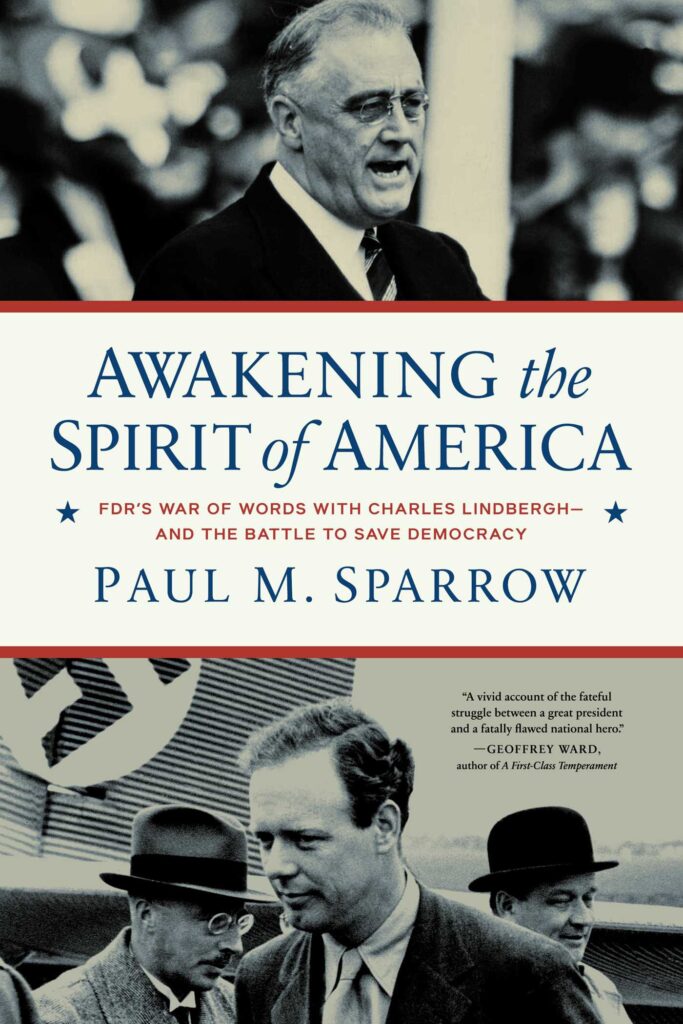

Awakening the Spirit of America
FDR’s War of Words With Charles Lindbergh―and the Battle to Save Democracy
By Paul M. Sparrow
Pegasus, 2024. 304 pages.
Imagine a Europe ravaged by war and a United States torn between isolationists and interventionists. The year is 1939, and the stage is set for an epic battle of words between President Franklin Delano Roosevelt (FDR) and isolationists led by Charles Lindbergh. In Paul M. Sparrow’s book Awakening the Spirit of America, the public debates and rhetorical volleys are set against the background of the Second World War and domestic turmoil.
Sparrow provides a compelling description of those tumultuous years and the rhetorical battle between conflicting ideas. He argues that America’s support for the United Kingdom and the allied cause was not inevitable but the result of conscious effort by FDR and his supporters to awaken Americans to their moral sensibilities and the dangers of fascism.
Sparrow is the former director of the Franklin D. Roosevelt Presidential Library and brings a wealth of knowledge on the President to this book. He vividly recounts how FDR and Lindbergh were complex individuals with distinct beliefs and personalities.
Roosevelt is described as trying to lead a country woefully prepared for the coming storm, while straining against a congress and a public who do not understand the danger from Nazi Germany. Through public speeches, media interviews, his famous “fireside chats”, and clever political cunning, FDR used his rhetorical skills to push the country in an interventionist direction.
Conversely, Lindbergh stalks Roosevelt throughout the book as his primary antagonist and the speaker of the isolationist movement. Using his fame and considerable charisma, Lindbergh was often provided space by isolationists and anti-Roosevelt media moguls and industrialists to publicly rebuke Roosevelt and his interventionist position. Simultaneously, Lindbergh received help from antisemitic or pro-Nazi elements who wanted to use him to amplify their message.
Sparrow documents these dueling narratives, and it provides a fascinating insight into the political debate of the time. It also documents the monumental task FDR faced in trying to bring the country about to seeing the evil of Nazi Germany and the need to confront it. While public opinion eventually turned in favor of Roosevelt, he spent years fighting an uphill battle against isolationist sentiment and American prejudice.
Additionally, this book explores the ideological turmoil and foreign authoritarian influence in 1930s America. Some of the most interesting movements detailed in the book are the collaboration between Lindbergh, the isolationist movement, and pro-Nazi agitators.
Readers will also be surprised by the echoes of modern struggles with propaganda and disinformation in political discourse. When Roosevelt spoke of “certain techniques of propaganda, created and developed in dictator countries, have been imported into this campaign,” he referred indirectly to Nazi-funded misinformation campaigns which had links to prominent Americans, including members of Congress.
However, the book is not entirely without flaws. Although Sparrow frames the narrative as a head-to-head struggle between Franklin Roosevelt and Charles Lindbergh, Lindbergh occasionally slips from view while lesser isolationists, or lengthy excursions into Roosevelt’s wider presidential record, take center stage. These digressions are most obvious when Sparrow turns to FDR’s domestic agenda. For example, Sparrow makes multiple digressions to explore FDR’s record on civil rights, particularly events leading up to Executive Order 8802. While it was a significant step toward ensuring equal employment opportunities for all Americans, it received no counterpoint from the isolationist side and feels somewhat detached from the book’s central debate between Lindbergh and FDR.
Despite these flaws, Sparrow demonstrates that the morally correct decision to prepare for a confrontation with the fascist powers and to defend higher moral principles was not an inevitable force of history. Whether these Americans were well-intentioned citizens who Roosevelt referred to a “…small group of sincere, patriotic men and women whose real passion for peace has shut their eyes to the ugly realities of international banditry and to the need to resist it at all costs” or ideological allies of totalitarian regimes, there were significant elements in American society that favored the position of the isolationists. However, that fate was avoided due to strong leadership from FDR and a bipartisan effort of Americans to reawaken what Roosevelt termed the “spirit of America” and reject the evil arising from malicious actors, both foreign and domestic.
Overall, Sparrow offers a brisk, accessible portrait of 1930s America and FDR’s uphill battle to shift public opinion. FDR’s story shows how principled leadership can rekindle a nation’s sense of purpose in the face of moral apathy. Readers will gain clear insight into a pivotal moment of history and wrestle with important questions regarding the spirit of America.
More from IRD:
Watch IRD President Mark Tooley’s interview with Paul Sparrow, author of Awakening the Spirit of America: FDR’s War of Words With Charles Lindbergh—and the Battle to Save Democracy here.



Comment by David on May 1, 2025 at 8:22 am
“The three most important groups who have been pressing this country toward war are the British, the Jewish and the Roosevelt Administration.”—Charles Lindbergh (11 Sep. 1941).
In three months, the US would be at war with Germany and Lindbergh had nothing more to say. Henry Ford, who wrote “The International Jew,” might be mentioned as well. Hitler himself stated this book influenced his actions. He honored Lindbergh and Ford with the Order of the German Eagle and the Grand Cross of the German Eagle respectively.
Comment by Tim Ware on May 2, 2025 at 12:23 am
FDR said in one of his “fireside chats,”Your boys will not be sent into any foreign wars,” at the very same time he was wrangling and machinating secretly behind the scenes to send them. A pure liar. My grandmother never forgave him for that lie, as he sent her boy to the foreign war, and that boy never returned.
And for what? To establish the USSR as a world power, turn half of Europe over to communism, and establish the state of Israel.
Comment by David on May 2, 2025 at 9:18 am
Americans were naive to think world events would not involve the US. The Japanese attack and the declaration of war by German against the US ultimately changed their thinking. A major aspect of supporting the establishment of Israel by the Allies was the desire not to have to deal with Jewish refugees in their own countries. This feeling goes back to the Balfour Declaration whose author had laws passed to prohibit Russian Jews from entering the UK.
Comment by John on May 3, 2025 at 12:07 am
Tim Ware,
Are you actually trying to make the case that things would have been better if the US hadn’t joined the fight against fascism and left the Nazis to finish the Final Solution and likely become the first to acquire the atomic bomb? If we had not joined the fight in Europe and the Pacific then most likely either the Axis Powers would have been victorious or the USSR would still turned them back at Stalingrad and proceeded to become an even larger and more dangerous superpower. Either way we would ended up fighting later rather than sooner and the odds stakes more against us. Both my grandfathers fought in WWII and I’m proud to be named after both of them. It’s sad that some people can be so cynical of the past even as they continue to enjoy blessings of those did so much make safer for them.
Comment by Tim Ware on May 3, 2025 at 7:21 pm
John,
You remind me of the politicians who, when they contracted the coronavirus after taking the vaccine, parroted the line that they would have been a lot sicker had they not taken the vaccine.
We cannot surmise what “could” have happened or “would” have happened. We only know what did happen.
Have you forgotten the millions of Soviet citizens killed by an emboldened Stalin, and the millions who have been killed in various United States bombings and incursions in the Middle East in order to safeguard Zionosm? Not to mention the million or so Germans killed by the Soviets after the war….not to mention the approximately 500,000 killed in the firebombing of Dresden….not to mention the tens of thousands (maybe more) of Gazans slaughtered by Israel…not to mention that the Middle East has been a disastrous mess since 1945 with untold cost in human suffering…and I could go on and on.
Comment by Jeff on May 6, 2025 at 1:39 am
Tim said: “FDR said in one of his “fireside chats”,”Your boys will not be sent into any foreign wars,” at the very same time he was wrangling and machinating secretly behind the scenes to send them. A pure liar.”
Well, he was a Democrat. What did America expect, besides a pure liar?