
I’ve long been critical of the Episcopal Church for effectively resigning itself to the role of a “boutique church.”
Episcopalians, broadly, no longer believe that they offer something unique to the world or that most people would be particularly interested. Instead, they’ve found themselves catering to a caste of highly educated (and increasingly aged) white liberals. The problems are apparent; the group is less likely to procreate and, when they do, their children do not remain within the Church. Data bears this out, and the denomination’s priorities reflect this skewed demographic: caricature of the Episcopal Church as a chaplaincy to lefty professors and a handful of identity categories is deserved.
This is compounded by a form of universalism and religious humanism that has displaced the Gospel of Jesus Christ, sapping evangelistic energy. No kids and no converts, save for a few liberal Catholics and Exvangelicals. Readers of this blog know that this is nothing new.
Left unsaid is that Anglicans outside of the Episcopal Church could very well be painting themselves into another corner.
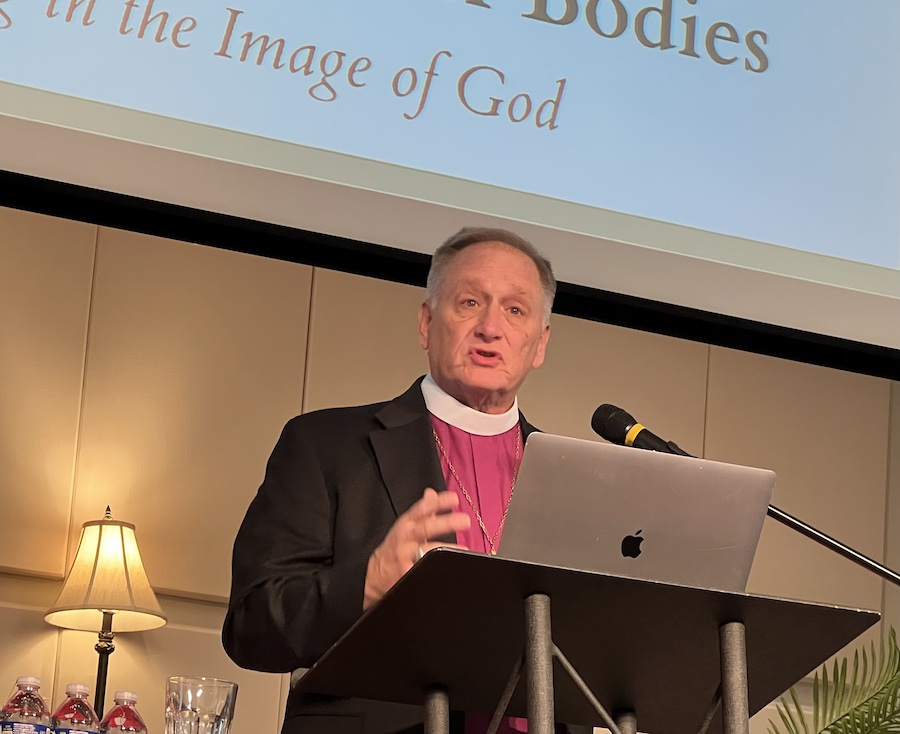
“Our studies show that the Anglican Church is in growth,” Bishop Derek Jones of the Anglican Church in North America (ACNA)’s Jurisdiction Armed Forces and Chaplaincy recently shared in a presentation on religious liberty and traditional Christian values. “But, I believe that what’s going on is a great shift.”
Jones pointed to data from groups like Pew and Barna showing that faithful Christian communities that maintain Biblical teaching are actually growing while denominations that accommodate secular values continue their decades-long decline.
“Right now it is the historic sacramental churches: Orthodox, Roman, and Anglican that are growing, along with Messianic Judaism while all other faith groups are on decline. All.” Jones emphasized. “And I believe that the Anglican Church has simply been the benefactor of those faithful Christians from Protestant denominational groups finding their way to an Anglican Church.”
While I suspect that Jones might be overstating Orthodox growth, and possibly unaware that Roman Catholicism struggles with retention more than any Christian group in the United States, he’s right about the nature of the present growth of Anglicanism. Even an enthusiastic cheerleader of ACNA like me needs only look around in our most vibrant congregations to see that we’re witnessing consolidation, not conversion from unbelief. We also tend to draw disproportionately from the professional class, just as Episcopalians do. But, as a century of Pentecostal growth showed, and a century of Methodist and Baptist growth before that, reaching the working class with the Gospel is essential: the Gospel message is for everyone.
Jones spoke March 1 at the St. Luke’s Anglican Theology Conference in Hilton Head Island, South Carolina, where he asked how many present had their origin in a Protestant faith group.
Nearly everyone raised their hands.
“Does that answer your question? We’re coming to the end of that growth,” Jones flatly declared. “It’s time for us as a church to say we have a responsibility to our communities to be a beacon of light of the truth of the Gospel. It’s time for us to be going up and saying ‘do you know Jesus Christ as your personal Lord and savior?’”
Jones wasn’t seeking to lay blame: “I don’t always do the best either,” he acknowledged. But he offered a clear-eyed view that Anglican churches attracting a narrow subset of Protestants (usually Baptists and Presbyterians considering a liturgical expression or Methodists exiting a rapidly liberalizing United Methodist Church) won’t see that same pipeline of new members indefinitely, and the cultural headwinds of secularism will hit Anglicans, too.
Episcopalians and other Anglicans in North America may see themselves as worlds apart, and that’s not without basis. We Anglicans can be grateful that many of these faithful Protestants are deepening their Christian discipleship in our churches and that our rates of procreation appear healthier than within the Episcopal Church (yes, procreation is a form of church growth – it’s how the Amish double in size every generation).
That said, we can learn from the mistakes of the Episcopal Church and not paint ourselves into a demographic corner. God’s view is more expansive than our own: he’s calling us not to recline and wait for others to come to us, but to go to them.
More:
Watch Bishop Derek Jones’ talk, “Legislating Morality in the Midst of Cultural Wars” from the St. Luke’s Anglican Theology Conference here.
‘To Be Human’: Anglicans Consider Ourselves, Our Souls, Our Bodies




Comment by Dan on April 4, 2025 at 5:18 pm
Bishop Jones forgot to mention Confessional Lutherans; e.g. the LCMS, in his list of historically sacramental and liturgical churches.
Comment by Jeffrey Walton on April 4, 2025 at 5:38 pm
Dan, Confessional Lutherans are wonderful friends, and I wish them success as ecumenical partners in sharing the gospel, but the LCMS has been in steady decline for many years now. Every LCMS district has experienced decline across the past decade, some as much as a 25 percent loss. Yes, the LCMS decline isn’t as great as that of the ELCA (small comfort) but the LCMS is really struggling to reach people in this country who aren’t of Northern European ancestry. This past year the IRD had an LCMS intern living in DC who had to go to Alexandria to find an LCMS congregation because there simply wasn’t one in the Nation’s Capital that is active in any sense.
Comment by Russell on April 4, 2025 at 8:29 pm
Let’s hope ACNA couples can breed large families. That may be the single best method for expanding the denomination, given ACNA’s association with “the professional class” rather than working-class Americans. Consider the $140 tickets being sold to eat a three-course dinner next month with Archbishop Wood and his wife at a VA bar and grill. Rather steep for the average person.
Comment by William Millsaps on April 4, 2025 at 9:21 pm
The Episcopal Missionary Church’s founding. Bishop was The Rt. Rev. A. Donald Davies. The original clergy group were almost all priests from The Episcopal Church. Almost all the laity were also from that organization. While we are still tiny almost all the clergy now never even attended an Episcopal Church. Often I find myself to be the only former Episcopalian in a meeting of clergy and laity. Yes , a lot of our clergy and laity were Baptists or Presbyterians or from some other Protestant group, but others had never been baptized or been regular attendees of any church.
Bishop Derek Jones is right. We are excited when college students show up, but we even more excited when a person whose family has never had a college graduate shows up and sticks with us. Recently, we have had a number of adult baptisms. This is good news.
Comment by Tim Ware on April 4, 2025 at 10:59 pm
It is not an exaggeration to say that mainline Christianity, of whatever stripe, is for “those who can afford it.” $140 to eat beside the bishop? Sounds exactly like what Jesus would have done!
The sooner these organizations go out of business, the better. They are the ones responsible for the destruction of American Christianity.
Comment by Tim Mc on April 5, 2025 at 8:13 am
Years ago, my family was hiking in Rocky Mountain National Park and as we rounded a corner, there was a priest setting up a table to have the Eucharist available. He was either an Anglican or Roman Catholic. I don’t know if he planned on having Mass said or not. He was not ready and just setting up his stuff. In todays world, I would have stopped and talked, but my family was in a hurry, to get to the top of the mountain trail, so we moved on.
This is what should happen in todays world, meet people where they are. Most weekends families are at ball games with their kids playing sports instead of in church. Ask the powers that be to set up a table and have communion available.
John Wesley preached in a field, or where the farmers and miners and people were. We should do the same today.
Comment by David on April 5, 2025 at 6:51 pm
The European-American population in the US has had birthrates below replacement level for years. Denominations which depend on these members are going to shrink. Immigrants tend to be Roman Catholic or non Mainline Protestant. The Amish are an exception to this, but even they are exceed by Hassidic Jews in the US who have an average of 8 children per family.
The plight of denominations is not unlike that of classical music. This has not lost its artistic value, but society has turned away from it. In the late 1940s, audiences reflected the typical adult population. Today, they tend to be the older generation. The Met Opera was frequently sold out in the 1970s, but now, only about 70% of the tickets are sold. Attempts to attract a younger audience have generally failed.
The Anglican Church has cathedral tradition of fine music, though various forms can be found there. I suspect this sadly turns people away. One cannot ignore trends in society.
Comment by Tim Ware on April 6, 2025 at 12:09 am
Well…I don’t think anyone can accuse the denominations of ignoring the trends in society. Their fatal flaw is that, liberal and conservative alike, they always go whichever way the wind blows. In my experience over the years, Methodist groups are among the worst for that…never saw a trend they didn’t jump on.
Comment by Gary Bebop on April 7, 2025 at 2:40 pm
“. . . never saw a trend they didn’t jump on.” Tim nails it. Succinct and right on point. My liberal coastal conference punished the faithful and promoted the antithetical.
Comment by James on April 7, 2025 at 3:03 pm
I attended a PCA church for several years that grew in membership while I was there. Everyone bragged about how we were growing but it seems like most of the new members I spoke to were simply leaving a UMC church down the road because it was getting too liberal.
Comment by Dave Jackson on April 18, 2025 at 12:49 pm
My experience with the Episcopal Church: if the hierarchy disagrees with Holy Scripture, then use the Holy Scripture Eraser and justify through convoluted multi-syllabic logic the unjustifiable choices and lifestyles of Alphabet People or any trendy political cause originating in a faculty lounge.
Brothers and sisters, what we have here is a denominational circular firing squad.
I didn’t leave the Church—the Church left me as well as thousands of others.