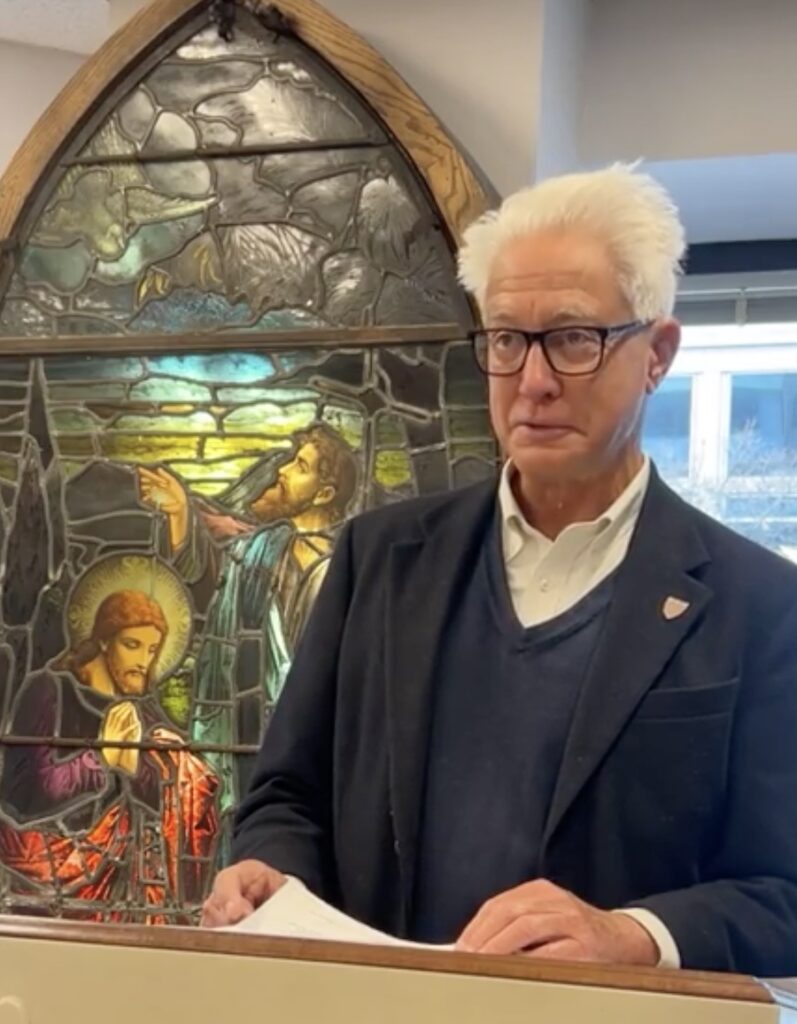

The Institute on Religion and Democracy hosted the Rev. Dr. Richard Allen Hyde, Pastor of Community United Church of Christ of San Carlos, to deliver our Wednesday Worship sermon on March 26.
Dr. Hyde, a Congregationalist minister, spoke to the IRD staff on the passage of Isaiah 55:3-11 and “Before We Were the Land’s.”
Video of the worship service can be accessed below as well as text of the sermon.
If you are interested in joining IRD for an upcoming time of worship and lunch together, please contact Events and Outreach Director Sarah Stewart at [email protected].
Before We Were the Land’s
Sermon, March 26, 2025
Institute on Religion & Democracy
The 3rd week of Lent
Isaiah 55:3-5; 10-11
Incline your ear, and come to me;
hear, that your soul may live;
and I will make with you an everlasting covenant,
my steadfast, sure love for David.
Behold, I made him a witness to the peoples,
a leader and commander for the peoples.
Behold, you shall call nations that you know not,
and nations that knew you not shall run to you,
because of the LORD your God, and of the Holy One of Israel,
for he has glorified you.
. . . .
For as the rain and the snow come down from heaven,
and return not thither but water the earth,
making it bring forth and sprout,
giving seed to the sower and bread to the eater,
so shall my word be that goes forth from my mouth;
it shall not return to me empty,
but it shall accomplish that which I purpose,
and prosper in the thing for which I sent it.
Sixty-six years ago today, March 26, 1959, Robert Frost held a celebration for himself on his 85th birthday, at the Waldorf-Astoria hotel in New York City. At the accompanying press conference, a reporter asked him – apropos of what I do not know – about the decay of New England. Frost replied,
“The next President of the United States will be from Boston. Does that sound as if New England is decaying?”
As murmurs and chuckles arose up from the invited throng, the reporter asked whom he meant.
“He’s a Puritan named Kennedy,” Frost said. “The only Puritans left these days are the Roman Catholics.”
It took a poet to say it (and make us wonder ever after what he meant). Scientists examine things and separate things and refine things and define things and decide what goes with and follows from what in order to find the key causal link and thereby predict the future; poets are un-scientists. Poets put things together; put things together that don’t seem to belong together in order to shake us up a bit, startle us into a deeper understanding; or maybe just stop grasping for understanding and sit for a moment in wonder.
A year and a half later, in response to the news that Kennedy had won the election, Frost called it “a triumph of Protestantism – over itself.” A few months after that, Frost recited one of America’s greatest poems by heart on the sunny, cold afternoon of President Kennedy’s Inauguration:
“The Gift Outright”
The land was ours before we were the land’s.
She was our land more than a hundred years
Before we were her people. She was ours
In Massachusetts, in Virginia,
But we were England’s, still colonials,
Possessing what we still were unpossessed by,
Possessed by what we now no more possessed.
Something we were withholding made us weak
Until we found out that it was ourselves
We were withholding from our land of living,
And forthwith found salvation in surrender.
Such as we were we gave ourselves outright
(The deed of gift was many deeds of war)
To the land vaguely realizing westward,
But still unstoried, artless, unenhanced,
Such as she was, such as she would become.
If you have trouble understanding Frost’s poetry, listen to the following prose, written by Daniel Boorstin, historian and Librarian of Congress:
With characteristic anachronism, Americans had their nation first and paid the price afterward. The full price would not be paid until nearly a year after the nation declared itself independent.
Before Independence, Americans were both British subjects and citizens of Massachusetts, New York, Virginia, or some other colony. After independence, they ceased to be Britons, but had not yet become Americans. There was not yet an American nation to command their loyalty. Still they remained Virginians, or colonists of some other stripe, and their primary and continuing loyalty remained to the own colony, now become a state.
Although Americans lacked the feudal past which plagued the European nation-makers in their efforts to unify their countries, there was an American counterpart. Here space played the role of time. If American history had been brief, American geography somehow made up the difference.
Biblical history and American history both begin with the promise of land. This American land of course has shaped us all, but the book we arrived with has shaped us as well. Indeed, that book shaped us to be ready for this land before we knew it was there.
Simply being born here – as most of us here today were – made John F. Kennedy an American. Being baptized and receiving all of the sacraments of the church except Holy Orders, made him Roman Catholic. Growing up in New England, attending New England schools including Harvard, the grandaddy of them all, made John F. Kennedy a Puritan, someone profoundly shaped by the book and all the aftershocks of the Reformation and the English civil Wars.
Whatever our connection to the geographical home of Puritanism, so are we all. What Lucien Price wrote almost 100 years ago in his review of Builders of the Bay Colony (by Samuel Eliot Morison, in The Atlantic Monthly, September 1930) is still true:
“The Puritan tradition remains the New England schoolmaster of the nation. Detest him we may, but respect him we must. Many of his former pupils hate him like the very Devil. That is nothing to him. The fact remains that he made men of us.”
Older and even more respected authority Alexis de Tocqueville wrioe two centuries ago: “I think I can see the whole destiny of America contained in the first Puritan who landed on those shores … “
We are made Americans by a having a land in common and a story in common and the essence of that story is living in covenant; living in covenant with God and with one another in mutual responsibility; because were God’s before we were the land’s.
Some 2,600 years ago the prophet Isaiah addressed his people:
Behold, you shall call nations that you know not,
and nations that knew you not shall run to you,
because of the LORD your God, and of the Holy One of Israel,
for he has glorified you.
We all know that Puritan and Puritanical survive in our language now mostly as epithets. We need to reclaim that heritage – our common heritage – for its forward-thinking and creativity.
Nations we knew not would and nations Isaiah knew not indeed have run to us for protection and for leadership; protection because we are wealthy and powerful; for leadership because we are trustworthy and reliable; people who abided by covenant; people who could put people and ideas together for something new and creative.
Only in America could Walt Whitman write:
Here is not merely a nation but a teeming nation of nations. The Americans of all nations at any time upon the earth have probably the fullest poetical nature. The United States themselves are essentially the greatest poem.
Only in America could people torn apart by history be put back together. Only in America could Protestantism triumph over itself and, in a startling change of roles, be the greater Christian communion that tolerates the lesser; only in America could Protestants and Catholics freely intermarry; only in America could so many people arrive and move around and work together for the common good.
Only in American could a small school founded by English Puritans adopt an alma mater that praises the Puritans and sing it to an old Irish tune, which concludes:
With freedom to think, and with patience to bear,
And for right ever bravely to live.
Let not moss-covered error moor thee at its side,
As the world on truth’s current glides by
Be the herald of light, and the bearer of love,
Till the stock of the Puritans die.
Therefore:
as the rain and the snow come down from heaven,
and return not thither but water the earth,
(making it bring forth and sprout,
giving seed to the sower and bread to the eater,)
so shall my word be that goes forth from my mouth;
it shall not return to me empty,
but it shall accomplish that which I purpose,
and prosper in the thing for which I sent it.
There is yet more light and truth to break forth from God’s holy word on this continent. Let us go forth and be that light and that truth.

Comment by Thomas on March 29, 2025 at 8:51 pm
John F. Kennedy was from a time when the Roman Catholics from hs family were actually Roman Catholics, Nowdays they have almost all committed apostasy and follow their party has their true religion.