
[Editor’s note: read Part I of Riley Case’s series here. Part II is here.]
Is there hope for United Methodism in America?
The question comes at a time in America’s religious life when roughly one-quarter of all U.S. United Methodist churches have disaffiliated primarily because they hold to a traditional understanding of human sexuality, marriage and the family. Mainline denominations such as Methodists, Episcopalians, Presbyterians, United Church of Christ, and Christian Church (Disciples of Christ), which once represented more than half of American Protestantism, now represent only 11 percent of the whole. The percentage of Americans who consider themselves Christian is decreasing while the number of “nones” (no special religious affiliation of any kind) is increasing.
Despite these discouraging trends, many of our denominational leaders speak of a bright future. One prominent large church pastor in 2023 stated “I have never been more hopeful for the United Methodist Church than I am at the present moment.”
Others of us, because of a church that has nourished us through the years, and because we believe that there are still vital, evangelical churches and ministries that are, or at least have the potential, of bearing much fruit, are still committed to a denomination that has been so much a part of our lives. This is despite the fact that United Methodism faces serious problems. So, and this is the thrust of this article, drastic changes and new directions must be a part of United Methodism’s future.
First, however, we must admit we have a problem.
Methodist largely defined the word “evangelical” in its American context. Despite the vision of the early Puritans and other Christian groups, Christianity, by the time of the Revolutionary War, was in trouble. Deism was the religion of preference for several of the founding fathers. Only 10 percent of the American population were church members. However, when Methodism organized in 1784, Francis Asbury is said to have proclaimed, “O American, America, God will make it the glory of the world for religion.”
Early preachers were charged, “You have nothing to do but save souls” (which is not all that different from “making disciples of Jesus Christ for the transformation of the world”). Methodism introduced revivalism, the altar call, the mourner’s bench, the camp meeting, and the new birth and so swept the American frontier that, by 1850, one out of every three Americans was a church member and one-third of that group was Methodist. Methodists, along with Baptists, so influenced American society that theological evangelicalism became the anchor of American religious culture. All of this happened, it must be noted, for Methodists without the benefit of boards, agencies or seminaries.
Then several things happened. Methodism, which originally reached the poor, became respectable. Methodism was the first Christian church in America which attracted African-Americans, both slave and free. By 1865 seven of every 10 former slaves who joined any church had joined a Methodist church. Methodism opposed frills, jewelry, and ostentatious living, but by the last half of the 19th century this was changing. Methodism committed itself to education and social standing. By 1900 the number of African-Americans who identified as Baptist surpassed the number of African-Americans who identified as Methodists. Methodists began establishing colleges and seminaries. One leading seminary, Boston, was dominated by well-known theologians such as Borden Parker Bowne, who spoke of the necessity for drastic change in the church:
The church has need of a body of scholarly investigators to do its intellectual work. They will have the function of formulating the spiritual life so as best to express it and keep it from losing its way in swamps of ignorance and superstition. They will have to adjust religious thoughts to the ever advancing thought of cultivated intelligence so as to remove endless misunderstanding.
In other words, the more learned among us, not ordinary people, should be entrusted to make decisions for the denomination. By this time Methodism was already defining the word “mainstream,” which is a word that defines Christian groups who were (are) respectable citizens, community leaders, and not given to religious excesses. Even then, however, Methodists were known for strong moral stances. They opposed alcohol, sexual immorality, and “worldliness” of various forms. They also strongly supported the importance of the family.
In 1890 Methodism still was the religious choice of 18% of Americans (these figures taken from Starke and Finke, The Churching of America, 1776-1990, Rutgers University Press, 1990). However, by 1926 this had slipped to 12%; by 1985 it was 6.4%. Today it has slipped to less than 3%. In the 1915 edition of Yearbook of Churches (for America) the combined membership of the Methodist Episcopal Church, Methodist Episcopal Church South, the Methodist Protestant Church, the United Brethren Church and the Evangelical Churches—the denominations that today make up the United Methodist Church—totaled 6,534,051 members, almost two million more members than today. And this when the population of the U.S. was 100 million while today is over 350 million.
How else have things been changing? The groups that today make up the United Methodist Church have for some time been trending more and more toward institutionalism, liberalism, and bureaucracy. In 1923 a number of independent agencies were combined to form what we today know as Church World Service. By the mid-1920s every seminary in the Methodist Episcopal Church and the Methodist Episcopal Church South had declared that their theological perspective was that of modernism. By the 1950s the Discipline of the Methodist Church declared that only church school material prepared by the Methodist Church was to be used in “church school” classes (other churches spoke of “Sunday schools” but Methodists wanted even the language changed). Not only that, but hymnals and audio-visuals and evangelists and missionaries and mission projects were only to be used that were “approved.” Para-church groups were suspect. I remember an article in Classmate, the take-home paper for teen-agers, which declared that Youth for Christ and Campus Crusade, because they were dominated by persons who had a different understanding of Christianity, should not be supported by Methodist youth. The leadership of denominational agencies and publications was dominated by what might be considered as a ruling elite, not at all hesitant to inform ordinary church members what was acceptable and what was not.
The 1968 Methodist-Evangelical United Brethren (EUB) merger resulted in what many today consider even more bureaucratic overload. Four new superboards, Higher Education, Discipleship, Global Ministries, and Church and Society operated like independent fiefdoms. Another agency, the General Council on Ministries, meant to coordinate the work of the boards, was inherited from the EUB side of the merger. But it basically was powerless and eventually was replaced by another bureaucratic-dominated board, the Connectional Table. The 1968 merger created another voice for the bureaucracy, the Book of Resolutions. The church had passed resolutions before 1968 which appeared in the Book of Discipline, but now a whole volume was to be dedicated to statements and resolutions generated primarily by boards and agencies. These would instruct not just the church but society in general how it ought to think and act. At first only a few resolutions were approved—3 in 1968, 2 more in 1970 and six more in 1972. Then they began to multiply. In 1984 the General Conference passed 62 resolutions. By 2016 The Book of Resolutions consisted of 781 pages. Of the resolutions included were 19 on the subject of racism, 18 on Native Americans, 45 on the United Nations, and 22 on women (only 3 were on men). As an indication of the church’s changing priorities, the 2016 Book of Resolutions contains only one resolution on evangelism and one on motherhood.
But ordinary Methodists (and EUBs) were (are) not so easily controlled. One embarrassing study revealed that something like 90% of the churches in the M.E. Church South in the 1940s, were using hymnals in their Sunday schools that were not on the approved list. When I became a district superintendent in 1983 I did my own survey of the churches in my district. 27% were using materials in their Sunday schools not approved by the Methodist Board of Discipleship. Something like 25% were not using the UM hymnal. Many churches were supporting missionaries and projects related to non-denominational agencies. At that time, in contrast to today, programming was done primarily on a district level. The district sponsored church camps, mission saturation programs, Lentin emphases, marriage enrichment programs, and many fellowship events. Now, many or most of these areas of programming are the responsibility of conference staff and agencies.
What about conference staff? When I first entered the ministry in the 1950s my North Indiana Methodist Conference had one staff person relating to camping and one part-time conference treasurer, who operated out of his home. But in the name of efficiency and increasing institutionalism, conferences needed to get bigger and so five former Methodist or EUB conferences have been merged into one Indiana Conference. The responsibilities of the staff persons have changed as has the number of staff. According to the present conference website, 33 staff persons are now employed by the conference, not including district superintendents and office help (such as administrative assistants). To be fair, the numbers include a number of people who are part-time, but it still seems excessive. At least five of the conference staff have responsibilities in areas such as diversity, inclusivism, and justice ministries. All of this is in a conference which, after disaffiliation, has about half of the membership as the various conferences together reported sixty years ago.
I still keep contact with local churches who have disaffiliated from the UMC. While many of these churches have become part of a new denomination, the Global Methodist Church, a number of others have chosen to stay independent. One reason, which I have heard on several occasions, is that they fear even the new Global Methodist Church will slide into institutionalism and bureaucracy, with committees and agencies in far off places telling them how to run their churches. This is unfortunate in part because it reflects some cultural trends that are not all positive. We live in a time when we are not nearly as open as we once were to institutionalism and bureaucracy and, to use a Methodist term, connectionalism. So there must be a middle way.
United Methodism has too many boards, agencies, and experts with agendas that often are at variance with persons in the local church. We are already cutting back on some of this simply because we do not have the funds to support everything we have done in the past. The church needs funds for its mission. It also needs the expertise of gifted leaders. To balance all of this should be on a high priority list for United Methodism.
More from IRD:
United Methodism, Mainline Protestantism, Christian Faith – Is There Hope?
The Future of United Methodism – Part II


Comment by Gary Bebop on March 25, 2025 at 12:08 pm
Riley has the heart of an institutionalist. He says, “We live in a time when we are not nearly as open as we once were to institutionalism and bureaucracy and, to use a Methodist term, connectionalism. So there must be a middle way.” The narrative is a familiar, worn path. The “middle way” is a nostalgic meme. But do you believe it has efficacy?
Comment by Dan on March 25, 2025 at 3:09 pm
I believe the following quote from the article sows the seeds of UMC and general evangelical decline –
“Early preachers were charged, “You have nothing to do but save souls” (which is not all that different from “making disciples of Jesus Christ for the transformation of the world”). Methodism introduced revivalism, the altar call, the mourner’s bench, the camp meeting, and the new birth”
No preacher ever saved a soul – that is the province of the Holy Spirit alone. Revivalism, altar calls, camp meetings, and the new birth place an overemphasis on an emotionally based decision theology that can easily lead to shallow discipleship. Faithfully preaching the Gospel, rightly administering the Sacraments, and thorough, orthodox catechesis of converts and new members is what will build a solid church that can withstand the vicissitudes of the prevailing cultural zeitgeist.
Comment by Different Steve on March 25, 2025 at 5:40 pm
The statement “No preacher ever saved a soul – that is the province of the Holy Spirit alone” can be critiqued from several angles:
The Role of Preachers: While the statement emphasizes the Holy Spirit’s role in salvation, it may downplay the significant influence that preachers and spiritual leaders can have in guiding individuals toward faith. Preachers often serve as vessels for conveying spiritual truths, providing encouragement, and fostering community, which can lead individuals to open their hearts to the Holy Spirit’s work.
Human Agency: The assertion could be seen as overly deterministic, suggesting that human actions (like preaching) have no role in the process of salvation. Many theological perspectives argue that while the Holy Spirit is essential, human response to God’s call and the actions of others can play a crucial role in an individual’s journey to faith.
Biblical Context: The Bible contains numerous passages that highlight the importance of preaching and teaching in spreading the Gospel (e.g., Romans 10:14-15). This suggests that while the Holy Spirit is the ultimate agent of salvation, the act of preaching is a vital means through which people hear the message and respond.
Community and Relationship: Salvation is often viewed as a communal experience within many faith traditions. Preachers, mentors, and fellow believers can create an environment that nurtures faith and encourages individuals to seek a relationship with God. The statement may overlook the relational aspect of faith development.
Diverse Perspectives: Different Christian denominations and theological traditions may interpret the relationship between the Holy Spirit and preaching differently. Some may emphasize the cooperative role of human effort and divine grace, while others may lean more heavily on the sovereignty of the Holy Spirit.
In summary, while the statement underscores the centrality of the Holy Spirit in salvation, it may benefit from a more nuanced understanding of the interplay between divine action and human agency, as well as the important role that preaching and community play in the faith journey.
Comment by David on March 26, 2025 at 7:34 am
It is refreshing to see an accurate portrayal of religion in early America instead of the popular myth that America was founded as a Christian country.
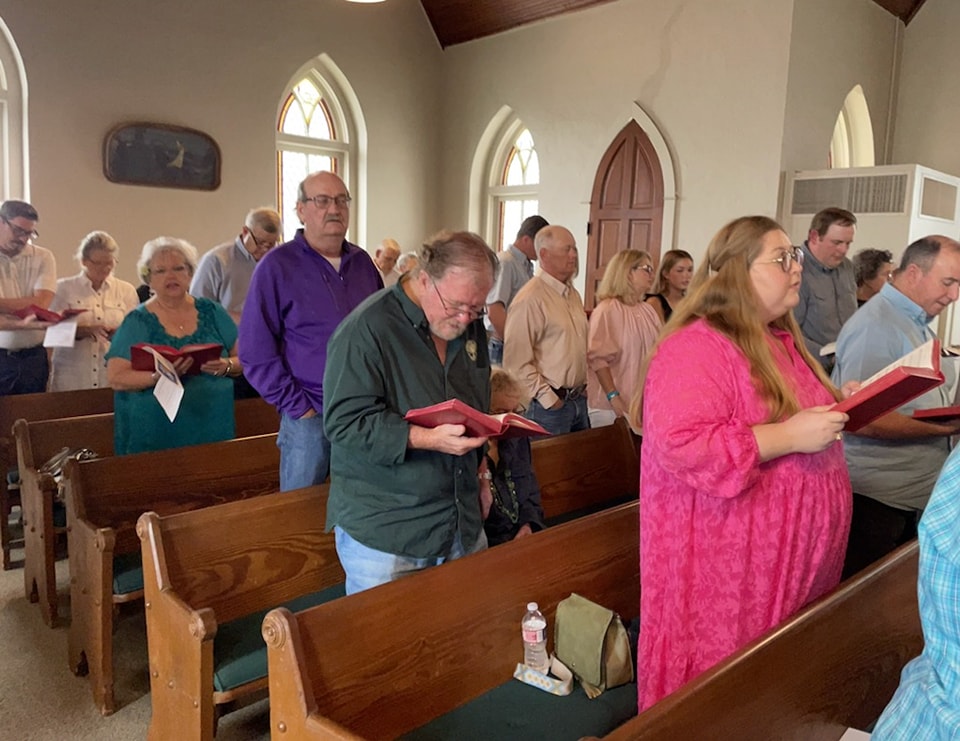
The future might be discerned from the title image—congregants middle aged and older who will not be around forever. I have encountered figures that the median Methodist age is around 60, far old than the 35 of the US as a whole.
Comment by Different Steve on March 26, 2025 at 8:32 am
Follow up Q: Could it be an excuse for poor performance?
A: Yes, the statement could be interpreted as an excuse for poor performance in preaching or ministry. If someone believes that only the Holy Spirit can save souls, they might downplay their own responsibility to effectively communicate the message or engage with their congregation. This perspective could lead to a lack of motivation to improve their preaching skills or to actively seek ways to connect with and inspire others.
However, it’s also important to recognize that many people who hold this belief still strive to be effective in their roles, understanding that while they may not control the outcome, they can still play a vital part in sharing their faith and supporting others in their spiritual journeys. The balance between divine sovereignty and human responsibility is a complex and often debated topic in theology.
Comment by Joe M on March 26, 2025 at 2:41 pm
What a great and instructive article. Thank you.
One comment:
“‘You have nothing to do but save souls’ (which is not all that different from ‘making disciples of Jesus Christ for the transformation of the world’).”
Yes, it IS different. The medium is part of the message. and the more wordy second variant obscures the vitality of preaching the gospel. That’s what got the UMC into a mess in the first place.
Comment by Gary Bebop on March 26, 2025 at 7:28 pm
As a church historian Riley holds dear the ephemeral. But many local churches closed by the UMC witnessed the discarding of their legacy, not a preserving of it. The record of those churches was washed away uncelebrated. Many of us were buried (so to speak) without a marker.
Comment by Tim Ware on March 27, 2025 at 12:40 am
I think there is one perspective of what constitutes “the church” presented in the artlcle and another presented in the comments.
The first perspective of “the church” is that “the church” consists of the institutions, the organizations, the denominational structures, the officials, the bureaucracies, and so forth.
The second perspective is that “the church” consists of all the individuals who are followers of Jesus, all taken together.
The first perspective is what is taught in seminaries and is what most pastors and denominational bureaucrats hold
The second perspective is what most lay people hold.
Comment by Tim Mc on March 27, 2025 at 8:48 am
Yes the real church could survive without these:
Quote “consists of the institutions, the organizations, the denominational structures, the officials, the bureaucracies, and so forth.”
Comment by Wilson R. on March 27, 2025 at 11:13 am
@Tim Ware:
I think your assessment is correct, at least insofar as UM churchpeople go. There is little to no awareness in most UMC congregations of the work of the various agencies. Historically, the agency with the most impact on congregations has been the United Methodist Publishing House. But it has been true for some time that a majority of UM congregations do not rely on their Sunday School, VBS or Bible study materials (with the notable exception of the Disciple Bible Study books and videos, which are excellent).
Comment by Skipper on March 29, 2025 at 9:29 am
So sad that all of the old Mainlines have gone astray! I see no hope for United Methodists (and other Mainlines) until they are ready to turn back to God. They remind me of many Bible verses: “Why do the heathen rage?” Psalm 2:1-2, (plotting against God is ultimately in vain).
“Be not wise in your own eyes, fear the Lord, turn away from evil.” Proverbs 3:7
“Fools have no desire to learn, they would much rather give their own opinion.” Proverbs 18:2
“As a dog returns to his own vomit, so a fool repeats his folly.” Proverbs 26:11
“An ungodly man digs up evil, and it is on his lips like a burning fire.” Proverbs 16:27
“Wisdom is supreme; therefore get wisdom. Though is cost all you have, get understanding.” Proverbs 4:7
“Whoever leads the upright into an evil way will fall into his own pit, but the blameless will have a good inheritance.” Proverbs 28:11
“The integrity of the upright will guide them: but the perverseness of transgressors will destroy them.” Proverbs 11:3
“Love rejoices in the truth, but not in evil.” I Corinthians 13:6
Comment by J S Lang on March 31, 2025 at 8:41 am
In the 1980s I worked for the UM Publishing House, in the division that produced Sunday school literature. The bureaucrats were not happy that so many UM churches used nondenominational materials, or even Southern Baptist materials. In fact, the Baptist Bookstores (now called Lifeway) did a brisk business selling to UM churches. Someone at UM Publishing finally did a little research and found that the nondenominational literature was (1) cheaper than the UM materials, (2) theologically orthodox, and (3) better quality paper and illustrations. Needless to say, the UM staff utterly despised the Good News movement, not just for being theologically conservative but for daring to purchase “unapproved” Sunday school materials. Many times I heard Good News referred to as an “immoral” group. The professional staff at UM Publishing and at the Board of Discipleship had MA or MDiv degrees, and they looked down on the laity who would not accept their guidance.
Since the time I worked at UM Publishing, the company has shrunk along with the denomination. The phrase “Get woke, go broke” comes to mind.
Comment by David Gingrich on April 1, 2025 at 7:37 am
“Roughly one-quarter of all U.S. United Methodist churches have disaffiliated primarily because they hold to a traditional understanding of human sexuality, marriage and the family.”
Please replace the word “traditional” with “Biblical” to make this statement more accurate.