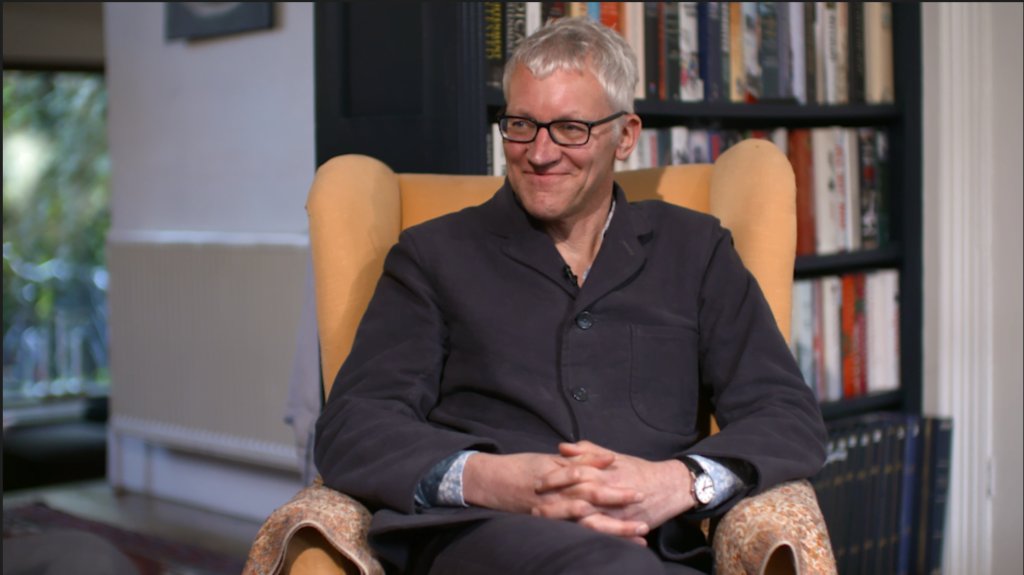

On February 7, Trinity Forum President Cherie Harder moderated a discussion about Christianity’s rise with British historian Tom Holland, author of Dominion: The Making of the Western Mind. Framing the talk, Harder asked, “How is it in a world that celebrates strength and winning, where might is so often seen as right, that the religion of the meek would inherit the Earth?” Discussing sections of his 2019 book Dominion, Holland answers as a historian rather than as a theologian or an apologist.
In the research and writing of Dominion, Holland attempted “to stress test my hunch that Christianity really had been the most seismic and revolutionary development not just in the history of the West but probably globally.”
For historians, Holland notes the crucifixion is the most unusual aspect of the four gospel accounts. Although several ancient religions include stories of the death and resurrection of gods, none of these religions would tell of their gods dying in a painful, humiliating way. Moreover, they would not have depicted their gods as subject to crucifixion which Holland describes as “paradigmatically the punishment visited on slaves.”
Even to its initial audience, Christianity was radically counter-cultural.
Furthermore, the character of Jesus is a “bizarre” and “unfathomable” mystery. Harder asked Holland to explain his own quote from Dominion: “Nothing was remotely as uncanny as the character of Jesus himself. No one quite like him had ever been portrayed in literature.”
Holland notes that if Jesus is purely a literary character, he is the most remarkable literary creation of all time. To replicate Jesus, an author would have to write a character that is simultaneously human and divine. Then, the author would have to portray him in such a way that people two thousand years later in continents the author has never heard of will still believe this figure is God and man.
It would take an unbelievably gifted author to accomplish the task if it were possible at all. And yet, four different authors managed to do so. Although Holland does not undertake to prove the historicity of the gospel story, he argues that categorizing Jesus’s parables and gospel stories as mere fiction does not solve the riddle. Either the gospel authors channel a historical Jesus or there is profound mystery in how such an uncanny story could have been written, gained prominence, and remained influential two thousand years later.
Furthermore, Holland credits the idea of human dignity itself to the imago dei found in the Hebrew Scriptures. The very idea and gut instinct that all humans have inherent dignity is theological, he claims. Thus, he names humanism as a Christian heresy that removes God while still privileging humanity with a dignity that all others should respect.
For Holland, liberalism itself is a secularization of the Apostle Paul’s message to the Galatians. There, Paul famously writes “there is neither Jew nor Gentile, neither slave nor free, nor is there male and female, for you are all one in Christ Jesus.” Over time, history has bled away the “in Christ” for political goods asserting that men and women should be equal, that human beings have inherent equality regardless of ethnic background, and that distinctions between slave and free should be dissolved in an institutional sense. Instead of “in Christ,” the ideas have become manifest in society. Yet, according to Holland, the liberal ideas “in their DNA and in their marrow” remain shaped by Christian teachings.
Finally, Holland argues Christianity’s – specifically St. Augustine’s – notion of original sin provides “the most authentic, democratic notion ever developed.” Without it, we must claim that humans are perfectible here on Earth. This imposes a hierarchy of virtue with little room for the sinner. According to this view held by Pelagius and some progressives today, the sinful have simply not done well enough or tried hard enough. Thus, the notion of original sin equalizes all regardless of class and contributes to a democratic spirit.
Holland’s answer lies in the strangeness, the bizarreness, and the unfathomable aspects of the Christian story. Although we do not typically use these words to describe the Gospel, they do well in encapsulating its striking, counter-cultural nature.
In the ancient world where power and strength were rewarded above all, Christianity celebrated a God who died as a defeated slave (at least as understood by the Romans). In a patriarchal society honoring wealth and class, Christianity celebrated the martyrdom of Blandina, a slave woman.
Today, culture views Christianity as restricting, backwards, or outdated. In part, we are desensitized to the story because we grew up in the world it largely shaped. Yet, to its initial audience, the gospel was a revolutionary upending of hierarchies, traditions, and values. In many ways, it still is.
There is immense beauty in the strangeness and unprecedented aspects of the gospel, such as the crucifixion, that ancient man could not even fathom, much less create as their God.



Comment by Gary Bebop on March 12, 2025 at 12:13 pm
Always remember that Christianity is engaged in resistance to the spiritual forces of darkness. Triumphalism must be restrained. No premature end-zone celebration until the Final Revelation of Jesus Christ.