
In a recent Touchstone journal article, “In ‘God’ We Trusted” (July/August, 2018, pp. 25-27), author D. Eric Schansberg wrote about religion in America during the 1950s. He began by citing Will Herberg’s classic 1955 book, Protestant, Catholic, Jew.
Seeing Herberg’s name got my attention. He was the Jewish scholar who was a friend and colleague of the late Thomas Oden, long-time Methodist professor at Drew School of Theology. Oden, one of our generation’s pre-eminent Wesleyan theologians, has written how he and Herberg, a faculty member at Drew for some 30 years, became friends during Oden’s first year as professor there in 1970. They shared frequent luncheons and conversations over tea.
Herberg challenged Oden one day saying, “Tom, if you are ever going to become a credible theologian instead of a know-it-all-pundit, you had best restart your life on firmer ground. You are not a theologian except in name only, even if you are paid to be one.” That remark pierced Tom’s heart. And it changed his life. Oden’s great “theological reversal” began as a result of that conversation and friendship. (Read the full account of this exchange in Oden’s A Change of Heart: A Personal and Theological Memoir, Downers Grove, IL, Intervarsity Press, 2014, pp. 133ff.)
So, I was interested in Herberg’s critique of American Christianity in the 1950s. He wrote of great “religious belonging and identification” in the 1950s. Church membership and Sunday school enrollment were at historically high levels, and church construction was booming. Bibles were distributed in record numbers, and he observed that 80 percent of the populace thought the Bible was the “revealed word of God.” (The 80 percent was for the “populace,” not the clergy.)
Surveys during this period showed “belief in God” to be nearly universal, but Herberg asks just what did this “belief” really mean. Half of those surveyed could not name even one of the four Gospels. He then added a penetrating observation about American faith in the 1950s: “It is thus frequently a religiousness without serious commitment, without real inner conviction, without genuine existential decision. What should reach down to the core of existence, shattering and renewing, merely skims the surface of life, and yet succeeds in generating the sincere feeling of being religious.” Those are rather haunting words.
Reflecting on Herberg’s critique, I wondered about the reasons for a religious faith so shallow, so lacking in commitment and inner conviction. That sounds nothing like a robust faith grounded in scriptural teaching. Herberg notes, rightly, that many factors may have played into this strong drive to embrace some sort of religious faith but “to wear it lightly.” He cited the ending of the global threat of World War II followed quickly by another in Korea, a healthy post-war economy with its temptations toward materialism, etc. But the question must be asked about those years, was the Christian faith being taught during the 1950s grounded in sound biblical teaching?
This is a critical question. The clergy leading the American churches during the 1950s would have been taught during the era of the 1920s to the 1950s. In those years, many seminaries and professors had likely embraced the popular new wine of theological liberalism, or the “new theology”, as it was called.
What was the “new theology? Theological liberalism was the movement that endeavored to accommodate the Christian faith to new, anti-supernatural axioms that had become widely accepted in the late 1890s and early 1900s. Powerful new intellectual movements—the new science, social Darwinism, and the influence of German rationalism—swept across the country during this era. In the midst of this intellectual tsunami, theological liberalism emerged. It was American Protestantism’s attempt to accommodate its Christian teachings to this new, and suddenly quite popular, intellectual movement. As one might imagine, the new secular, anti-supernatural emphases had an eviscerating influence on America’s seminaries and churches during those years.
Alister McGrath, former professor of theology at Oxford and more recently at King’s College London, wrote about theological liberalism: “Perhaps the most distinctive feature of the movement is its accommodationism—that is, its insistence that traditional Christian doctrines should be restated or reinterpreted in order to render them harmonious with the spirit of the age.”
And that happened, both in American Methodism as well as other mainline Protestant denominations during those early decades of the 1900s. (For a fuller account of the impact on American Methodism, see my The Rise of Theological Liberalism and the Decline of American Methodism, Seedbed Publishing, Franklin, TN, 2017). The result of this accommodation was a move away from the supernatural aspects of the faith, with a new and enthusiastic preoccupation with the ethical teachings of Jesus.
Surprisingly, doctrines such as the virgin birth, the resurrection of Christ, the ascension, and the promised return of Christ had become difficult for many pastors and theologians to affirm amidst the exhilarating and supposedly liberating views of the new scientific and evolutionary worldview. As a result, the great creeds of the Christian faith (the Apostles’ and Nicene Creeds, etc.) were deemphasized, their usage even put aside for the more supposedly relevant “Social Creed of the Churches.” Pressing social needs in America’s urban centers made it easy to justify a passionate new focus on ethics and building the kingdom of God on earth—or “Christianizing society” as it was often called.
Adding to the popular new social emphasis was its convenient avoidance of the supernatural doctrines of traditional Christianity, which had become something of an embarrassment to churches that were supposedly “coming of age” intellectually. These developments may help us understand, at least partially, what happened to the spiritual vitality of America’s churches in the 1950s. Several brief vignettes will help illustrate.
Vignette One – In September of 1930, German Lutheran pastor and future martyr Dietrich Bonhoeffer came to study at Union Theological Seminary in New York City. He was not your typical theology student. He already had an earned doctorate from Berlin University and had studied under Adolf von Harnack, a renowned liberal theologian in Germany. While Bonhoeffer did not agree with many of Harnack’s conclusions, he respected his serious scholarship.
Bonhoeffer soon learned that he had arrived in America in the midst of major theological tensions between those who affirmed the “new theology” and those who held to the traditional faith—call them orthodox, traditionalists, essentialists, or fundamentalists. The German pastor’s remarks about what he found at Union and in New York give insight into that period. (Following citations are from Eric Metaxas’s Bonhoeffer: Pastor, Martyr, Prophet, Spy: A Righteous Gentile vs. the Third Reich Nashville: Thomas Nelson, 2010, Chapter 7, pp. 99ff.)
At Union, Bonhoeffer found the theological situation worse than he might have anticipated. In his words: “There is no theology here … The students—on the average twenty-five to thirty years old—are clueless with respect to what dogmatics is really about. They are unfamiliar with even the most basic questions. They become intoxicated with liberal and humanistic phrases, laugh at the fundamentalists, and yet basically are not even up to their level.”
While he acknowledged several basic groups, he noted that “without doubt the most vigorous… have turned their back on all genuine theology and study many economic and political problems. Here, they feel, is the renewal of the Gospel for our time.” While he noted the students showed admirable personal compassion for the unemployed over the winter season, still, he added, “It must not, however, be left unmentioned that the theological education of this group is virtually nil…”
Bonhoeffer was equally disillusioned about the American churches, especially in New York City. He recalled: “The sermon has been reduced to parenthetical church remarks about newspaper events. As long as I’ve been here, I have heard only one sermon in which you could hear something like a genuine proclamation.” He continued, “One big question continually attracting my attention … is whether one here really can still speak about Christianity?”
Clearly, his experience observing American churches, with the exception of several impressive African-American churches, was deeply disappointing. Summarizing his experience, he wrote: “In New York they preach about virtually everything, only one thing is not addressed, or is addressed so rarely that I have as yet been unable to hear it, namely, the gospel of Jesus Christ, the cross, sin and forgiveness, death and life.”
What had taken the place of the Christian message? According to Bonhoeffer: “An ethical and social idealism borne by a faith in progress that—who knows how—claims the right to call itself ‘Christian.’”
This indictment came not from an American evangelical or fundamentalist but from Dietrich Bonhoeffer, who would become a respected theologian, author and martyr of the German Church under Hitler. Union Theological Seminary was no doubt considered at the time to be on the cutting edge of new theological trends. Its students would have been considered future leaders of American Protestant churches. But what would be the substance of their preaching and teaching? To Bonhoeffer, they were “clueless” about theology.
One senses there must be a connection between what Bonhoeffer experienced and Herberg’s observation about America’s 1950s religiosity that, he observed, was frequently “a religiousness without serious commitment, without real inner conviction, without genuine existential decision.” Seminarians who are “clueless” about theology and are caught up in merely social and political matters are woefully unprepared for local church ministry. We would assume that the embracing of the “new theology” Bonhoeffer found at Union would not be too unlike that found at other mainline Protestant seminaries across America during that period.
Vignette Two – In July of 1944, James G. Gilkey was invited to be the main speaker at a Texas Pastors’ School for Methodist clergy at Southern Methodist University in Dallas, Texas. Gilkey, a popular pastor of South Congregational Church in Springfield, Massachusetts at the time, was a graduate of Harvard College and (noted earlier) Union Theological Seminary. Well-known evangelical Methodist pastor Robert P. Shuler protested the Gilkey invitation, claiming Methodism was bringing into Methodist pastors’ schools clergy who were experts in the denial of the basic doctrines of classic Christianity. (Methodist pastors’ schools would draw some 300-400 clergy as a continuing education event.)
Shuler called attention to Gilkey’s book, A Faith to Affirm, in which the Congregational pastor did not hesitate to state the “new doctrine” he had embraced. Speaking about what “we liberals” believe about Jesus, he claimed Jesus was born in the normal way, the eldest child of Joseph and Mary; that the miracles attributed to him are in reality legends which sprang up during and after his life; his most important act was not to die on the cross, but to live and teach our race its most significant set of religious and ethical beliefs; and that his soul or spirit was resurrected, not his body, and it still continues on in some further realm of existence.
After this litany of denials, Gilkey went on to write, “We cannot think that by dying Jesus purchased for human beings forgiveness of sin: to us Jesus’ death is tragedy, nothing more.” All he had left of Christianity were the teachings of Jesus. This, of course, was a central characteristic of theological liberalism. He wrote, “We Liberals regard them [the teachings of Jesus] as the most precious elements in Christianity; and we propose to take them, combine them with new truths and insights gained since Jesus’ time, and then offer this combination of teachings to the modern world as a new form of the Christian faith.” (Emphasis mine)
One gasps at such assertions. Little wonder there were protests at Gilkey’s invitation to speak. (See pp. 76-78 of Theological Liberalism.)
In the early decades of the 20th century, theological liberalism flourished in America while serious biblical study languished. The “new theology” urged the Church to put aside the controversial supernatural aspects of Christianity and focus instead on the moral and ethical teachings of Jesus. Certainly, not all adherents of theological liberalism would have accepted all the doctrinal denials. No doubt some clergy wanted to be perceived as liberal and modern, but yet held to some traditional understandings of the faith, perhaps more out of nostalgia than deep conviction. Theological liberalism brought a very different understanding of historic Christianity. It changed drastically the churches’ proclamation as well as the substance of theological education during this period. Things supernatural were out.
This vignette, like that of Dietrich Bonhoeffer, may help us understand why the American church, which enjoyed such robust numbers in the 1950s, was described by Herberg as displaying a religiosity “without serious commitment, without real inner conviction, (and) without genuine existential decision.” This was a religious faith, he observed, that “merely skims the surface of life.”
One wonders what the clergy of those days had been taught in their seminary education. In many American seminaries, things supernatural had been set aside for the new emphasis on the social teachings of Jesus. Such a change would have had enormous implications for the churches’ proclamation. And what about the laity hearing this “new doctrine?” Church members would have been reluctant to make a “serious commitment” with heart-felt “inner conviction” to a set of social and ethical teachings, as noble and helpful as they might be.What we know for sure is that a message centered on “an ethical and social idealism borne by a faith in progress” (Bonhoeffer’s observation), and a message of Jesus’ “social teachings combined with new truths and insights” (Gilkey’s proposal) are not worthy substitutes, singularly or together, for the “faith that was once for all entrusted to the saints.” (Jude 3 – NRSV) Little wonder the mainline churches languished.



Comment by Tim Mc on February 10, 2025 at 7:39 am
Bonhoeffer’s book about ‘Cheap’ grace must have found its beginnings in America at a theological school.
Lord have mercy on us!
Comment by Wilson R on February 10, 2025 at 3:06 pm
In its apparent zeal to blame every problem in American Christianity on liberal seminaries, this column misses the mark by a mile when the answers are pretty obvious to any objective watcher.
I grew up in the church in the 1960s–specifically, in conservative, small-town Methodist churches. I also attended many Baptist churches with members of my extended family. If liberal theologians exercised ANY influence on these pastors and congregations, it was not evident in their words or actions. There were no proclamations about social justice. And yet all of these conservative churches experienced the kind of decline over the decades that affected the larger congregations in liberal big cities.
What changed in the society I grew up is much more in line with Herberg’s critique about shallow Christianity, combined with changes in secular American society. I’ve described the shallow churches I saw across America as “Kiwanis Clubs with Jesus” — service organizations that undeniably do good work and bring people together but aren’t particularly centered on Christian discipleship.
Before the 1970s, there was something of a social stigma on those who conspicuously did other things on Sunday besides attend church. And there weren’t nearly as many options besides church on Sundays then, either; most businesses and restaurants were closed on Sundays. Even in towns of 50,000 to 100,000 people that I was familiar with, regular businesses were closed and the only restaurants open were those that catered to the after-church crowd. When the sabbath became like any other day for American businesses and the social stigma against non-churchgoers entirely disappeared, church attendance began to fall. In the internet age, ALL social organizations in the US experienced permanent declines, from Masons and Elks Clubs to Kiwanis, Lions and Rotarians to churches. Theological liberalism had nothing to do with any of those phenomena. And Herberg was right. Those changes in society made such an impact on churches because the commitment to discipleship among Americans was never very deep, even before US seminaries became more theologically liberal.
Comment by Wilson R. on February 10, 2025 at 5:37 pm
One more thing I’d add:
My father was a theologically conservative Methodist pastor. One thing all pastors in the 60s in the South learned was not to push the implications of New Testament teachings about the nature of the kingdom of God too far, because Jesus’ insistence that the categories of first and last, and Paul’s language about no distinctions between slave/free and male/female carried implications that could be seen as threatening by Southerner segregationists who were committed to “our way of life” and the idea that women should not work outside the home, much less be worship leaders. And so most pastors stayed silent on these issues for the sake of keeping attendance high and themselves out of trouble.
I came to understand as an adult that the Gospel is countercultural to every human culture, but every culture is built on pecking orders or one type or another. And most Americans, even now, aren’t ready for that.
Comment by Salvatore Anthony Luiso on February 10, 2025 at 6:50 pm
Somewhere I’ve read something to the effect that the basis of the religious “boom” in America during the 1950s was a “faith in faith”. In other words, a belief that it is inherently good to have religious beliefs and to be religious. That is *not* the same as faith in God, and it is not the same as believing that a certain set of religious doctrines are objectively and exclusively true.
Back then, it was common to believe that being a member of a church and attending church were important to being a good citizen. It was also common to believe that Americans could resist the spread of atheistic communism by being religious.
Belief in social conformity and pressures of social conformity were also factors.
Comment by Riley B Case on February 10, 2025 at 7:50 pm
You’e right on, Jim. As usual.
Comment by Tim Ware on February 10, 2025 at 8:28 pm
The real reasons for the decline of religion in the United States are anyone’s guess. Each of us will blame it on the things we want to blame it on!
But there is a body of research that suggests the real culprit does not come from within institutional Christianity at all but rather from societal changes. There is some support for the view that people in a modern society tend to be less religious when the larger society does not share common values and principles, when there are no generally agreed upon standards by which society expects people to behave, when the members of society do not feel part of a whole, and when the emphasis is on “me” and what I want. In other words, people tend to be less religious when they do not feel a part of a larger, cohesive society; when they feel isolated, alone, separated, and egotistical. One could make a good argument that our society has changed so that people are indeed more isolated, alone, separated, and egotistical than they were 70 years ago. We live in a fractured society, at each other’s throats, divided into groups which hate each other, in fact which hate all those not in our group (witness the genocide and ethnic cleansing in Gaza…those people don’t matter since they’re not in our group).
And so one could say that the destruction of a cohesive American society and the resultant emphasis on “me” are the largest factors in the decline of American Christianity.
Comment by John on February 10, 2025 at 10:28 pm
Oh, look another IRD article blaming the world’s problems on liberal theology. How original!
I love how the author not so adeptly glosses over Bonhoeffer’s pivotal experiences at Abyssinian Baptist Church with the following sentence. “Clearly, his experience observing American churches, with the exception of several impressive African-American churches, was deeply disappointing.”
It was at Abyssinian that Bonhoeffer met Adam Clayton Powell Sr., a preacher and social justice advocate who actually coined the term “cheap grace.” I think it’s safe to say this man and his church had more than a passing influence on Bonhoeffer. Here’s what the German theologian later wrote of Abyssinian. “Here one can truly speak and hear about sin and grace and the love of God… the Black Christ is preached with rapturous passion and vision.”
But those aspects of Bonhoeffer’s life and thought don’t interest the IRD, because they don’t fit the narrative they want to push.
Comment by Tim Ware on February 11, 2025 at 12:42 am
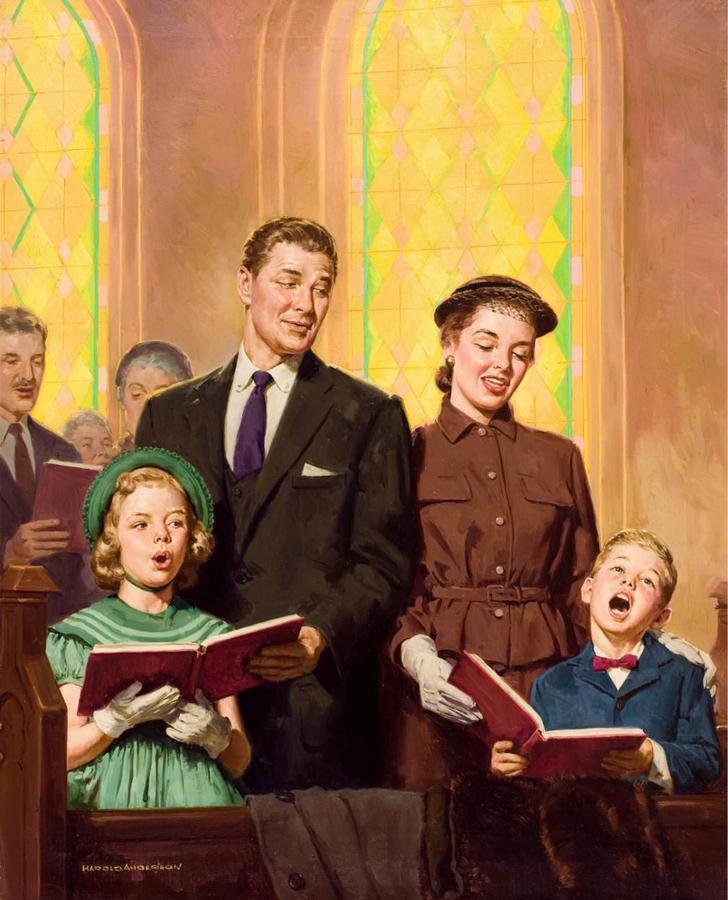
My point is proven by the picture accompanying the article. The picture of the family is appropriate for the 40s and 50s.
But to conform to today’s standards, the couple would at least have to be a mixed race couple, and preferably a homosexual mixed race couple. The children would have to be both biracial and gender indeterminate. And they wouldn’t be holding hymnbooks; they would have been looking up at the larger-than-life video screens with tears in their eyes and hands held up as they swayed to the syrupy performance of the “worship leaders.”
And right there you have the problem…the disintegration and destruction of society…which led to the destruction of American Christianity, which may have been shallow, but which was at least a veneer, which is a lot more than we have today.
Comment by John67 on February 11, 2025 at 6:30 am
Please provide a link to the picture of a family worshipping in church.
There is a whole series of these pictures, which were used in public places (buses) as a public service announcement. I would like to contact the artist or publisher. Thank you.
Comment by Marianne on February 11, 2025 at 6:57 am
Tim, I would say you’ve got it backwards. The destruction of faith and religion caused the destruction of family and society.
Comment by Wilson R. on February 11, 2025 at 10:07 am
The gospel of Jesus is by nature a boat-rocking religion. The gospel proclaimed by churches in the 1940s through the 1960s was anything but. Churches intentionally did not rock the boat because they were oriented toward growth and feared that anything more demanding than a shallow Christianity would drive people away.
During the Civil Rights era of the 1960s, the assertion of equal rights for women, and the national division over the Vietnam War, churches found that they could no longer shy away from such hot-button issues but simultaneously were ill-prepared to address them because the Christianity they preached was so shallow and undemanding. Many pastors who addressed civil rights from the pulpit saw people leave; some of those who declined to address these issues also saw people leave because, to them, their churches seemed no longer relevant if they were not willing to address topics that the New Testament itself addressed.
Comment by Stephen Rankin on February 11, 2025 at 10:12 am
In response to Wilson R’s comments, what he says is true, but misses Jim Heidinger’s main point. I think his mistake is to generalize too much from his references to a specific region (Texas) during a relatively small period of time (the 60s and 70s). Of course, the ethos of Texas Methodism did not show the influence of theological liberalism at that time. But what has happened the past fifty or seventy-five years in Texas Methodism? And more broadly in mainline Protestantism? Heidinger is pointing to a larger, more general, and longer-term trend. By contrast, one thinks of Dean Hogue’s book, Why Conservative Churches are Growing. Hogue was a serious researcher and studied trends carefully (and wasn’t necessarily conservative himself). There are several causes why mainline Protestantism has declined in numbers and social prominence. Some of the social forces eroding all the civic organizations Wilson R names are working inside the church, and so, what he says is easy enough to affirm. But it has little to do with Heidinger’s main poin and certainly does not refute it.
Comment by John on February 11, 2025 at 12:58 pm
Tim Ware,
What a vivid imagination you have! You actually think that this portrait of a white, obviously middle-class family at church was something every American in 1950 saw themselves in? White people weren’t used exclusively in advertising and media campaigns at the time because society was color-blind or even just because they were the majority. They used because in most cases, that was the only market the businesses running the ads wanted to reach and they were afraid depicting anyone else would drive the white customers away. It was a society built solely for their comfort and convenience…and no one else’s. A billboard ad trying to get people to move to surbans in the 50s always depicted whites because other groups were expected to stay in the ghetto. Banks refused African Americans mortgages to buy houses in the suburbs, even when they could afford it. Realtors refused to accept offers from them and neighborhood associations worked to drive out any who managed to slip passed the red line. If you think African Americans back then were oblivious to the fact that advertisers deliberately ignored them, think again. The writings of leading intellects from the period like James Baldwin attest that popular American media had left no place for its non-white citizens except as enemies to be crushed (John Wayne movies) or as subvervient stereotypes to be mocked and pitied (Mammy and Stepin Fetchin). “It comes as a great shock to discover that the country which is your birthplace and to which your life and identity has not, in its whole system of reality, evolved any place for you. ” James Baldwin, 1965.
The society wasn’t anymore united or harmonious in the 1950s. If anything it was more isolated and divided. That’s why Bonhoeffer had to go the Black churches to find authentic Christianity being preached.
Comment by Wilson R. on February 11, 2025 at 1:04 pm
Stephen:
Yours is a fair comment. I am sure that my experience in Texas Methodism — even the occasions when I would hear sermons at large urban churches in Dallas and Ft. Worth — was very different from that of someone in a more liberal part of the country.
Even so, based on wide experience in Southern churches since I left Texas 45 years ago, I have to think that the influence of liberal seminaries is much less overall than Mr. Heidinger seems to believe, and not the primary reason why church attendance in the mainstream denominations has declined so sharply since the 1950s. If this decline were limited to urban churches, where the liberal influence is arguably much greater, he’d have a point. The fact that the decline is across the board, affecting small-town conservative churches, too, suggests to me that the primary cause is beyond what gets taught in seminaries.
Again, however, I concede that I am generalizing from experience in Texas and the South.
Comment by Gary Bebop on February 11, 2025 at 7:33 pm
The trolls stir from the dust bins of history to wave their little mainline scepters every time Jim Heidinger writes. The trolls represent, what Rusty Reno calls, “the Rainbow Reich.” But they aren’t in control and they haven’t been given powers to edit our thoughts.
Comment by Tim Ware on February 12, 2025 at 12:06 am
Thanks, John, for yet another of your sanctimonious diatribes. You just proved my point.
Comment by John on February 12, 2025 at 12:03 pm
Tim Ware,
And what point would that be? That everyone assumes things were better in the past until they actually have to learn about it?
Comment by Diane on February 12, 2025 at 5:31 pm
Looking at the illustration of a white, 1950s nuclear family that accompanies this article, it’s obvious they’re not mouthing the same hymn. What’s up with that? Could there be a hidden message that suggests 1950s white, church-going families were a bit dysfunctional, not on the same page? The pictured little boy appears to be a mini drama queen character, flamboyantly singing his heart out – with his dad giving him a weird side-eye. What’s the artist’s message?
Comment by Wilson R. on February 13, 2025 at 10:47 am
Diane, his sister seems to notice it, too. Though Dad and Sis would not have used this term, Little Brother has clearly registered on their internal “Gaydar.”
Comment by Greg Johnson on February 14, 2025 at 10:33 am
John67 wrote on 2/11/2025:
> Please provide a link to the picture of a family worshiping in church.
Here’s a procedure for image search that yields a fascinating collection of related images. Search suggests the artist is Harold Anderson, and that Norman Rockwell produced similar familial paintings.
1. Many browsers let you right click an image and “Copy image link” or “Open image in new tab”.
2. Go to https://images.google.com (O
3. Click the camera icon 📷 at right.
4. Where the panel offers “Paste image link”, for this image per step 1 paste in this text:
https://juicyecumenism.com/wp-content/uploads/1950s-Religious-Boom.jpg
5. Press “Search”.
Thanks all for the comments on this “1950s” topic. Thought and experience show. I now return to lurking.
Comment by Simple Horn on February 14, 2025 at 4:44 pm
Social Darwinism is not and never was a science. It isn’t Darwinian in any sense. It is an economic idea.