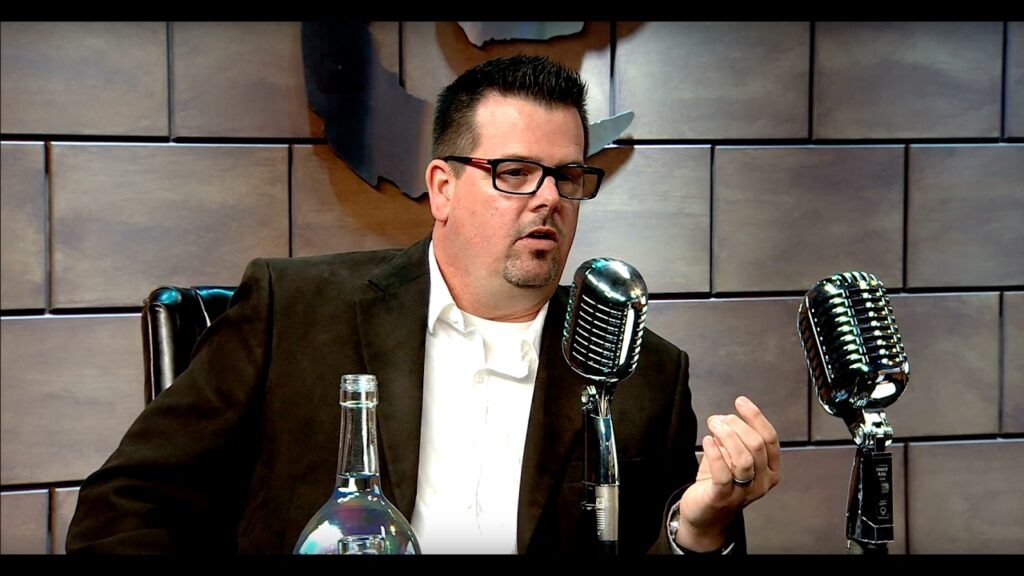

George Haraksin of the Reasons to Believe apologetics organization spoke at the Southern Evangelical Seminary Apologetics Conference on October 11 on the disappearance of moral knowledge. To illustrate his point, he said that Google maps have replaced skill many people once had at reading maps and finding obscure locations. “Spatial memory’ and ‘mental mapping’ has [i.e., have] disappeared in a generation of people.” He finds this true of his students, and even colleagues who are younger. There is thus a “disappearance of directional knowledge.”
Haraksin then talked about the disappearance of moral knowledge. He oversees the scholar community at Reasons to Believe, and is also a father. “How do you make a good person,” he asked. Like directional knowledge, generally held moral knowledge has disappeared in our society. Following the Christian philosopher and University of Southern California professor Dallas Willard and his book “The Disappearance of Moral Knowledge,” Haraksin quoted Willard saying “there is now in our contemporary time no recognized systematic body of moral teaching that can be presented as moral knowledge by the institutions of Western society.” Haraksin then summarized some of the conclusions of Willard and others regarding the lack of a common morality in contemporary society.
Confidently Holding Moral Beliefs
He asked what we mean by knowledge. It is not simply belief, or a belief which is in fact true, but a true belief which is justified. Again quoting Williard, he said that “knowledge is our ability or the human capacity to represent things as they are on appropriate basis of thought and experience.” However, one can have a belief with “some evidence” which is nevertheless untrue. Truth is essential to a evidentially supported belief being knowledge.
Knowledge is thus obviously “not a simple matter.” Philosophers identify “at least” three ways people know. First, there is “knowledge by personal acquaintance.” This involves being “directly aware of something.” We are directly aware of the things we experience in ordinary life. Secondly, there is there is “knowledge as a mastery of data, or know-how.” How to change a tire or play the piano would be examples. Thirdly, there is “propositional knowledge.”
He said that “when it comes to morality, we can have a direct awareness of right and wrong, even if we couldn’t propositionally articulate it.” This obviously is not the same as having an ethical system. But where moral knowledge is concerned, that gives “a person authority and power to do something in another person’s life.” Where one is recognized as having knowledge in a particular area, such as plumbing or dentistry, “people hand over trust” to others to intervene in their lives in that area, but not in other areas. Yet morality informs all of life. Secular law can intervene in any area, but without a common morality to back it up, it is not generally recognized as righteous, and people do not know that what is legally expected ought to be done. Haraksin referred to the prophet Hosea who said, “my people are destroyed for lack of knowledge (Hos.4:6).” Romans chapter 1 also refers to “the suppression of knowledge” leading to a world of violence and oppression.
The Loss of Moral Knowledge
In the present day moral knowledge is lost or obscured. Haraksin referred to the words of Martin Luther King and his booklet “Knock at Midnight,” referring to Jesus’s parable of the lampstand in Luke chapter 11 (Lk.11;33-36). King said that today, morality has become a matter of “what the majority is doing… right and wrong are relative to likes and dislikes.” But even though morality has been reduced to preference, paradoxically people speak as if morality were real. There is “much moral talk, and so much morals legislation in our society.” People talk a lot about morality. They are not simply expressing their own preferences, but making claims about what other people should or shouldn’t do. Pro-life Americans have long noted that people who profess to be “pro-choice” may be vegetarians, or campaign against factory farming. Similarly relativists may be opposed to “bullying, sexual assault, or greed” at the same time that they deny universal moral principles.
“What are some of the causes of the disappearance” of moral knowledge, he asked. They are, he said, “legion in a lot of places.” These include “the discrediting of religion, particularly Christianity, maybe even Judaism, as a source of knowledge of reality, and especially moral reality.” People still may go to religious institutions “for comfort,” but not moral instruction. Secondly, “moral facts” have been rejected in favor of “moral opinions.” Thirdly, there is a rejection of the idea of the soul as a focus of moral activity, replacing it with physicalistic explanations of human behavior. Where an horrific crime has been committed, people ask what was wrong with the criminal’s brain. People back away from calling a bad act “immoral or evil.” To speak of brains as “immoral” sounds strange, it appears to be “a category mistake.”
A further reason is that differences between cultures are used to show that there are no universal moral principles, and so no standards of judgment that could be used to judge people in other cultures. Even Christian students may say “everyone believes differently about morality.” Finally, moral principles are “seen as power plays.” They are not regarded as something to be trusted, “but rather a manipulation.” Incredibly, “morality is seen as even harmful.” There is no talk of “what the vision of the good life is, what is a good person, and how do I become a good person,” Instead, ethics students are given moral dilemmas to wrestle with, but not told what true morality is.
Moral Confusion in the Institutions
Quoting John Mearsheimer, a political scientist and international relations scholar at the University of Chicago, Haraksin said that today’s universities try to “develop critical thinking, broaden intellectual horizons,” expose people to new ideas, and “enhance self-awareness.” But universities are not concerned with “providing truth.” Mearsheimer explicitly stated that “we’re not there to teach morality.” The result, Haraksin said, is “a confusing environment for a person.” He referred to Scott Soames – like Willard, a philosophy professor at the University of Southern California – who said that “since no single moral perspective dominates the others in society, especially the university, intimidation, coercion, and condescension fill the gap left by the absence of moral reasoning.”
Haraksin also cited philosopher of science Michael Ruse, who said that people who believe that horrific crimes are acceptable are “simply mistaken.” But he did not say “immoral” or “evil.” Like Nietzsche in the nineteenth century, Ruse followed the practice of collapsing “a moral category into a rational or intellectual category.” This, Haraksin said, “has been a big shift.” Yet despite pronouncing against atrocities, Ruse also said that “God is dead, so why should I be good,” and “morality is flim-flam.” Thus, Ruse seemed to both affirm and deny real, objective morality. Although there have been scientific efforts to “provide a foundation for moral knowledge,” these have been unsuccessful, Haraksin said, and the secular world is left with “moral nihilism.”
Finally, there has been a shift from “knowing moral facts, to moral opinions.” Little children have an innate sense of morality, which is frequently heard when a child says “that’s not fair.” Children must be purged “out of their moral awareness.” Unhappily, “this is actually what is happening in schools.” He pointed to a website for elementary school children, “Binky’s Games of Facts and Opinions.” In the game, facts can be shown, judgments of value are held to be opinions. Similarly, in the Common Core curriculum for elementary and high school, children are taught that all moral or aesthetic evaluations are opinions, yet the students must sign a statement that they will not “cheat or bully people.” Again, there appears to be confusion about how objective moral judgments are.
The Desire for and Aversion to Morality
Thus, students are effectively taught that all moral and aesthetic claims “are opinion claims, because you can’t show that they are true, or knowledge.” This means that “morality disappears.” People can hold beliefs about what is moral, but they are not commonly accepted knowledge. Haraksin said to the contrary that “a statement can actually be true even if I can’t prove it.” One can have a true, and thus factual, opinion of the weather, he said. Our innate moral awareness is clearly a fact. He seemed to suggest that the burden of proof lies with those who would deny its authority. Quoting James Davison Hunter, Haraksin said:
“As it is currently institutionalized, public education does just the opposite of what it intends. In its present form it undermines the convictions upon which character must be based, if it is to exist at all. We say we want character; we even legislate that way in our day, but we really don’t know what we ask for. To have a renewal of character is to have a renewal of a creedal order that constrains, limits, binds, obligates, and compels. This price is too high for us to pay. We want character, but without unyielding conviction. We want strong morality, but without the emotional burden of guilt or shame. We want virtue, but without moral justifications that invariably offend others. We want good without having to name evil. We want decency without the authority to insist upon it, and we want community without any limitations on personal freedom. We want what we cannot possibly have on the terms we want it.”
Haraksin also quoted T.S. Elliott saying that “we’re all looking for a system so perfect that we don’t have to be good.” This, Haraksin said, “is the waters we swim in.”
In response to a question, and noting Richard Dawkins recent advocacy of “cultural Christianity,” Haraksin said that “people are recognizing now the vacuum. It’s like the water has been sucked out.” Another questioner said that a common practice today is to apply moral standards to people we don’t like. Haraksin responded that people do not apply skepticism about the commonly accepted morality of the past (such as the commandment against theft) when morality is in their favor.
In response to another questioner, he said that we are indeed not in an era of relativism – but citing a book of the same name – in an era of “new absolutes.” These absolutes attempt to prohibit obedience to the precepts of traditional religion and morality from public, and now increasingly private life. They are based not on reason or revelation but simply on political power.
Haraksin said regarding the new moral environment: “I actually don’t think people have been reasoned into these positions, I think people have been massaged into these positions.” In particular, “the technologies we use massage us in a certain direction.” He noted “from elementary school teaching all the way to the Supreme Court how you are taught that you create your identity, you’re not given an essence or an identity.” Technology “massages” us into creating our identity.
Haraksin clearly laid out the problem of the loss of moral knowledge, but left the issue of its recovery for future treatment another day. He did seem to propose two building blocks however – the innate sense of morality that children must be trained to discredit, and “creedal order” referred to by Hunter. (This writer would add the right of conscience, the right not to take an action believed to be evil, as intuitively known in a proper account of moral knowledge). It is unreasonable to expect unanimity in society, but if creedal order is to contribute to moral knowledge, it must be widely held, as it frankly no longer is. Apologetics supporting a personal, benevolent God, and Christianity in particular, will be important. Recovery cannot be expected in the near future.
In that regard, Haraksin said that “Christians have to have courageous, confident humility in demonstrating in our actions that we … have moral knowledge … If it’s going to be recovered, we better have a good vision, we better intend to do it, and we got to think carefully about the means of making good people.”



Comment by Wilson R. on November 19, 2024 at 11:04 am
To say there is a “loss” of moral knowledge in the modern world presupposes that it once abounded here. Does there seem to be a dearth of moral knowledge in our society? Absolutely. At the same time, ours is a society that tolerated the existence of human slavery for more than 80 years after its founding. It is a society that enforced racial segregation for another 100 years after slavery ended. This discriminatory treatment extended to many churches. From a Christian standpoint, it’s hard to think of any moral sins committed by our society that are more anti-Gospel than these. That should be kept in mind in any discussion about moral “decline.”
Comment by David on November 19, 2024 at 6:08 pm
“Make morality great again!”
Comment by John E on November 20, 2024 at 12:14 am
I appreciate Wilson R’s reflection on this article. I try not to look to the past as being somehow morally purer than today, although I would argue the inverse is just as true: sure, on some vital questions we have made progress, but I think on others we have gone in a problematic direction.
Comment by Tim Ware on November 20, 2024 at 12:36 am
Show me in the Bible where it condemns slavery. And don’t fall back on that ridiculous line that slave doesn’t mean slave.
As far as racial segregation is conerned, granted there is no concept of race in the Bible (where you see “race” in some translations is a creation of the translators), but look in the Old Testament at the numerous references to keeping free from the influence of “outsiders.”
The fact is that you cannot use the Bible to condemn either slavery or racial segregation, unless you do some very creative explaining away of many different passages in many different contexts.
So if you do that creative explaining away, haven’t you dispensed with the Bible itself and are just retaining the passages that you can interpret/interpolate to suit your own purposes? If you are doing that, then what use is the Bible, if you are going to pick and choose only that which is convenient and explain/creatively interpret away everything else?
Either the Bible is the foundation of the Christian faith, or it isn’t. If you decide it isn’t, fine, but quit citing your proof texts about justice and mercy. Those can be explained/interpreted away, too, using the exact same methods that you use to explain/interpret away the passages you don’t like. You can’t just select out of the Bible what you like.
You get on here and critize people for ignoring certain things in the Bible, apparently unaware that you do exactly the same thing that you hate others for doing.
And yes, I do mean hate. It’s obvious.
Comment by Tim Ware on November 20, 2024 at 12:43 am
By the way, you make such a big deal out of so-called transgender being ok because it’s not specifically condemned in the Bible…so why do you not apply the same standard to slavery and racial segregation???
Comment by Wilson R. on November 20, 2024 at 11:24 am
Tim, do you believe slavery is compatible with Christianity?
Comment by Wilson R. on November 20, 2024 at 11:43 am
John E
I would agree with you that it’s not all one thing or the other. In some areas I think we have made real moral progress, while in others we have “backslid” as a society.
Comment by Tim Ware on November 21, 2024 at 12:15 am
WilsonR,
It is not for me to decide whether slavery is compatible with Christianity. I’m just pointing out that the Bible, both Old and New Testaments, accepts it. You can derive a position in opposition to the Bible if you think you know better. But if you do that, let me repeat, you should quit selecting the few things in the Bible that you do agree with and using them as proof texts.
Comment by Wilson R. on November 21, 2024 at 12:13 pm
You can’t decide if Christianity is compatible with human slavery?
Comment by Rick Plasterer on November 21, 2024 at 3:00 pm
I think George Haraksin’s comments about moral collapse stand. Sixty or seventy years ago, most Americans would have agreed that the Ten Commandments ought to be obeyed, that the virtue lists of the New Testament expressed righteousness, and that the constitutional liberalism of John Locke and Thomas Jefferson was just government. Today that is no longer the case. There were disagreements about issues such as pacifism and slavery, but until the last couple of generations, the moral core was untouched. Now the self-indulgence of the vice lists is glamorized. Recently, “health” and “the science” have been tried as basic morality. But they failed.
Rick
Comment by Tim Ware on November 21, 2024 at 8:14 pm
WilsonR,
I didn’t say I couldn’t decide. I said it is not up to me to decide. The Bible accepts slavery. Period. There is no doubt about that and no room for argument. It’s all over the place in many different contexts in both the Old Testament and the New.
Since the Bible is the foundational source writing for Christianity, we have to say that the foundational source writing for Christianity accepts slavery. That would indicate that slavery is not inconsistent with Christianity. You may not like that, but that’s the way it is.
That’s why I said it’s not up to me to decide. I’m not the one who made the rules. I just study the foundational source writing for Christianity and see what it says. Christianity doesn’t care what I think and doesn’t care what my opinion is.
People can create all the religions they want to that are not based on the foundational source writing for Christianity and call them “Christianity,” but that does not change what the Bible says, and neither does it mean those religions they have created are really Christianity.
And here we get to the crux of the matter……You can’t take a handful of things you like about Christianity, reject the rest and come up with stuff on your own that you like, then create a religion out of that and call it Christianity. It don’t work that way.
Comment by Wilson R. on November 22, 2024 at 12:09 pm
Rick:
There are some interesting thoughts to chew on here.
Maybe before we can understand the idea of “moral collapse,” perhaps we need to agree on how we define the “moral core” that you mentioned. You specifically cited the Ten Commandments and the virtue lists of the New Testament. Certainly, “self-indulgence” seems to be on the rise. Interestingly, though, the sexual revolution that began in the ’60s and ’70s — and self-indulgence was part of that insofar as it concerned casual sexual partnerships — appears to basically have died in today’s younger generations.
There are many more specific things I could mention. But I don’t think I could agree to a definition of moral core that doesn’t include the commandment to love neighbor. On that front, I’m not so sure there has been a collapse because I’m not convinced we collectively ever lived up to a consistent standard to begin with.
As for slavery, I want to make sure I’m clear on what you’re saying. It SOUNDS like you’re saying that there were disagreements on the morality of slavery 60 to 70 years ago. That was only true among hard-core segregationists who were clinging to the myth of the Lost Cause and the claim that segregation and subjugation were essential to “our Southern way of life.” I grew up in that milieu during that time. A lot of Christians I grew up with were infected by that disease.
But surely you are not suggesting (are you?) that there was no clarity or consensus about the morality of human slavery.
Comment by Wilson R. on November 22, 2024 at 12:58 pm
Tim Ware:
I submit the question to you again: Do you believe that human slavery is compatible with Christian practice?
I already know what’s in the Bible. I don’t disagree that the texts acknowledge slavery without expressly condemning it. So is that the only standard for assessing whether human slavery is morally wrong?
Let’s note a few other points here:
• The Bible also does not uphold slavery as a positive good. It acknowledges the reality of it. The call for slaves to obey their masters cannot reasonably be taken as an endorsement of slavery as an institution; and in any event Paul in the next breath reminds slaveowners that they, too, have a master in heaven and should be mindful of the welfare of those under their dominion.
• If we apply your standard on assessing slavery, then don’t we have to say that we cannot condemn polygamy, since the Bible acknowledges it and does not specifically condemn it?
• While there are no specific prohibitions against slavery that I know of, the Bible contains a number of hints about its view on the morality of it. Deuteronomy 15 commands not only the freeing of debt slaves in the 7th year of the cycle but that the owner also give them resources so they don’t quickly fall back into debt and risk going back into slavery–a strong implication that this is not the natural condition that God intended for humans made in the divine image. Paul’s failure to expressly condemn slavery as an institution–which would have been seen as a direct threat to Roman authority–ought to be seen in the context of his firm belief that Jesus’ return was imminent and, therefore, the whole question was basically moot. But Paul’s repeated insistence that there can be no distinctions between slave and free within the body of Christ is a very strong suggestion that slavery is not part of the order of God’s kingdom. His approach to the estranged slave, Onesimus—calling on his owner, Philemon, to greet him “no longer as a slave, but as a beloved brother”—is even stronger evidence of Paul’s view of the institution. Notably also, John Wesley cited the letter to Philemon in his anti-slavery efforts.
But I keep coming back to the larger questions here:
Are we REALLY have to debate the morality of slavery in a forum of Christians? Are you REALLY taking such a narrow and legalistic view of the Bible that you cannot bring yourself to say that slavery is immoral just because the Bible doesn’t say it explicitly?
My original question to you covered both slavery and racial segregation/discrimination. So, again, do you think these are incompatible with Christian morality?
Comment by Rick Plasterer on November 22, 2024 at 1:38 pm
test
Comment by Wilson R. on November 22, 2024 at 2:37 pm
“Slavery is not inconsistent with Christianity.”
Wow.
But thanks for making it clear where you are.
And, wow.