
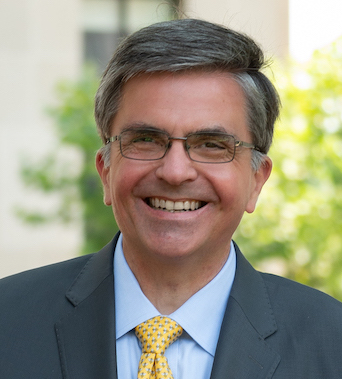
This November 1 will be my 30th anniversary at the Institute on Religion and Democracy (IRD)! I was honored last Thursday by a very nice party attended by colleagues and friends. It’s been a wonderful and unexpected journey that is not yet over. My decades at IRD have seen dramatic changes in American religion.
This change was illustrated last week when I spoke to some Christian college students, a dozen young women and one young man. All but two of them were unfamiliar with the concept of “denominations,” which I explained to them. None really knew what “Mainline Protestants” were. I may as well have been discussing a forgotten species of dinosaur. They were all, to my knowledge, church going, but attend nondenominational churches. One young woman attends a congregation of the Presbyterian Church in America, to which she felt some loyalty. Another young woman mentioned hers was Assemblies of God (Pentecostal Wesleyan), although she is moving towards Calvinism, illustrated by the book in front of her by a prominent Reformed seminary president.
I really relished telling them about the old days of American religion and how we have arrived at our current moment. Denominations, conservative and liberal, are fading or already faded. Nondenominationalism is the only major growing American religion category. Nondenominationalism, if it were a denomination, would be America’s largest Protestant religious body.
IRD spent much of its history focused on denominations. I was hired in 1994 by my presidential predecessor Diane Knippers to start and run a program for United Methodists. IRD had programs for Presbyterians and Episcopalians. We worked with renewal groups in the other Mainline Protestant denominations. There was hope of reforming the old Mainline Protestant denominations, even though they had already been in decline for 30 years, and even though their centers of authority were long captive to heterodox influences. The Mainline Protestant battles are now long over. Those denominations have all divided and shrunk drastically. Many will not exist in 10 years. Some conservative denominations will not exist in 10 years. All of American religion is in a churn. If I’m addressing college students in 10 years, there will be much more to review.
Today I was also sharing some of these changes with IRD’s last remaining founder, David Jessup. Here’s an excerpt from Time magazine in 1983:
The United Methodist Church, which has lost 1.4 million members since 1968, would normally welcome most converts. But its leaders must rue the day in 1979 when David Jessup, who had become a religious dropout in college, decided to join the Marvin Memorial Church of Silver Spring, Md. Jessup, 42, who works with the AFL-CIO’S Committee on Political Education, began to have questions about organizations that received Methodist funds. The end result of his curiosity is the Institute on Religion and Democracy, which, though small, can justly claim credit for the present furor over Protestant politics.
David’s curiosity in United Methodist spending was provoked when his children returned from Sunday school raising money for what seemed to him to be suspicious causes. As Time reported:
Founder Jessup joined the early Berkeley free-speech movement, and later the Peace Corps as well as black-voter-registration and labor-organizing campaigns. But even in his radical student days he was strongly anti Communist. In 1980 he and his wife, in what became known as the Jessup Report, totaled up $442,000 in Methodist moneys aiding groups he judged to be Marxist or totalitarian, and sent the list to the denomination’s financial overseers.
David distributed their report to delegates at the 1980 United Methodist General Conference. There he met new friends. As Time reported:
Through his campaign Jessup met folksy Texas Evangelist Ed Robb, 56, a conservative Democrat and a leader in Good News, an evangelical caucus that had long criticized Methodist agencies for overplaying social issues. Good News promoted Jessup’s charges in its publications. A few months later, Jessup and Robb set up the I.R.D. in Washington, D.C., to monitor political activity by various denominations. They enlisted a credibility-building board of advisers whose 28 members range from socialist to right-wing on domestic issues but are pro-U.S. on foreign policy.
As David reminded me over lunch, his investigation of spending by the United Methodist General Board of Global Ministries prompted that board to investigate David, which included a visit with David’s then pastor. The agency also complained to David’s employer, the AFL-CIO, threatening to withhold future political collaboration. David’s pastor did not defend him. But the head of the AFL-CIO strongly rebuffed their threat in a letter to the missions board, advising that David’s religious activities were not his employer’s business.
David’s research, and subsequent research by IRD staff, resulted in my own discovery of troubling United Methodist spending and politics when I was my local church’s missions chair in the late 1980s. In 1989 I invited David and others from IRD to speak at my local church. I began my own initiative of challenge to the missions board, which resulted in then IRD President IRD offer of employment. I gladly accepted, 30 years ago.
The United Methodist battles are concluded. But IRD’s work continues in new arenas that recognize America’s new religious reality. And as at the beginning, IRD vigorously affirms the Christian case for democracy, human rights, and religious freedom for all. Forty years ago, IRD challenged Marxist-Leninists and their fellow travelers in the churches. Today people in the U.S. church world on the political extremes still contest claims of democracy, human rights, and religious freedom equally for all.
God gives equal dignity to all persons whom He made in His image. But fallen human nature in all times defies His wishes and makes prideful claims of superiority for one group over others, justifying coercion and persecution for some ostensibly righteous cause. IRD always seeks to encourage churches and Christians to challenge these spurious claims and to model God’s justice and mercy for all.
Thirty years ago, I did not expect to still be at IRD in 2024. My work focused on the United Methodist Church, and I assumed it would conclude with the end of that denominational battle. I became IRD president 15 years ago. Today IRD speaks to Christians through different programs: The New Whiggery initiative extolling spiritually informed classical liberty, Providence (our Christian Realism journal), our “In Defense of Christians” advocacy for persecuted overseas believers, and our John Wesley Institute for theological formation, plus campus outreach and countless events for young professionals in DC. I’m planning new initiatives to strengthen Protestant Christian ethicists and to create a Christian voice in Washington, DC for the free market.
Today, no less than thirty years ago, I remain persuaded that IRD must point to a thoughtful Christian social witness affirming decency and dignity for all. The need is endless, and the work continues.




Comment by Deb White on October 26, 2024 at 9:54 am
Thank you for your hard work over these thirty years, Mark.
Comment by Joe M on October 27, 2024 at 2:07 pm
As someone who grew up in the UMC and felt the influence of lay witness weekends in the 1970s, I say thank you.
Years ago I never would have guessed the Methodists would be the *last* of the mainlines to have a remnant forcing the organization to hang on to its institutional orthodoxy . When I read “The United Methodist battles are concluded,” I am simultaneously sad and grateful.
Comment by Randall Murphree on October 27, 2024 at 7:37 pm
Mark, thanks for your faithful leadership at IRD. I grew up in the Methodist Church (pre-United) in north Alabama, and I was always proud of a heritage of pastors and missionaries in my extended family. However, I was prompted to leave the UMC in 1991 a few years after moving to Tupelo to work at AFA. I retired last year, after 40 years … so I think you have another good decade ahead. I look forward to following your ministry and continuing to pray for you. God bless you.
Comment by Search for Truth on November 3, 2024 at 11:44 am
Mark, I thank you for your years of supporting Christian values in our churches and encouraging their parishioners to support public policies that forward those values.
I have been told that while the non-demoninal attendance is increasing, I have also been told that many who are leaving the traditional protestant denominations are turning to the Catholic Church, which to the dismay of many of our protestant brothers is also Christian.
I assure you your work is not yet finished. From some of the current rhetoric that has been report, I fear that within the next few years, public expression of Christianity will become illegal and a jailable offense.