
Good News, the United Methodist movement of evangelicals, is phasing out of existence. In the fast-changing religious scene, most of the Good News leaders and many of its followers are now identifying with the newly formed Global Methodist Church (GMC). Since the GMC is committed to historic Methodist faith and practice there is much less need for a “renewal” group like Good News.
So, as Good News prepares to clean out the desks and lock the doors and say, “Goodbye,” we want to say, thank you, Good News, for a job well done. And—we believe a few parting thoughts are in order.
I am privileged to have been part of this story ever since I responded to Chuck Keysor’s original article in the Christian Advocate July 14, 1966. The article, entitled, “Methodism’s Silent Minority,” written at a time when theological liberalism and institutional conservatism had dominated Methodist practice for nearly 50 years, spoke of the large number of evangelical Methodists who still held to the essentials of the faith, supported their local churches, and basically were the face of Methodism in local communities.
The article generated more written response than any other article in the long history of Christian Advocate. In the main the responders were “the little people,” that is, not pastors of big churches or seminary professors or bishops, but common, ordinary Methodists, many of whom, in addition to their commitment to historic Methodism, were also being influenced by a growing evangelical presence in American society. This presence was reflected in the popularity of Billy Graham and parachurch groups such as Youth for Christ and Campus Crusade, and also by the rising influence of such seminaries as Asbury, Fuller, Trinity (in Illinois) and Gorden Conwell.
From these supporters Keysor gathered a group which formed the first Good News Board. In Spring of 1967 Vol. 1, No. 1 of the Good News magazine was published.
The magazine, and an evangelical voice in the church, were well-timed. The 1960s brought to the American religious scene the “Death of God” movement, the secularization of American culture as well expressed in Harvey Cox’s book The Secular City, growing racial unrest, the controversial Vietnam war, political turmoil illustrated by the disruptions of the 1968 Democratic convention, and student rebellion against the established order. Liberal seminaries, reflecting the culture of the day, were committed to “relevance,” academic freedom (which would disallow any confessional approach to theological training), and social change. Traditional studies were giving way to training in social action. Disruption, sit-ins, and demonstrations became the strategy to bring in this new social order. All of this came to a head at the 1968 General Conference, the time of the forming of the United Methodist Church by the merger of the Methodist Church and Evangelical United Brethren (EUB) Church. The merger came at the exact right moment for the institutional and liberal leaders of the church to reshape the church for the revolutionary “new day.”
The conference and the subsequent conferences in 1970 and 1972, were disasters from an evangelical point of view. The new United Methodist Church approved a new doctrinal statement, a new Social Principles statement, and established a top-heavy institutional structure featuring four superboards that for all practical purposes were not accountable to any group in the church. The conference also set up extensive quota systems for church agencies, lifted the ban against clergy use of tobacco and alcohol, launched a youth agency which operated separately from any adult involvement, and established the Ministerial Education Fund, which served basically to subsidize (bail out) ailing United Methodist (liberal) seminaries.
From that point on Good News would work for the cause of evangelical renewal in the United Methodist Church. Has it been successful? The following are some ways that Good News has had a positive effect on United Methodism (this article will address two areas–subsequent articles will address additional areas).
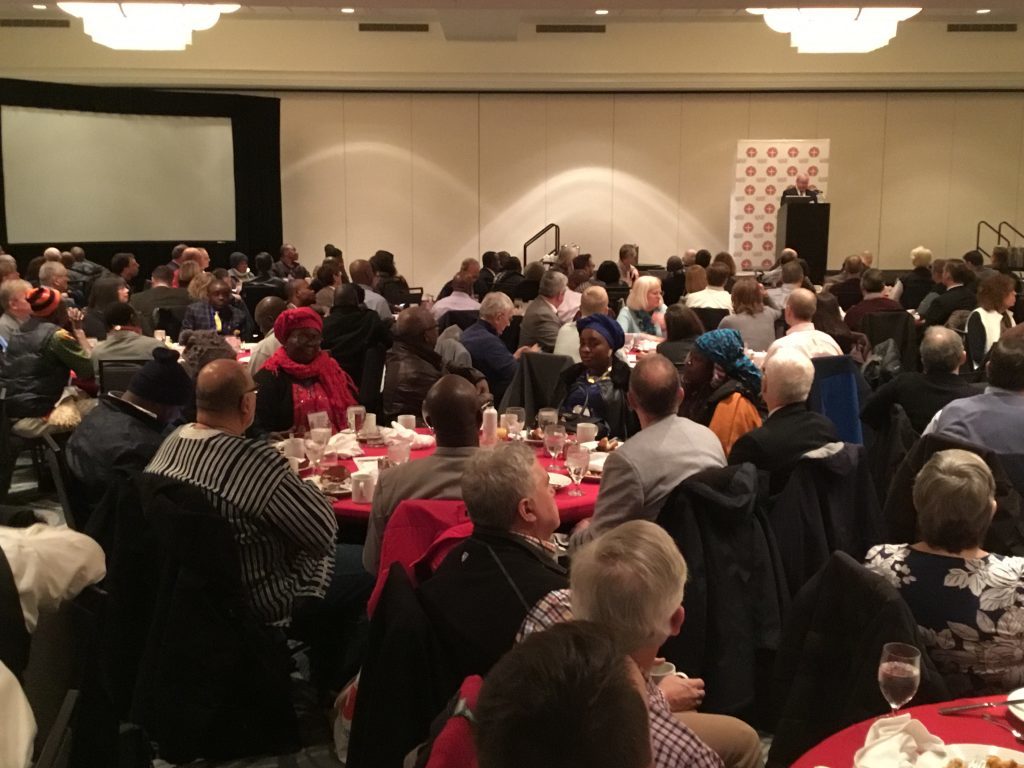
1) Encouragement. Many hundreds (thousands?) people have indicated they have remained United Methodist because of Good News. By the 1960s despite the entrenched liberalism of institutional Methodism and the Evangelical United Brethren (EUB) Church, a large percentage, perhaps even a majority, of Methodists were basically evangelical in their everyday lives. But it was a discouraged group. The launching of Good News brought enthusiasm and excitement. The first Good News Convocation in 1970 registered 1,600 persons and felt almost like a revival meeting. It was a new day for Methodism.
Perhaps some of the greatest encouragement came from persons not directly associated with Good News. Bishop Gerald Kennedy (featured on a Time magazine cover in 1964) gave personal encouragement to Charles Keysor, wrote an article for the first issue of the magazine, and spoke at Good News first convocation. Spurgeon Dunham, editor of Texas Methodist, which in its heyday was the highest circulated religious newspaper in the nation, editorialized that while the church had many liberal voices, it was time for a more conservative voice. One of the most encouraging voices was that of Bishop Roy Nichols who at the time he chaired the World Division of the Board of Global Ministries. Nichols spent three hours with the Good News board in a non-publicized meeting and communicated a message which might be summarized as “keep on keeping on.”
2) A new doctrinal statement in 1988. Perhaps this was the most significant accomplishment of Good News in its 57 year history. From the evangelical perspective the greatest disaster of the 1972 General Conference was the doctrinal statement for the new United Methodist Church. It was a sign of the times that the statement, prepared by a task force under the leadership of Dr. Albert Outler, took less than 20 minutes to be presented and approved by the 1972 General Conference, suggesting doctrine was not all that important for the new church. It introduced the idea of “pluralism,” (within a central core of beliefs anything goes). Outler did not want to define the “core” lest the church be accused of fundamentalism. So, people could define it however they wished. The statement then introduced the idea of the “quadrilateral,” which spoke of our discerning of truth by four equal principles: Scripture, tradition, reason, and experience. This new concept in reality undercut the full authority of Scripture. The statement then referred to the conciliar principle (evolving new truths are codified by “conference” actions thus opening the gate to assigning “conferences” final authority in doctrinal matters). The statement asserted that the doctrines of the church were not to be asserted “juridically” (heresy trial will not be allowed because church trials would be ruled out).
There were, of course, no evangelicals on the doctrinal task force. Good News was still so new to the institutional scene that it did not realize right away how terrible the statement was. When the reality hit as to how far afield the doctrinal statement had gone, it took Good News some time to form a response.
Meanwhile, the liberal institution was having a field day with the new statement. One book from Nashville spoke of the four central “truths” of Methodism: Scripture, reason, tradition, and experience. Seminary professors were overjoyed by being able to justify liberal affirmations by arguing that reason (as they understood it) and experience (as they understood it) together could override Scripture. Arguments for the acceptability of homosexual practice also pitted reason and experience against Scripture). Other religions were valid ways to God.
In 1976 Good News sent petitions to the General Conference asking for a new committee, or at least someone with authority, to define “the core of doctrine” within which “pluralism” was encouraged to function. Those petitions went nowhere. In 1980 Good sent petitions asking for a new doctrinal committee. The head of the Faith and Order legislative group, before the petitions were even considered, declared the present statement was fine. The petitions failed overwhelmingly.
In 1984 Good News tried an entirely different strategy. More than 500 petitions were sent to the conference, almost all of them from persons related to Good News. Over 350 of the petitions were part of a new strategy. These were sent by persons whose names would not necessarily be connected with Good News. These petitions referenced specific phrases or paragraphs in the statement. The idea was to revise the doctrinal statement with incremental changes. After two days of debate in which some petitions were approved and some not, the comment was made that the committee was not qualified to make so many changes and what was really needed was a new task force to deal with doctrinal matters. A petition was passed to such effect. Even Good News was surprised by how successful the strategy had worked. It led to a new task force, the very thing Good News had wanted.
While Good News (naturally) would not be represented on such a task force, a sympathetic chair, Bishop Earl Hunt, was appointed and a well-known evangelical, Ken Kinghorn from Asbury Seminary, who later penned most of the new statement, was also appointed. Good News was able to present papers before the task force.
At the 1988 General Conference, after much debate and many amendments, the new statement was approved. The word “pluralism” was excised; the “quadrilateral” was unmentioned, the idea of the conciliar principle was dropped as was any mention of “not to be understood juridically.”
The church would live to see another day.
The next article, (part II), on “Good News, a Job Well Done” will address Good News and Sunday school material, Good News and Human Sexuality, Good News and the Spawning of new renewal groups, and Good News and missions.


Comment by Tim on October 21, 2024 at 1:12 pm
The quadrilateral is what prevents United Methodists from turning into the Biblical Pharisees; folks who would get mad at Jesus for performing miracles on the Sabbath instead of rejoicing that a man had been healed. Folks who knew all of scripture but still didn’t act right in how they treated people.
We’ve now refined it as a three legged stool for understanding Scripture, making sure that Scripture is still the core of our beliefs, but how do you approach Scripture without reason, tradition, and experience? These are the vehicles by which we understand what God’s calling us to do.
The alternative is to put God in a box. A lot of evangelicals are quite certain they know exactly what God wants. So they call themselves traditionalists and feel like they speak for God. I think that’s much more dangerous than the quadrilateral.
Comment by David on October 21, 2024 at 6:03 pm
Theologically, Jesus was a Pharisee. He reportedly believed in the resurrection or afterlife, angels, and “spirits” (souls). The religious traditionists, the Sadducees, rejected these as being contrary to scripture. Jesus also attended synagogues, Pharisaic institutions. This was contrary to the practice of orthodox believers who held there should be only one place of worship for the one God.
After the destruction of the Temple in 70 CE, Judaism was guided by the Pharisees. They began to convert Gentiles much to the annoyance of the early Christians. This accounts for some present-day Jews having northern Italian genetic ancestry with no direct connection with the Middle East.
Comment by Tim on October 21, 2024 at 7:46 pm
David I agree with most of what you wrote. My use of the term in a prejudicial way was to align with how they are described in the Bible, but as you say Jesus seems to come out of that tradition and he is very good at debating with them, suggesting they are part of his background.
I stand by my claim though that Jesus is most obviously frustrated with people who can recite the law but care not about the person in front of them, and in the New Testament that is often Pharisees.
Comment by MikeB on October 21, 2024 at 8:14 pm
Tim,
Again, you go out of your way to harass, you can’t know if human biological sex is indeed mentioned in the Bible or true, but you are certain exactly who Jesus is most frustrated with…
Do you actually even believe in miracles?
Again nothing but lies come from your mouth, you reject tradition, engage in heresy, and deny science and scripture.
You continue to make the sound of one man praising his own lies.
Comment by Tim Ware on October 21, 2024 at 10:22 pm
It might be good to remember that outside of the birth, the journey into Egypt and back, the episode in Jerusalem when Jesus was 12, and the fact that we are told Jesus was a “builder” (usually translated as carpenter), we know nothing about what Jesus did before He was baptized by John and began His public ministry.
To say that Jesus was a Pharisee or from the tradition of the Pharisees is pure assumption. The fact is that we do not know what Jesus did before He began His public ministry. Any theological house we build on an assumption is a house of cards, not to mention misleading.
Comment by Tim on October 22, 2024 at 6:09 am
I think David’s point was to argue against my using Pharisee as a synonym for hypocrite, and it was a fair point. There’s a fair amount of scholarship on the Jewish side of who the Pharisees were and his point about modern Judaism being descended from them is valid.
I don’t want my choice to critique the New Testament Pharisees to undermine the point I was trying to make, which is that the quadrilateral the UMC adopted in 1968 and later refined as three legs to approach Scripture is valid.
Scripture is a lot to unpack, and was written across hundreds of years of history by people in very different societies for very different purposes. So anyone who claims God’s intent is obvious from Scripture is inherently making assumptions.
A more honest approach, guided by the Holy Spirit, is to consider what we learn from Scripture with regards to our traditions, what we’ve learned in our own lives, and the best God-given reasoning we have. Hence the quadrilateral.
Comment by MikeB on October 22, 2024 at 7:39 am
Tim,
You reject tradition at every opportunity.
You reject the biblical cannon
You reject Nicea
You reject the primacy of God
You embrace trans theology
You embrace gay marriage
You embrace the primacy of man to the point you admitted you have no use of a Christianity that does not serve man first.
You stalk nice people like Mr Case just so you can attack them using words you don’t believe anyway.
You definitely are showing where your heart is.
Comment by Wilson R. on October 22, 2024 at 1:11 pm
I had to go back and do some digging after reading this. Turns out that the author’s characterization of the 1972 doctrinal statement lacks critical context and is therefore misleading. The author here presents quotes from Dr. Albert Outler but omits clarifying comments from one of the other committee members, Rev. Georgia Harkness. Here is a key excerpt from the contemporary New York Times report on the General Conference:
“The statement notes that the United Methodist Church has a “history of doctrinal diversity” and says it must chart a course “between dogmatism and indifferentism.”
The Rev. Dr. Georgia Harkness, theologian of Claremont, Calif., put it this way:
“Lay people generally are very vague as to what they believe unless they are very dogmatic.” She said the guidelines overcame both extremes, combining flexibility with firmness.”
https://www.nytimes.com/1972/04/22/archives/methodists-back-theological-pluralism.html
This doesn’t sound like some radical departure to me, as the author implies. In fact, it sounds moderate in intent, specifically rejecting extremes. The Times article also notes that the Methodist Church had not adopted a new doctrinal statement since 1912, and the Evangelical United Brethren had not done so since 1860. Given this gap, and given the merger of the two denominations, it sounds pretty reasonable that the conference thought a new statement was in order.
Nor does “theological pluralism” sound like a doctrine of anything goes.
Likewise, the author’s characterization of the Wesleyan Quadrilateral is misleading (deliberately so, it appears). From the author’s description above, it comes across as something made up out of whole cloth by Albert Outler; it doesn’t even mention John Wesley (perhaps because that would be inconvenient for the author’s contentions?)
The fact is that Dr. Outler was arguably the foremost expert on John Wesley and Wesleyan theology. I have one of his books on Wesleyan theology that I inherited from my father, who took classes from Outler when he was studying to become a Methodist minister at the Perkins School of Theology in the mid-1950s. (By the way, no one but the Klan in Texas would have called my father a liberal.)
Outler drew from Wesley’s own writings to describe the “quadrilateral” as Wesley’s way of interpreting scripture. Left unmentioned here is that scripture always forms the base, or foundation, of the quadrilateral. And OF COURSE all Christians, whether they want to admit it or not, use reason and experience as lenses through which to interpret Scripture. Otherwise, we’d favor stoning rebellious children, as scripture commands, or condone genocide, as the Israelites believed God ordered them to do upon entering the Promised Land.
A more honest and less slanted presentation of the history would have been helpful here.
Comment by Tim on October 22, 2024 at 4:11 pm
Wilson thank you for that link. The hope and excitement about being a big tent church is a good memory, and maybe an ideal to aim for again. We were always at our best working on the problems we all agreed needed to be solved.
Comment by Mike Lee on October 23, 2024 at 8:39 pm
Nuts!