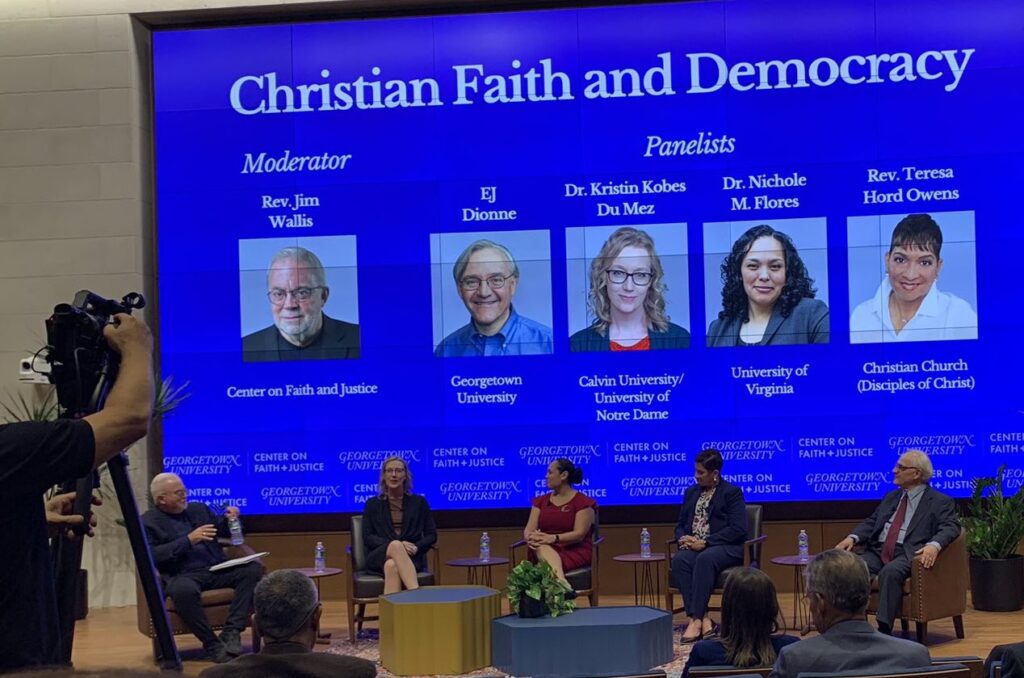
Politically progressive Christians at a recent Georgetown University event were exhorted to defend U.S. democracy that they charge is actively threatened by a leveraging of Christianity for political power.
“The United States confronts a crisis of democracy, and the American church confronts a test of faith,” reads the opening line of the Center on Faith and Justice statement on Christian Faith and Democracy. The statement summarized the Test of Faith: A Summit to Defend Democracy’s beliefs on Christian duty to defend democracy and provided principles through which to engage politically.
The September 19-20 Washington, D.C. gathering featured panel discussions with longtime Religious Left figures including Sojourners founder Jim Wallis, National Council of Churches President Bishop Vashti McKenzie, Sister Simone Campbell of the liberal Catholic social justice lobby NETWORK, and Duke University church historian and Episcopalian Diana Butler Bass. They were joined by Evangelical Left figures including The Color of Compromise author Jemar Tisby and Jesus and John Wayne author and Calvin University Professor of History and Gender Studies Kristin Kobes Du Mez.
Democracy is “facing new threats within our nation, and new challenges around the globe,” the statement reads, charging that the Christian faith “stands distorted and corrupted—especially to a new generation.” These two threats, statement drafters insist, stem from the same source – the leveraging of Christianity for political power.
“Jesus Christ is distorted and leveraged in defense of authoritarian leaders who seek to erode freedoms essential to a thriving democracy,” the statement continues. “Some Christians enthusiastically praise dictatorial leaders and regimes.”
This political leverage not only undermines democracy but is effectively corrupting the Christian faith. Likewise, it argues that the Christian moral teaching is to uphold and defend democracy in its modern age of attack. The Christian fall is not only their support for these authoritarian leaders but their willful engagement in “political violence.”
Statement authors point to the January 6, 2021 Capitol Insurrection as evidence of political violence threatening democracy. It states that the “peaceful transfer of power came under a direct attack during a violent insurrection at the U.S. Capitol.” This political violence reflects the state of the Christian faith in America because “some who rioted on the Capitol steps and stormed into the congressional chamber did so in the name of Jesus Christ.”
From articulating the pressing need for Christians to defend America’s institution of democracy, the Christian Faith and Democracy statement provides political principles for Christians to reinstate and reinforce as a basis of action.
These principles include concepts such as the human dignity of all people from the Imago Dei, and the forbearance of sin affecting all people and human institutions. The statement even furthers its understanding of sin by stating, ”The mechanisms of democracy, the balances of power, and the protections of a Constitutional framework rein in human tendencies to dominate, demean, and exploit.”
Conference speakers echoed these words. Kobes Du Mez argued that supporters of Christian Nationalism misuse Jesus’ words to further a selfish political agenda.
“Sin runs through every human heart, and often it is the people who think they are following Jesus, who tak[e] Jesus’ name and baptiz[e] their own personal, prideful, selfish agenda… those are the ones who are condemned by the Scriptures,” Kobes Du Mez shared on a panel addressing the Christian Faith and Democracy statement, unphased by the irony of a Christian conference that uses Jesus’ name to promote a politics of the political Left.
The statement also uplifts principles such as promoting “Truth and Integrity,” “Loving the Stranger and the Enemy,” supporting “Solidarity and the Common Good,” encouraging civil participation regardless of economic status, encouraging “Religious Pluralism,” and emphasizing “Peacemaking and Bridge-Building” with all people.
There are a total of 142 ecumenical signatories, many of whom are faculty at universities such as Harvard, Princeton, Georgetown, Notre Dame etc. Several Black Evangelical officials were present along with signatories from Mainline Protestant denominations. Numerous signatories are affiliated with para-church organizations focused upon social justice and racism.
Jim Wallis, founder of Sojourners, explained why he still identified as an evangelical, seeking to unite the gospel message and social justice to the poor.
“The reason why I still use the term “small ‘e’ evangelical” is Jesus’ definition of that…the gospel, according to Jesus, is good news to the poor,” Wallis explained. “Whatever else may be, it’s not the gospel of Jesus Christ, period.”
The statement ends with a call across different faith traditions in the shared unity to defend democracy and preserve political participation.
“We have to not only save democracy but transform it,” Wallis concluded his evening remarks, adding that the statement gave a broader vision of what that transformation may look like.
“In keeping with these principles, we, the undersigned, commit to advancing a multi-racial, multi-faith, multi-generational democracy, where every voice is valued and every person afforded the opportunity to participate fully and freely in the life of the community.”



Comment by David S. on October 15, 2024 at 12:37 pm
I could take these people seriously, if it were not for, as the author implies, the total lack of self-awareness these people have. Never do they criticize the excesses of the political left, just the right.
Comment by Tim Ware on October 15, 2024 at 7:50 pm
Of all the things the Christian left has agitated about over the years, I don’t ever remember them being concerned about democracy until now. Yet, as if right on cue, when “saving democracy” becomes the slogan du jour of the political left, they all of a sudden, completely coincidentally, I’m sure, feel democracy is in crisis and feel an overwhelming need to join in the chorus to save democracy.
Just another example of organized Christianity following whatever is current in society, or at least their little corner of society.
“Where every voice is valued”? What a joke! They only want to hear voices that agree with them. Voices that do not agree with them they want to silence, because after all, those voices are a threat to democracy, prejudiced, racist, homophobic, misogynistic, hateful, uninclusive, or whatever catchword they are using at any particular time.
The scary thing about these people, though, and what makes them so dangerous, is that they genuinely do not believe they are like that. They have been deceived.
Comment by David Gingrich on October 16, 2024 at 6:46 am
These poor people seem to never look in the mirror.
Comment by Mark Siegman on October 16, 2024 at 11:51 am
Perfect example of why nobody should be surprised that the largest growing religious group in the United States are the “nones”. This gathering (also highlighted in a news story on the PCUSA website under “Presbyterian News Service”) screams to anybody paying attention that there is no difference between a secular, left wing political agenda, and Christianity. Just a bit more virtue signaling and condescending sanctimony. No surprise that these denominations are shells of their former selves, offering nothing to those seeking truth or meaning in life. Just send money! Sad but not at all surprising.
Comment by Td on October 17, 2024 at 10:37 pm
They have let their politics form their faith instead of their faith forming their politics. These people truly cannot get over their hatred for Donald Trump, Republicans, and who votes for them.
Comment by Diane on October 19, 2024 at 10:39 pm
I’ll take secularism any day after reading Project 2025, which exclusively names the church, not the synagogue or mosque, as a building block of a moral society. The writer is a member of a global faith community that is forever in the news with having to spend millions on clergy sexual abuse settlements – and he thinks we’re all going to buy in to the church as a moral building block of society? Several months ago, I called the Southern Baptist Convention and one of the numbered options on the phone menu was “report sexual abuse”. Good grief – the church’s immorality is over the top! Project 2025 went on to declare that “transgender ideology” is pornography and that teachers and public librarians who purvey such should face imprisonment and their names placed on a sex offender registry. Extreme? Absolutely! I’ll take secularism, it’s nicer.
Comment by Stephen Hoffmann on October 21, 2024 at 8:11 pm
Diane: Since when is the Anglican Church of North America mired in sex abuse settlements?
Comment by Wilson R. on October 22, 2024 at 11:27 am
I’m responding to Td’s claim that liberals “let their politics form their faith instead of their faith forming their politics.” Over my 65+ years, I have noticed that many politically conservative Christians appear to have a huge blind spot on this issue. They profess that their own political views are guided by their faith–and I accept their claim. But they also routinely argue that anyone who is politically liberal necessarily must be putting politics over faith. They seem unable to allow for the possibility that other Christians (like me) apply their faith to draw conclusions about politics that are different from their own. The implication is that these liberals are not actually Christians, or are at least badly deluded and, therefore, dangerous.
I start with the text of Genesis 1, in which God lays the moral alongside the physical foundation of the world by making human beings in the image and likeness of God. I apply the concept of justice from the OT prophets, who affirm over and over that anything that tolerance by the community of anything that diminishes the dignity of others created in God’s image—from human sacrifice to ignoring the plight of the poor and marginalized to exploiting one’s workers to failing to love the resident alien as one’s self—is an injustice that places the community out of right relationship with God. It’s no accident that “justice” and “righteousness” are so often paired in the OT; they are what results from following the two great commandments of loving God and loving neighbor. And then I read how Jesus builds on and interprets these commandments. I think about why he twice defines his mission as involving “good news to the poor.” If he’s bringing good news to everyone, why does he especially mention the poor? Why does he tell a story in which Lazarus the beggar receives the love and nurture no one showed him during his lifetime, which the rich man at whose gates Lazarus sat every day gets told he is separated from the bosom of Abraham because he has “already enjoyed his share of good things?”
This is just a barebones sketch of how the Bible has shaped my political attitudes since my teenage years.
Like religious “conservatives,” I enjoy the freedom to vote for policies that reflect my beliefs—something that early Christians living under an empire did not enjoy.
So when I encounter politicians who show no concern for the poor in their words or their policies, I take that into account in how I vote.
When the governor of my state signs a no-permit open carry law at the headquarters of a gun manufacturer and says that unrestricted gun rights are paramount, even if children have to die, I read Jeremiah’s words about the sacrifice of children on altars to pagan idols, and I take that into account in how I vote.
When politicians say they want to do away with free school lunches for children who arrive hungry and can’t afford the cost of a meal, I read Jesus’ words and take them into account when I vote.
When politicians make it easier and easier to incarcerate people for nonviolent offenses, and then make it harder and harder for them to regain voting rights or the ability to become an employed, productive citizen again upon their release, I read the New Testament’s words about forgiveness, restoration, and reconciliation, and I take that into account when I vote.
I could go on. Hopefully, you get the idea.
But I have noticed a pattern. When Christians apply their principles in these ways, so-called conservatives tend to denounce them as “social justice warriors”—as if the idea of a society based on justice and righteousness is absent from the Bible—or even claim they aren’t Christians at all. These so-called conservatives also tend to talk about “Christian values” only in terms of hot-button social issues, such as homosexuality, abortion, and gender identity.
The author of this column, unfortunately, is similarly guilty of lazy generalizations, willful distortions, and intellectual dishonesty.
Comment by Douglas E Ehrhardt on October 22, 2024 at 2:12 pm
No Wilson no!. There’s no such thing as liberal Christians. Liberals wish the government would offer salvation. I grew up around liberals, the most intolerant people ever.
Comment by Wilson R. on October 22, 2024 at 2:59 pm
Doug, if that’s your definition of liberals, you might need to get out more.