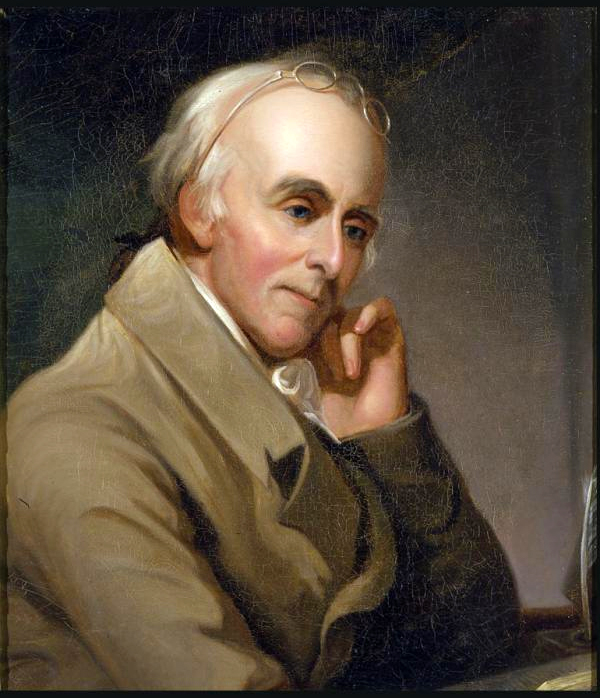

Historian of American religion Thomas Kidd of Midwestern Baptist Theological Seminary recently shared a quote from Benjamin Rush to Thomas Jefferson:
I agree with you in your wishes to keep religion and government independent of each Other. Were it possible for St. Paul to rise from his grave at the present juncture, he would say to the Clergy who are now so active in settling the political Affairs of the World. “Cease from your political labors, your kingdom is not of this World. Read my Epistles. In no part of them will you perceive me aiming to depose a pagan Emperor, or to place a Christian upon a throne. Christianity disdains to receive Support from human Governments. From this, it derives its preeminence over all the religions that ever have, or ever Shall exist in the World. Human Governments may receive Support from Christianity but it must be only from the love of justice, and peace which it is calculated to produce in the minds of men. By promoting these, and all the Other Christian Virtues by your precepts, and example, you will much sooner overthrow errors of all kind, and establish our pure and holy religion in the World, than by aiming to produce by your preaching, or pamphlets any change in the political state of mankind.”
Rush and Jefferson were corresponding within the context of government established religion, which of course had been the norm in Europe, and really throughout the world, since nearly the beginning of civilization, whether Christianity, Islam, Buddhism, Hinduism, or paganism. Jefferson and James Madison successfully worked to end the established Church of England in Virginia, which was supported by tax dollars, and under which dissenters were sometimes persecuted, even imprisoned. The vision of non-established religion eventually prevailed throughout the United States, to the benefit of vibrant Christianity.
Methodists and Baptists at the time Rush wrote this letter, and who supported non-establishment, were surging during the Second Great Awakening, as they evangelized the frontier. Non establishment never meant that religious people or religious institutions should withhold their views from public life. Unlike in post-revolutionary France, the American republic deemed religion in civil society to be a cornerstone of healthy democracy.
Rush notes that Christianity should support government “only from the love of justice and peace.” And he warns against clergy “settling the political affairs of the world.” This advice seems wise. Clergy are called to a particular vocation, to preach the Gospel, to disciple believers, to administer their churches. They are not generally invested with particular political wisdom and authority over their flocks. They are equal citizens and have every civil right to speak, of course. But wisdom and a proper regard for their office should generally restrain them on political topics, lest their flocks conflate the Gospel with political opinions.
In his 1830s observations, Alexis de Tocqueville noted that American churches, unlike European churches, were more vibrant and populated because they were not associated with a particular political perspective. (In 1800, when Rush wrote Jefferson, many New England clergy, especially in established churches, were quite politically outspoken against Jefferson.) The clergy, Tocqueville observed, generally stayed away from politics. Generally, the clergy, and the churches as institutions, affirmed and shaped American civil religion. Their prayers and public acts saw America as under God, meriting prayer, and support, which was inclusive of all Protestant denominations plus, eventually, Catholics, Jews, and generic theists.
Rush told Jefferson that the churches through their Gospel work more effectively overthrow “errors of all kind, and establish our pure and holy religion in the World, than by aiming to produce by your preaching, or pamphlets any change in the political state of mankind.”
This counsel from Rush seems timeless. The church most effectively shapes society by being the church, proclaiming the Gospel and performing Gospel work. As IRD’s 1981 founding statement declared:
The first political task of the Church is to be the Church. That is, Christians must proclaim and demonstrate the Gospel to all people, embracing them in a sustaining community of faith and discipline under the Lordship of Christ. In obedience to this biblical mandate, Christians have a special care for all who are in need, especially the poor, the oppressed, the despised and the marginal. The Church is called to be a community of diversity, including people of every race, nation, class, and political viewpoint. As a universal community, the Church witnesses to the limits of the national and ideological loyalties that divide mankind. Communal allegiance to Christ and his Kingdom is the indispensable check upon pretensions of the modern state. Because Christ is Lord, Caesar is not Lord. By humbling all secular claims to sovereignty, the Church makes its most important political contribution by being, fully and unapologetically, the Church.
The centrality of the church for Christians strengthens their resolve towards work in society while also understanding its right perspective, as the IRD statement said:
While our first allegiance is to the community of faith and its mission in the world, Christians do not withdraw from participation in other communities. To the contrary, we are called to be leaven and light in movements of cultural, and economic change. History is the arena in which Christians exercise their discipleship. Because our hope is eternal and transcendent, Christians can participate in society without despair or delusion. We do not despair of the meaning of history, nor do we delude ourselves that our efforts are to be equated with establishing the Kingdom of God. The fulfillment of history’s travail is the promised Rule of God, not the establishment of our human programs and designs.
IRD was founded to counteract leftist church officials and agencies who imagined they could hasten God’s Kingdom by supporting Marxist revolution in the Third World. But we must also realize with humility that God’s Kingdom will not materialize through our own preferred politics. Temporal politics are important because they reflect justice or the absence of it among humanity. But they are not ultimate, nor can we as fallen persons, even if redeemed, claim absolute wisdom and knowledge in our own political choices. We might be wrong. And even if we’re right, our rightness will be corrupted by human frailty.
We persevere through hope because we know God’s power transcends our human failures. And as Benjamin Rush told Thomas Jefferson, we will overthrow countless errors through “pure and holy religion.” We know that without holiness, we cannot see God.


Comment by Tim on October 10, 2024 at 7:57 am
I mostly agree with Rush’s point, that the love of justice and peace is where personal holiness crosses into the political arena appropriately. The problem of course is when society has greatly different views of what justice is. Even by de Toqueville’s time the US churches were careening towards a split over slavery.
Comment by Bill Haslet on October 15, 2024 at 7:43 pm
So, here is what I pray several times a day, every day. Most of this is from Jesus himself: “Thy Kingdom come; thy will be done on earth as it is in heaven by sunset today. Amen.” So far it has not happened, but I am not giving up.
Comment by David Gingrich on October 16, 2024 at 6:35 am
“But we must also realize with humility that God’s Kingdom will not materialize through our own preferred politics.”
God’s Kingdom will not materialize through any human effort. It will materialize when Christ returns.