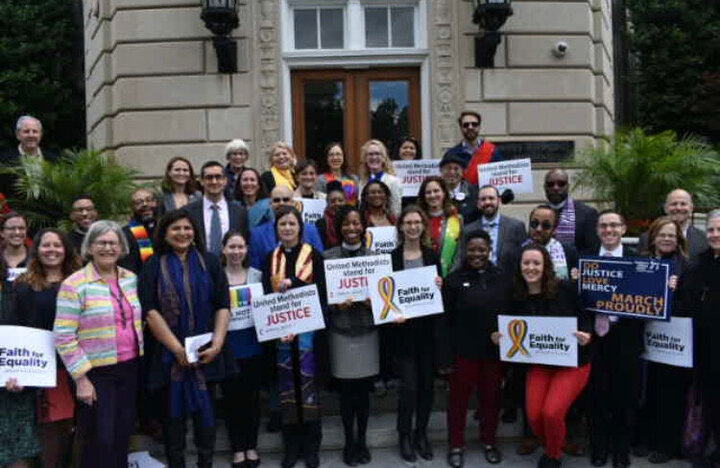
On Thursday, September 26, the United Methodist Building celebrated its 100th anniversary. Catty-cornered from the U.S. Capitol and next door to the Supreme Court, the UMB is the only non-governmental institution on Capitol Hill, a position it has held since its dedication in 1923.
The Board of Temperance, Prohibition, and Public Morals initially devised the UMB as a beachhead in the crusade against alcohol in the United States. Until the ratification of the 21st Amendment, the UMB was home to the most ferocious prohibitionists in the nation, advocating for lengthy jail times for drinkers and the dissolution of saloons by force of arms.
When the United Methodist Church was established in 1968, the denomination’s temperance initiatives were reorganized under the General Board of Church and Society (GBCS). Although even the Board of Temperance itself didn’t restrict its activities solely to Prohibition, it also advocated against child labor and in favor of capital punishment; the GBCS was intended to follow its predecessor’s teetotal footsteps. The trust containing the GBCS’ assets restricts their use to “work in the areas of temperance and alcohol problems.” The modern GBCS has virtually ignored this directive.
Unburdened by its traditional temperance focus, the UMB became Washington’s spiritual center of progressive activism. Marches for civil rights, peace in Vietnam, the Equal Rights Amendment, and many other causes were staged at the building throughout the 1960s and 1970s. The UMB also began renting out its offices in the name of ecumenism, with the building now containing Lutheran, Presbyterian, and Islamic denominational and interfaith offices with similar objectives.
In the 21st century, the GBCS has cemented its position at the forefront of liberal reforms in the church and the nation. In 2002, the building hosted prayer vigils against the declaration of war on Saddam Hussein. The building’s sign, which faces the Capitol, regularly features endorsements of topical liberal legislative initiatives, from open borders to Obamacare.
At the building’s hundredth birthday celebration, held on the front steps, GCBS officials reminisced fondly on the past few decades of progressive politicking and offered insights into the future of the UMC’s legislative agenda. The GCBS’ General Secretary, Bishop Julius Trimble, opened the event with a land acknowledgment and a call to resist colonialism in our modern society. Trimble described the work of the GCBS as a mission to “transform the world into an ever greater reflection of the divine will,” as articulated in the Methodist Social Creeds.
Later speakers included spoken word performers and others engaged in the work of the UMB. Jericho Brown, a Pulitzer-winning poet, praised the UMB for embodying the idea that “there is no difference between the saint and the activist.”
Looking toward the future of the UMB’s mission, Congressman Emanuel Cleaver (D-MO), a UMC pastor and resident of the UMB, identified the ascendance of Christian nationalism as the most pressing issue of modern politics. John Hill, former interim GCBS General Secretary, identified socialized healthcare and the abolition of the death penalty as key policy objectives for the next century of UMB activism at the Capitol.
Activism is in the bones of the Methodist tradition. Wesley himself described the mission of his movement as “to reform the nation,” and virtually every denomination in the Methodist or Holiness lineage has been involved in social reform, from ending the slave trade to establishing old age homes. In its historical role, the UMB was considered excessively radical in supporting Wesleyan social doctrines. Clarence Darrow, a famous attorney, wrote that the UMB was only constructed to sniff the breath of congressmen en route to the U.S. Capitol.
In our time, it seems that what was once billed as an enduring Protestant witness to the state has now become an incubator for activism against the policies once supported by the Methodist church and its mainline siblings. After a century amidst the halls of power, the role of the UMB as the outpost of Christian morality on Capitol Hill remains an open question.




Comment by Tim on October 1, 2024 at 3:54 pm
I’m struggling a bit with this article. In general I enjoy reading about the history and activism of Methodists in the temperence era. What I’m confused about is the charge that somehow its current role differs from years past.
Temperence was a social justice movement. The arguments for prohibition were that men were drinking their wages away, either trapping them as permanent thralls to their jobs, or keeping their wives and kids in destitute poverty. They argued for remaking society in a way they thought was more Christ-like.
The supposed deviations from this pattern are being against the unnecessary war in Iraq, being for the effort to get healthcare for everyone, advocating for the rights of refugees, and acknowledging our strained relations with indigenous peoples, including indigenous Methodists. I think you can make a very strong argument (and we as United Methodists do) that we are carrying forth our legacy of doing Christ’s work as earlier folks were.
Comment by Dan on October 1, 2024 at 4:34 pm
The legacy of holiness movements is to force, by rule of law, behavior that conforms to the behaviors judged good and moral by the standards of the holiness leaders. While the Bible advocates temperance, it did not mean total abstinence from alcohol, with the threat of fines and jail, if violated. Moving forward, the UMC has continued the “force the heathen to conform” values of its predecessors. Interestingly, if capital punishment is to be banned, wouldn’t that call for a ban on abortion, at the very least when the baby can survive on its own outside the womb?
Comment by Different Steve on October 1, 2024 at 5:40 pm
It’s interesting and encouraging that Tim appears to be struggling concerning the repurposing of an endowment/bequest. As far as “case to be made” goes, “grantor was racist/homophobic anyway” seems to be popular. Something to think about when considering giving money to institutions like this.
Comment by Dan W on October 1, 2024 at 7:59 pm
The political activism of the early 20th century Methodists, and the political activism of the early 21st century Methodists, are two sides of the same – Caesar’s coin.
Government run healthcare and the death penalty are also similar. One will end your (earthly) suffering a lot quicker.
Comment by David on October 2, 2024 at 7:00 am
I really do not see groups advocating for “government-run healthcare” (socialized medicine) as is found in the UK. What is favored is government health insurance for all similar to Medicare. The excuse is made that it will bankrupt the county, though it is found in other places that are not facing insolvency. This was proposed back in the New Deal, but withdrawn because of opposition from several quarters. Some feared that federal insurance would lead to racially integrated hospitals.
Comment by Tim Ware on October 2, 2024 at 12:12 pm
Since Constantine created the institutional church for political purposes back in the 300’s, some branches of Christianity have always attempted to use government to force certain views on others. That’s apparently OK when your views are the ones being forced on someone else, but as some people are finding out now, it’s a completely different story when someone else’s views are the ones being forced on you.
In other words, it’s OK to use organized Christianity to influence government when your views of Christianity are in the driver’s seat. But when someone else’s views of Christianity are in the driver’s seat…the panic is on!
Seems to me like the solution is to get organized Christianity out of the business of trying to control society altogether. In other words, get organized Christianity out of politics, both on the right and on the left.
Comment by David on October 9, 2024 at 6:20 am
This “social witness” organization has become nothing more than another religious organization that has gone totally liberal and woke is no different from any worldly organization.