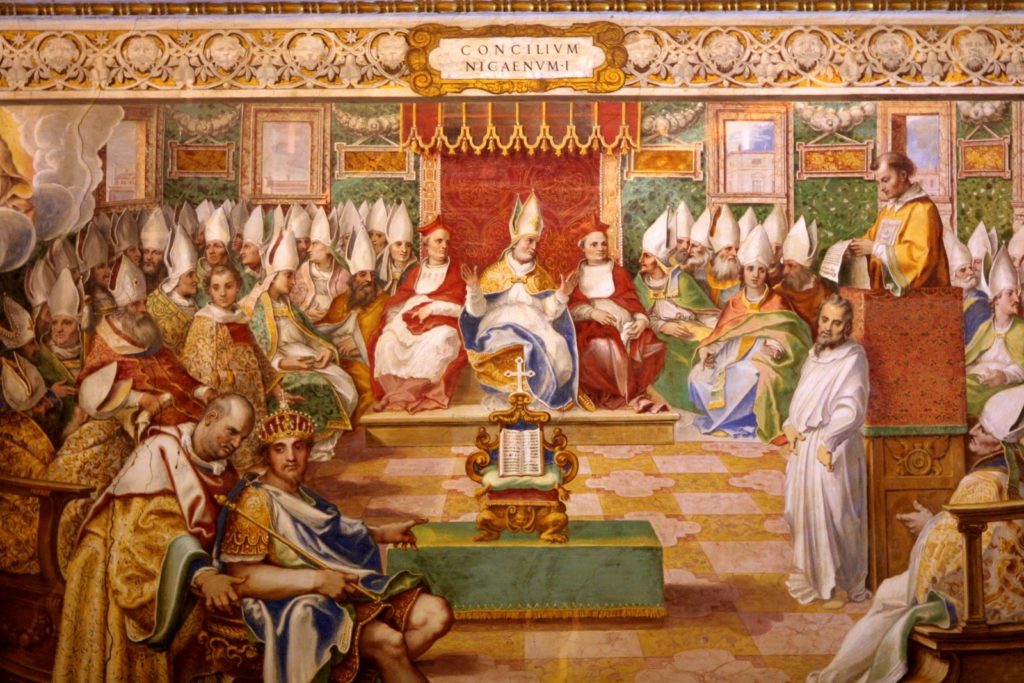
Must church traditions and corporate liturgy always impose, at least viewed by Protestant groups, ecclesiastical structures of the Roman Catholic Church? Early in my life, I would have answered yes.
Yet, although many Protestant denominations in the United States do not emphasize corporate liturgy or the essential creeds of the Christian Church, most affirm the principles of the historic creeds.
Raised in a congregationally governed church affiliated with the Southern Baptist Convention, I was skeptical of hierarchical church authority for much of my life and embraced the attitude that we need “no creed but Christ.” I believed only one text to be infallible, and it was not any of those crafted by ecumenical councils. Never mind that the canon of scripture itself was promulgated and reaffirmed by ecumenical councils.
Growing up, I bounced between Southern Baptist communities, a Lutheran church, non-denominational churches, and have settled in an Anglican church as a fellow in The Falls Church Anglican. While perhaps embracing Protestant disdain for church authority structures early in life, I have found the Anglican Church to offer a certain peace and security through well-established liturgical texts.
Study of Christianity in Southern Baptist and non-denominational settings initially led me to perceive liturgies as forced. Rather than intentionally crafted statements of faith, they felt like man-made dogma hindering personal exploration of the biblical texts; they seemed like traps rather than tools.
Aware that I did not understand why every particular word was carefully chosen, I felt I could not publicly assent to the foundational creeds. Mentions of the “one, holy, catholic and apostolic Church” were the icing on top; church traditions must have a Roman Catholic agenda, I thought.
Yet, appeals to tradition do not diminish personal relationships with God and the Word; they provide a theologically sound starting point.
Although the Southern Baptists and non-denominational churches that I have attended believe in the ideas of the essential biblical creeds – namely, the Nicene Creed, the Apostles’ Creed, and the Athanasian Creed – they did not corporately recite them as a congregation. Perhaps the congregants felt similar skepticism around traditions. Or, perhaps, they viewed such practices as superfluous since they already affirm the doctrines in the creeds. However, reciting them strengthens the church body and grounds the service in the beliefs held since biblical times.
Rather than blindly accepting the moral teachings of a distant church authority figure, as I had viewed the Pope or Catholic ecclesiastical structures, the congregations would merely be reciting statements they already believe. Moreover, local autonomy remains unchanged. For, as mentioned, the churches do not argue these creeds. Rather than introducing ecclesiastical hierarchy or diminishing emphasis on personal relationships with God, their recitation would constitute an act of remembrance and faithfulness to historical interpretations of the text.
As memorized by most Christians, the Lord’s Prayer begins with “Our Father.” Major prophets and biblical figures, including Christ himself, demonstrate corporate prayers and confessions. Corporate practices, then, reaffirm the unity of the church and universality of the human condition rather than detract from personal salvation.
After all, one church ought not to dismiss practices simply because they are embraced by the Roman Catholic Church or differing denominations. The Roman Catholic Church aims for the same ends as the Southern Baptist, non-denominational, and other Protestant congregations. They all seek to spread God’s Word, to love their neighbors, and serve the Kingdom of God. Although, after the Reformation, Protestants might place a mistrust or stigma around the Roman Catholic Church, they should not reject practices, such as liturgy, simply because they are a feature of Roman Catholicism.
Even where these denominations argue on applying the faith, they do not debate the essential creeds. All affirm the unity of the Trinity, in one Lord Jesus Christ who was begotten not made, and in life everlasting. The recitation of the creeds unifies congregations that may see themselves as separated. If these creeds constitute the core beliefs of the body, they should not remain hidden away.
While perhaps seeming trivial, the many splintered denominations of Christianity should embrace their similarities in purpose and on deep doctrinal beliefs with each other.
For those congregations determined to interpret scriptures entirely by themselves, they may lighten their task by embracing these carefully crafted summaries of doctrine that they already believe to be true.
Liturgical practices and church traditions in general need not seem imposing, dangerous to individual freedom, or reserved for the Roman Catholic Church. Instead, to others with similar stories, they may offer peace.



Comment by John Sampson on October 1, 2024 at 1:43 pm
Do the Baptists not have the 1689 Confession? The trouble with hierarchical authority is that churches find themselves, either actually or apparently, under the authority of false teachers, people they did not know nor choose. Then there is the trauma of separation or else bending over backwards to preserve a confusing unity.
Comment by Joan Wesley on October 1, 2024 at 3:13 pm
“Yet, appeals to tradition do not diminish personal relationships with God and the Word; they provide a theologically sound starting point. ”
For me, Jesus emerged from the shadows and then all the wheels started coming off–first with my longtime local UM church and then with my life in general. The undergirding of a lifetime of liturgical worship–including an understanding of the holy catholic/universal Church–of which the Roman Catholic Church is a part–became the knot in the end of my rope. The Heidelberg Catechism added a depth to the liturgy that I did not know was possible. Nothing has been the same since.
Comment by Dixie Hall on October 1, 2024 at 8:17 pm
From Assemblies of God to UMC to Anglican. The journey has been so good and I am so delighted to be firmly planted in a new ACNA parish. Thanks be to God!
Comment by Sarah Carter on October 3, 2024 at 10:13 am
The Anglican Pipeline got you too!
Comment by Thomas Roth on June 15, 2025 at 7:20 pm
Local autonomy?
Archbishop Carlo Maria Viganò was recently excommunicated by the Vatican for schism.
And perhaps you are not familiar with the GIRM? I think its purpose is to eliminate variations in the liturgy. That doesn’t strike me as “autonomy” either.