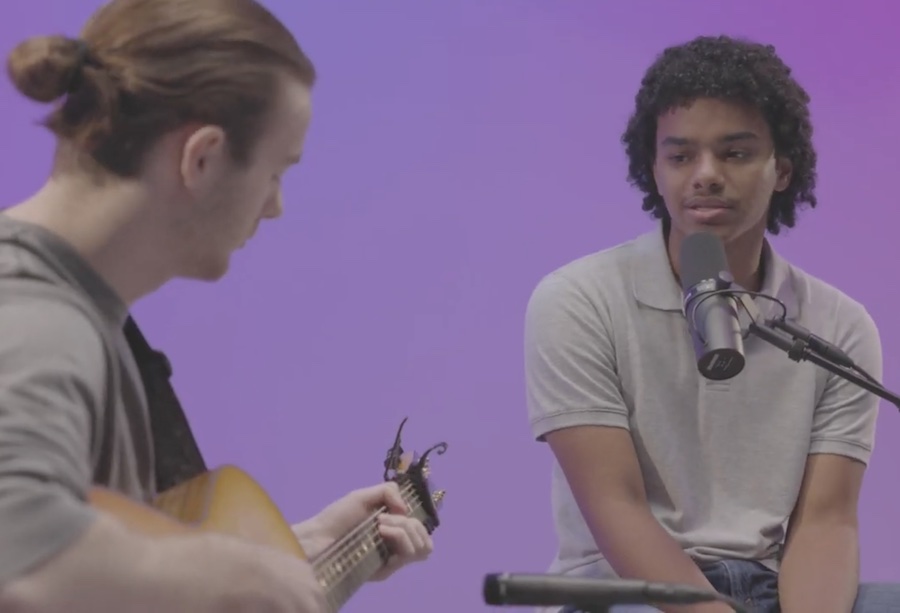
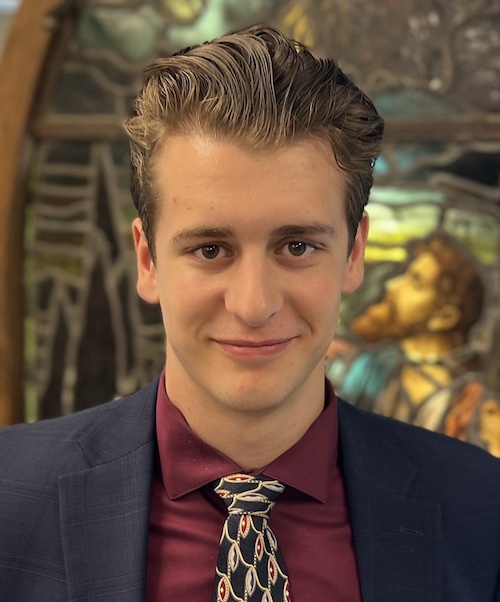
Poema, a week-long student art intensive put on annually by Burke Community Church (BCC), a 3,000-member nondenominational megachurch in Northern Virginia, completed its third camp July 29–August 2.
“It’s a win to me that it happened at all and that it’s been happening for three years,” said Ellie Goings, original co-founder of Poema, member at BCC, and professional painter. The camp is designed to provide a community for young Christian artists to integrate art and faith.
Poema co-founder and BCC Music Director Josh Toth describes the purpose of Poema as “to equip and encourage young artists in faith-filled creativity.”
“Artistic asceticism is a nascent theology in a lot of churches,” Toth proposed.
Poema was founded in 2022 by Toth and fellow BCC members including his wife Shannah and Ellie Goings.
In growing up as artists in northern Virginia and at a nondenominational church, their art was not always encouraged.
“All three of us have had the same journeys around art and faith,” Toth recounted. “Your faith and your art are intertwined. Ellie felt like she had to choose between art and the church. Shannah too—because a lot of churches don’t have a place for painting or dance. But for me, church does have a place for music in worship and liturgy. But my worship of God is not limited to, ‘is this song literally about Jesus and for worshiping Jesus?’”
Now, Poema provides a biblical community to the student artists at BCC.
Poema is held annually at the end of July. The week is broken up into a Monday-Thursday prep period, culminating on Friday with a capstone showcase for students to present their art.
Each morning of Poema’s first four days participating students arrived at BCC around 10 a.m. Once the students arrive, the day begins with Goings reading a Psalm. Each year has had a Scriptural theme; this year’s was the Psalms. After the reading, the students were encouraged to reflect on the Psalm by quickly practicing any artistic discipline. This was used as a warmup for the day, but also an exercise to focus students’ work on Biblical truth.
Next, the coordinators introduced the daily instructor. Monday-Thursday Poema hosted a different workshop.
“It’s a really good challenging experience for some students who are really deep in one medium, to branch out into other mediums,” Goings shared. Poema held workshops on theater, painting, songwriting, and comic art this year.
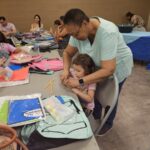
Workshops finish at 1 p.m.; followed by lunch. The day ends at 4 p.m. after studio time and critique. Studio time allowed students to begin a project they would work on to present at the showcase. Students found quiet spots around the church to draw or paint, or sat with a buddy to write a song, incrementally completing their projects.
Critique was directed and encouraged students toward improving their craft. It was held at the end of the last two days when students had made significant progress. Goings modeled it, in part, after typical art school critique, but is not identical.
“Critique in an art school context has a bad reputation—for a reason,” Goings explained. “I wanted to bring it into the Poema context without ripping students to shreds like art school critique would have.” It was an attempt to be a more edifying form of critique.
The showcase began at 7 p.m., Friday. Visual artists presented photography, paintings, and quilts for approximately half a hour. The auditory arts came after, with three songs, two solos and a trio, and a lone “flash fiction” (one-page fictional stories) performance.
BCC’s reaction to Poema has been consistently positive.
“It’s been a success. A small group every year—about ten students—they often come back,” Goings said. Though students often expect loneliness, their stress is quickly alleviated.
“We went there, and I didn’t think I’d know anyone, but one of my life group members was there and that was pretty cool,” said Emma Pipes, a student artist who participated in this year’s Poema.
Eli Fitzhenry was one of those returning students the past two years, and came back this year to assist.
“I was a very shy individual…I left it up to others if they wanted to reach out to me,” Fitzhenry recounted. “That inhibited my art, my ability to collaborate…and people’s ability to pour into my art.”
He was surprised by the encouragement the artistic community was able to give him three years ago: “It was my first experience in high school where there were no preformed cliques.”
Poema’s coordinators expect the demand for its unique service will continue.
“I think that our church is on its way to an art revival,” Goings said. “For my church this is a little bit [of] uncharted waters because it’s a very intellectually oriented church.” Even amidst the more utilitarian culture of DC, she believes the next generation needs something like Poema. “Beauty is the up-and-coming apologetic.”
Poema was motivated by a utilitarian culture in the church. Despite the inherent obstacles, however, it is gaining traction. Many students return to Poema for its community and inspiration. “I’ll definitely go next year, if they have it,” Pipes said.

Comment by David Gingrich on September 17, 2024 at 7:43 am
Good for these visionaries.