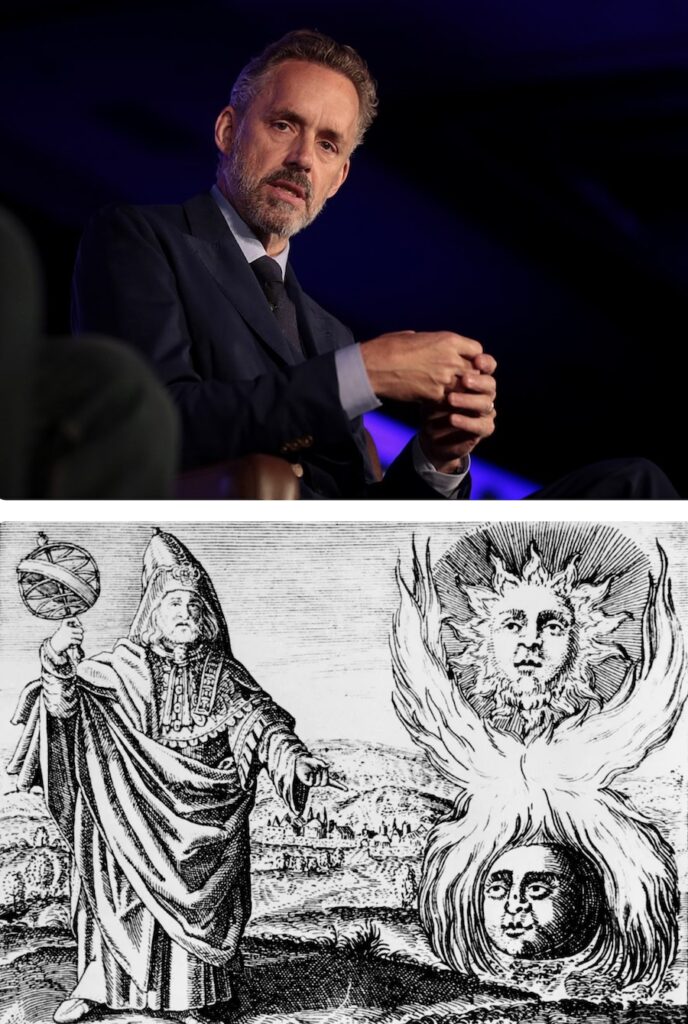

The ancient heresy of Hermeticism has, in recent years, made inroads into contemporary Western culture via thinkers such as Canadian psychologist and author Jordan Peterson.
Hermeticism is a set of esoteric beliefs primarily based on the writings of the legendary figure Hermes Trismegistus from (approximately) first century A.D. Greece and Egypt. Prioritizing experience above doctrine in all areas, Hermeticism equates the mind of man with God, and teaches salvation by “secret knowledge.”
Hermeticism is like the alcohol of heresies, convincing man that he can do anything. This is why it is both dangerous and attractive to many. It gave us socialism, as well as the work of Peterson, though each represents wildly different streams of Hermetic thought: one economic, the other psychological. Properly reacting to Hermeticism’s modern influence in all its forms will determine the next stage of Western culture.
Many orthodox believers have become drunk on the Hermetic heresy across Western history. In Enlightenment-era Germany, Pietist Christianity was associated with Hermetic mysticism, which greatly influenced many of the great German thinkers of that period. It was from those thinkers we received the “enlightened” thought of Karl Marx. New Age belief and the popularity of Jungian psychology are also examples of contemporary Hermeticism.
Pervasive wherever it goes, Hermeticism intoxicates to produce false teaching. Western culture currently faces two Hermetic threats: (1) the old political Hermeticism found in the Leftist movements, and (2) the unrecognized danger of Jungian Hermeticism gaining popularity in conservative circles.
In politics, Hermeticism is primarily a theological and eschatological heresy: by equating man with God it names man the savior of the world in the eventual political apocalypse. (What politician or disenfranchised peasant would not want a taste of that extreme self-righteousness?) The 20th century demonstrates how addictive that distinctly Hermetic idea is—in the many “Marxist utopias.” This is the chief example of Leftist political Hermeticism.
Hermeticism gained political ground on the Left through Marxism, and is now growing in cultural influence on the Right via the work of psychological thinkers. One need only look at Peterson’s partnership with the Daily Wire to understand the popularity Hermetic ideas have on the Right today. Though the friends of Peterson are often the friends of conservative Christians, Peterson and his ilk are perceived far too favorably by conservative Christians today.
Psychological hermeticism poses a problem to the West precisely because our current politics are the highest example of Hermetic syncretism. One strand of Hermeticism gave us socialism, what has been called the “last Christian heresy,” by historian Michael Sugrue. Orthodoxy should not allow another strand to grow strong.
Psychological Hermeticism gaining influence is a danger that grows in reality every day. It has not yet taken as much ground as the ideas of Marx or his intellectual descendents. But the degree to which it has grown should be alarming. The danger is one of dilution.
As the Church fights against the dangerous political ideas of the day, it needs as many allies as it can get. But if these allies tout ideas with such a damaging track record, though they are our friend for a time, Christians should be wary. If these ideas become more influential than orthodoxy in the future of the West, the Church will have failed to respond to a clear and present danger.
On the conservative side, Peterson’s Scriptural commentary is the primary example of Hermeticism. Peterson said in a conversation with cognitive scientist John Vervaeke: “I’ve been conceptualizing the sacred as a process….that dynamic relationship between conscience and calling, and that looks to be like what is conceptualized as the Holy Spirit.” It seems benign, but is a Trojan horse of psychological mysticism. The psychological Hermetics’ most common move is the distortion of Scripture to suit their own pseudo-Christian philosophies. Here Peterson makes the classic play of identifying God with the mind of man. It is the painful truth that while Peterson advertises himself as anti-relativist, the practical implications of his thought leave us without a God beyond a thought in our heads.
Mysticism of this sort has the uncanny knack of producing heretics. Historically, a mystic could affirm the Scriptures while technically disbelieving in their historicity—a sort of hermeneutic crossing your fingers. While much more “spiritual” than the materialist Hermeticism of socialism, Peterson’s work of diluting Scripture holds its own risks.
This is the danger we face as orthodox Christians in the West: one of dilution. It is not only an onslaught of materialistic scientism that fuels today’s great firestorms. That is only the vehicle. A pervasive mysticism comes up from the annals of history to greet us on both the Right and the Left. If materialism is the body, Hermeticism is the soul.
Though Christians and Conservatives are already pushing hard against the cultural encroachment of the Hermetic Left, the Hermetic Right must also be addressed. Their outsized cultural influence, even in orthodox circles, should draw the attention of whoever is concerned with the eventual destination of the West.
The West must not become drunk on Hermeticism. A very old Hermetic symbol is that of the Ouroboros, the snake eating its own tail. Peterson’s influence in the culture can be of great benefit to orthodoxy if directed properly—but it cannot be allowed to get out of control. If orthodox Christians do not respond in kind to the encroachment of Hermeticism in conservative politics, they will be like the Ouroboros, the snake eating its own tail.



Comment by Bruce Atkinson on August 13, 2024 at 11:49 am
Although the writer expressed many true ideas associated with the human history of publicized thought, he generalizes far too widely and indeed paints many ideological and theological movements with a broad brush that lacks discernment.
His blatant condemnation of Jordan Peterson (“Peterson and his ilk”) shows his own jealousy of Peterson’s fame and popularity. Although he is a trained psychologist, Peterson is a self-identified seeker and media reporter… exploring the boundaries of Christianity and various ideologies. Therefore, Peterson does not presume authority over anyone nor does he presume to have the superior knowledge to think of himself more highly than he ought. He does publicly express his current thinking bravely and knows that many will criticize him harshly. That he keeps learning from others and growing is evident to anyone who has followed his career. Therefore, Grose’s words against him are (pardon the pun) gross and reveal only his own hypocrisy and sense of intellectual superiority. That Peterson has interacted publicly (and popularly) with such theologically trained lights as Robert Baron and Os Guiness should not in any way subtract from their own accomplishments.
As a licensed psychologist since 1988, I can agree with Grose that the answers to both personal spiritual salvation and even moral progress in our societies will never be through the social sciences… even though (of course) every professional and academic will seek to promote and elevate the importance of their own chosen field of ‘science.’ Fortunately, like that which occurs in the hard sciences, empirical research in the mental health field will continue to fine tune many truths about our human biochemical and psychological reality, always approaching (but never arriving at) the more spiritually-oriented truths found in scripture. As it has been often said, all truth is God’s truth.
https://virtueonline.org/science-and-bible-relationship-revisited
Comment by John on August 13, 2024 at 11:59 am
I recently a transcript of the interview Elon Musk gave with Peterson and it occurred to me that neither of these men would pass as we would call a “believer” in Christianity. They don’t pray, they don’t go to church, and they don’t concern themselves with doctrines like the Trinity or Incarnation. Yet they advocate what they consider a Christian worldview and conservative social standards. Their advocacy of Christianity is not tied to any search for truth or anything transcendent. They look back sometimes 50 years ago or 100, or 1,000 even when churches and Christian forces had more influence on society and decide they want to return to that world. For them Christianity is a means to a very mundune or materialist end: More children, less depression, an end to political correctness, or even colonizing space in Musk’s case. They could care less whether there is a God or not and whether the Bible conveys truth. They’re not advocating Christian nationalism, but something even more sinister that can only defined as Christian nihilism.
Comment by Tim Ware on August 13, 2024 at 1:22 pm
Rather than always fighting against something, those who label themselves as orthodox Christians (with a small o) might be better off spending their time amd energy making the case for their own viewpoint. If all you do is fight against something without making a good case for your own viewpoint, all you’re doing is tearing down without offering a clear vision of how you propose to replace what you’ve torn down.
Comment by Tim Mc on August 13, 2024 at 3:19 pm
My boss and I just had a conversation about Christianity. My boss says he is a believer, but he doesn’t go to church, doesn’t read the Bible, doesn’t pray. Took his kids to church, when they were young, but since they have been grown up and left, he and wife stopped going. Wife is Catholic and he is Protestant.
He does not like what is happening in our American society. His words were, “The country is falling apart.” He thinks over the centuries since Jesus, the Bible has been changed and is not the same Bible it was in the beginning of Christianity.
I think our country is filled with people like this. That can’t see that the church will always be filled with sinners, not saints. They can’t see that the Bible has been the same Bible, until just recently, when we have these versions that leave out parts of the Bible or misrepresent it.
Lately, the devil has been winning the battle with his, “God didn’t surely say that” comments just like he did with Eve. Which make the Bible seem ridiculous in todays world.
Comment by Asbury Parkes on August 13, 2024 at 8:59 pm
This is a joke, right?
Comment by Telkom University on August 17, 2024 at 2:19 am
What criteria should the Church use to assess whether an ally’s ideas have a damaging track record?
Comment by Cal on August 24, 2024 at 10:39 am
In a fast-changing world that does not fit into pre-modern categories, having a free and flexible mind is preferable than static adherence to what some people call ‘orthodoxy’. It should be unsurprising that static-thinking ‘orthodox’ have been entirely overrun in today’s culture.
Comment by MikeB on August 25, 2024 at 11:05 am
Cal,
As one’s mother should have told you, if everyone else jumped off a cliff would you?
A free and flexible mind is an incredibly weak and undeveloped one. It’s the sign of someone with no logic, someone who in incapable of actual reasoning… it is a sign of a lack of intelligence.
Orthodox minds develop new AI algorithms and hardware architectures, which abide by the rules of math and the laws of physics. Flexible minds write on facebook that AI is smarter than us…
Comment by Jamie on January 1, 2025 at 9:33 pm
The author did not provide a single source or quote or even a paraphrase to support his baseless claims made about the beliefs of Hermeticism. The rest should be read, therefore, with a healthy dose of skepticism, if not just outright thrown away as inept floundering to make any sensible point at all grounded in something approaching the truth.
Comment by Hermes Trismegistus on April 29, 2025 at 5:27 am
Hermetic teachings argue not that man is God but that God is in man. A piece of the divine intellect–the nous or mind–is within us all, guarded by the soul that emanates spirit.