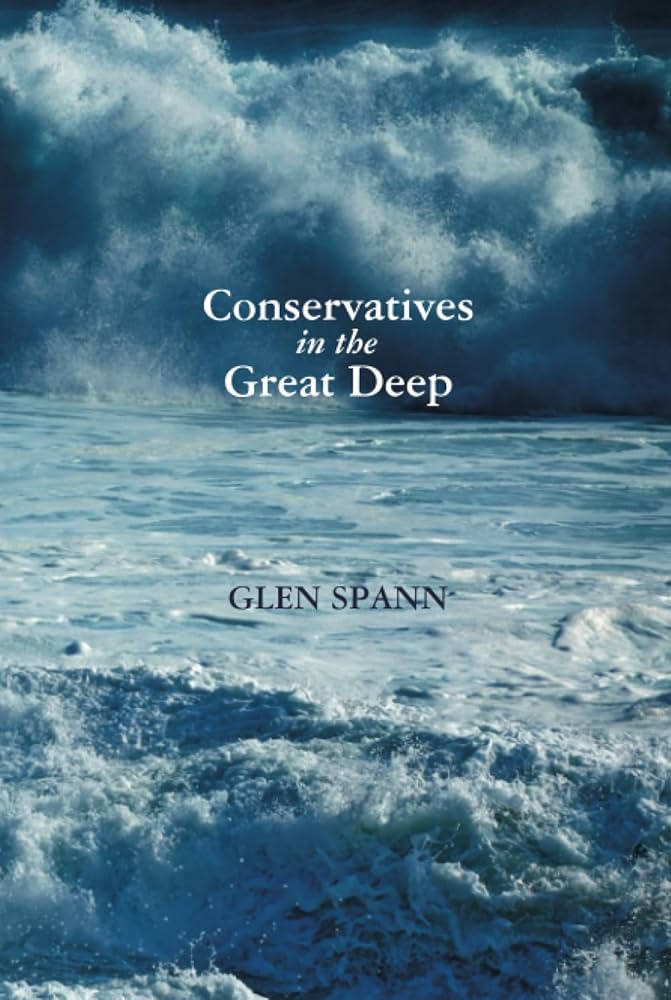

Conservatives in the Great Deep of the Methodist Church, 1900-1980 by Glen Spann.
Francis Asbury Press, 2023. 346 pages.
I kept hearing voices as I read Conservatives in the Great Deep by Dr. Glen Spann. I heard Spann’s voice as I read his carefully documented research and thoughtful summations. I heard the voices of Harold Paul Sloan, Robert P. Shuler, Charles Keysor, Ed Robb, C. Phillip Hinerman, David A. Seamands, and Virgil Maybray. I heard the voices of mentors (Andy Gallman, Dennis Kinlaw, Robert Coleman, Kenneth Kinghorn, Al Coppedge, Orin Simmerman, et al) and colleagues (pastors and laity, professors and Sunday School teachers, missionaries and community workers).
I heard these and other Methodist voices over the past 125 years, speaking from the untroubled and undisturbed ‘great deep’ in our sea of faith wherein lies, as Spann describes, “those Methodist witnesses who usually with great clarity have described themselves doctrinally as “evangelical” and who often have given further evidence of their faith position by being at odds with the generally liberal drift of the denominational leadership” (p.13).
Spann helps the reader hear these and other voices that proclaimed scriptural Christianity, patterns of piety, and an evangelical witness as Methodism experienced an institutional drift from its historic, orthodox doctrine evidenced in the liberalization of theological education, Sunday School literature, and missions through the period of 1890-1980.
These faithful witnesses served Christ and others through the church they loved, yet they typically were denied positions of influence upon the whole of the denomination over the years because of the predominance of relativistic leadership in the hierarchy of the church. Still, they did not despair.
Spann justly recognizes this “silent minority” of evangelical Methodists (which actually represented a majority of all Methodists) that remained steadfast, shunned the notion of schism, and weathered the constant storms and cross currents that continually undermined their efforts to “contend for the faith that was once for all entrusted to all the saints.”
As a pastor with evangelical convictions who served 48 years in an increasingly liberal United Methodist denomination, I found this book affirming of my efforts to bring spiritual renewal at all levels of the church. I was encouraged by the stories (‘voices’) Spann chose to share so thoroughly as witnesses of deep faith in the midst of ecclesiastical tumult and conflict. I also felt a strong confirmation from the central thesis of this book that our calling as Methodists is not to preserve a denomination but a deep legacy of faith that glorifies God and blesses the world with the whole gospel of Jesus Christ.
There are three distinct groups to whom I especially recommend reading Conservatives in the Great Deep.
First, believers with traditional values and evangelical convictions who sense a calling from God to continue being a witness of scriptural Christianity within theologically liberal denominations. The witness of the courageous servants in these pages whose efforts to impact the church to which they devoted their lives will inspire perseverance and offer wisdom.
Second, clergy and laity who felt led to leave their previous church affiliations to embrace a new wineskin being filled with the Holy Spirit. Our Methodist heritage is a spiritual renewal movement to reform the Church that eventually became a fresh expression of a worldwide community of faith.
Third, church historians and professors. Spann has presented a splendid example of scholarly research and a fair, critical analysis of the primary reasons that United Methodism, in its theological drift from exclusivity to relativity, increasingly has become irrelevant to a world that desperately needs the life-transforming, hope-filled message of the Gospel of Jesus Christ.


Comment by Gary Bebop on August 13, 2024 at 5:45 am
Anyone paying attention will have some perspective on the state of things at hand. These are quixotic times. Everything we assumed about “normal” is upside down and tradition has been displaced by perverse novelties. Our very thoughts are subject to sanction. So we have entered a moment when proclamation of the uncompromised gospel of Christ’s Lordship will be offensive to the prevailing gods of modernity. Are we ready for what is coming for us?
Comment by Warren Budd on August 18, 2024 at 7:17 am
During most of the eighties and nineties I sat on the board of Good News, an evangelical renewal group that fought long and hard for a return to Wesleyan Scriptural Christianity.
I will never forget sitting at a GN Board meeting in the eighties and observing to myself that there was not one Board member present that had not paid a price for their stand for orthodoxy.
This was particularly true when it came to the pastors present. In the UM denomination, career advancement and Good News involvement were mutually exclusive. But with the reach of Asbury Seminary and the amazing success of the Global Methodist Church, we are seeing the fruits of their labors.
Question: Does this book stop at 1980? The eighties are when the struggle heated up.
Comment by ROGER on August 20, 2024 at 4:13 pm
THE GOSPEL IS 1 CORINTHIANS 15: 1 – 4. GALATIANS 1 : 8 -9 TELLS US, IF WE ARE PREACHING ANOTHER GOSPEL THAN THIS, WE ARE ACCURSED. THE RESURRECTION MUST BE PART OF OUR SALVATION BELIEF.