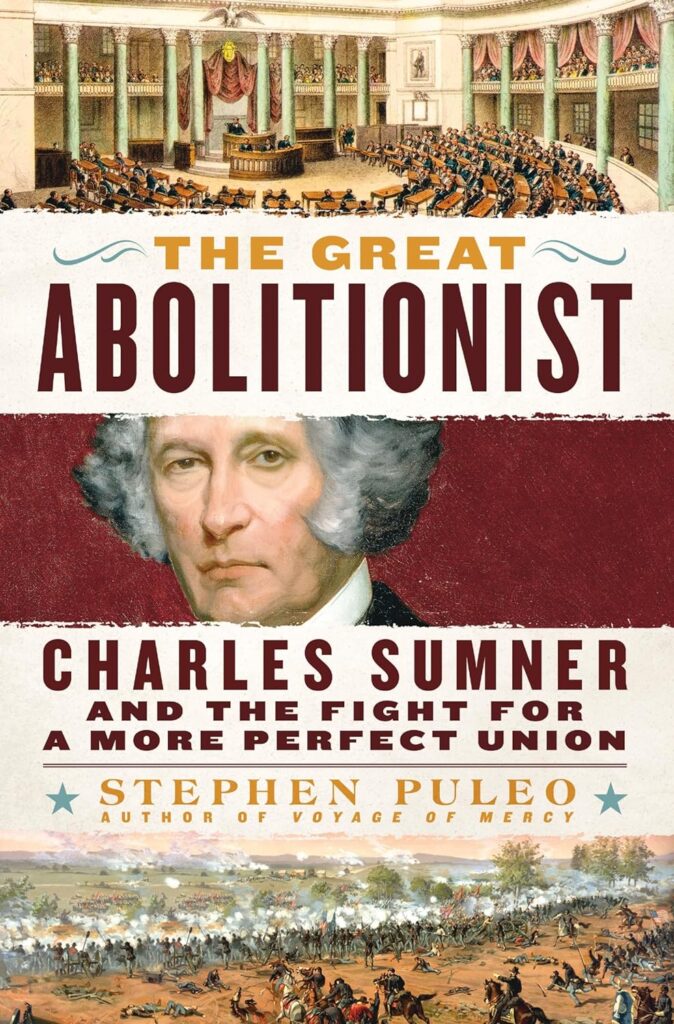

Charles Sumner, best recalled for being caned nearly to death on the U.S. Senate floor in 1856 for an anti-slavery speech, was maybe America’s most important anti-slavery crusader after Lincoln. But more than anti-slavery, Sumner adamantly and, unusually for his time, advocated for human equality irrespective of race. The phrase “equality before the law” originated with him. A new biography, The Great Abolitionist Charles Sumner, and the Fight for a More Perfect Union, by Stephen Puleo, tells the story.
In 1847 Sumner, a young Boston lawyer, litigated unsuccessfully on behalf of a young black girl’s right to attend a nearby all white school. The ruling against him set precedent for other discriminatory rulings decades later. But Sumner had the last laugh, as his arguments informed the 1954 Brown vs Board of Education decision against segregated schools. It took 107 years.
Outrage over the Fugitive Slave Act elected Sumner to the U.S. Senate from Massachusetts in 1851, amid increasing radicalization. Sumner had denounced that act, which amplified the legal obligation of non-slave states to capture escaped slaves, ”in the name of the Constitution which it violates, of my country which it dishonors, of humanity which it disowns, of Christianity which it offends.”
His 1856 “Crime Against Kansas Speech,” against the campaign to seize that state for slavery, provoked a savage caning by a southern Congressman. Sumner took years to recover from severe injuries, which had left his prostrate bloody body on the Senate floor, while his unapologetic pro-slavery assailant was widely celebrated for his crime. He had entered the U.S. Senate as the only member of the brief Free-Soil Party, but later became a leading light of the new Republican Party.
Sumner’s anti-slavery oratory was masterful and influential. His consistent stance across years against any compromise with the “slave power” across many years was courageous, enduring, principled and had few equals in American history. From the start he realized the Civil War would destroy slavery. Despite his zeal, and unlike other more impatient abolitionists, he understood and largely supported Lincoln’s slow but inexorable moves against slavery. Sumner was at Lincoln’s death bed, holding his hand, and weeping.
After the war Sumner was among “radical Republicans” who wanted vigorous Reconstruction. He hesitated to support the 14th and 15th Amendments to the Constitution, affirming citizenship and voting rights to blacks (for men in the latter), only because they did not go far enough to affirm human equality. He foresaw how southern whites would ignore and bypass their intent. Sumner drafted the Civil Rights Act of 1875, which passed shortly after his death, and of which he spoke on his death bed. It guaranteed equal access to public accommodations, which later court rulings neutralized, until mid 20th century court rulings and the Civil Rights act of 1964.
Towards his life’s end, Sumner was dining at a friend’s house, where he learned the black servants sought to meet him. He stood awkwardly at the dining room door as they kissed his hands with gushing gratitude. Sumner appreciated his glory but was stoic amid its many demonstrations. He was at odds with President Grant, partly over Grant’s failed attempt to absorb Santo Domingo into the U.S., which led to Sumner’s quitting the Republican Party. Yet at his death he lay in state in the U.S. Capitol. An homage from a southern congressman and former Confederate, commending Sumner as a constant friend to liberty, elicited stunned applause and tears.
Whence did Sumner derive his passion for human equality and justice? The biography does not really explain. On an early trip to Europe, young Sumner observed black students in France operate as equals, which evidently helped persuade him that racial hierarchy was socially imposed, and racial prejudice was at odds with the natural order. Sumner, as a New Englander, of course absorbed his region’s egalitarian tradition. His family belonged to a Unitarian church, although Sumner apparently never joined a church. Yet Sumner frequently cited the Bible and Jesus Christ in his anti-slavery speeches.
A 1911 homage to Sumner recalled that Sumner’s Methodist friend, Bishop Haven of Boston, said, “It was Christianity without Christ that Sumner felt and preached and practiced, —a Christianity not of doctrine, but of life.” The homage noted that “Sumner’s lofty ethical idealism was nurtured by a deep fountain of religion within his soul, his evangelical friend failed to recognize; and this the superficial student of his character is apt even now to overlook.” And the homage quoted a Sumner friend: “I never knew a man with a firmer grasp upon faith in the good God.” The homage noted that Sumner originated the anti-slavery cause in the “Everlasting Arm.”
In his 1852 speech to the U.S. Senate “To Repeal the Anti-Fugitive Slave Bill,” Sumner cited “as parallel” the Japanese Jesuit martyrs of 17th century Japan, who were compelled to disavow Christ by walking on images of Him on the ground. Most Japanese Christians refused and were executed. Sumner concluded: “Multitudes among us will not be less steadfast in refusing to trample on the living image of their Redeemer.”
For Sumner, every slave bore the “living image of their Redeemer.” To abet slavery was to trample on Christ’s very own image. May we recall this analogy in our politics of today as we decide how others in our society and in the world should be treated. And may we recall the example of Sumner, a difficult and austere man, whose passionate commitment to humanity as bearers of Christ’s image was relentless unto death.



Comment by David Connon on July 5, 2024 at 10:23 pm
Thank you, Mark Tooley, for an interesting and well-written review of The Great Abolitionist.
Comment by Mark E Roberts, PhD on July 6, 2024 at 5:30 pm
Wow! Thank you for this post about a true hero. Any idea why Puleo doesn’t probe ‘Whence did Sumner derive his passion for human equality and justice?’
Comment by Michael G Madden on July 6, 2024 at 6:21 pm
I think that Tooley’s remarks are somewhat misleading. Brooks did not cane Sumner because of the anti-slavery content of his speech. He attacked Sumner because Sumner made unnecessary (to the point of the overall speech) derogatory remarks against Sumner’s relative who was a senator absent from the Senate because of a severe illness and thus not able to defend himself. I suggest that Tooley read the book, The Caning by the same author Puleo.
It is my understanding that such personal attacks on other senators are now forbidden by Senate rules. I think that is why Elizabeth Warren came under fire for her criticism of Jeff Sessions.
Comment by Diane on July 7, 2024 at 12:34 am
Thank-you for this article. Parker Pillsbury, a New England abolitionist, male feminist and a contemporary of Sumner (they corresponded), is a distant cousin on my New England ancestral tree. Ordained in the Congregational tradition, Pillsbury was de-frocked/booted out for his abolitionist rabble- rousing in churches. His life story is a good read.
Comment by David Gingrich on July 7, 2024 at 8:46 am
There is, of course, no such thing as “Christianity without Christ”.