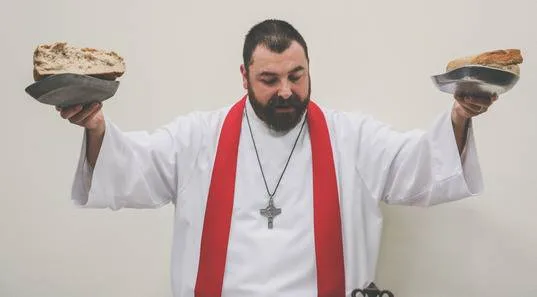
Recently an Iowa pastor denounced the First Amendment of the U.S. Constitution as idolatrous, exciting support from professing Christian nationalists who want a confessional state.
That pastor declared:
What is the faulty crumbling foundation that Christians need to remove before we can rebuild our civilization? What are the old ruins that need to be swept away before we can rebuild? It is the First Amendment to the Constitution.
His church belongs to the Communion of Reformed Evangelical Churches (CREC), which, according to Wikipedia, is small denomination of 130 congregations globally. Its doctrine is Reformed/Calvinist, and it is laissez-faire on infant baptism. Nearly all American Protestants advocating for a Christian confessional state are Reformed/Calvinist. Of course, the vast majority of Reformed/Calvinist Christians in America reject this concept. But the idea of a Christian government that restricts non-Christian religion is gaining traction among some “postliberal” Christians who cite magisterial Protestant teaching in the 1500s and 1600s.
The pastor’s defenders insisted he was not entirely renouncing the First Amendment but only later court interpretations that precluded blasphemy laws and church establishment.
In an earlier sermon, the pastor had declared:
Christians have idolatrously put the Bill of Rights before the Bible. We even say things like, I might not agree with your faith, but I’ll fight to support your right to practice it. And in the name of religious freedom, we have opened up this land to be a place where any and all gods can be worshipped. And so, we have given ourselves to be oppressed by Demons! And our tolerance of false religion, and our tolerance of immorality, has led to Christians becoming oppressed in our land by those very same people we tolerated.
The pastor cited the Satanic statue erected during a multifaith holiday display in the Iowa state capitol, which one legislator, who’s also a pastor, defended as an unfortunate necessity preferable to state control of speech. “Jesus and Satan are the same to our Christian government officials,” the troubled pastor alleged in response.
This religious neutrality was not the intent of America’s founders and the Constitution, the pastor preached. The First Amendment only intended to prohibit national churches, but not state churches. Oddly, he noted Virginia once established Anglicanism, which in fact was disestablished before the Constitution, in the Virginia Statue of Religious Freedom, foreshadowing the First Amendment, and crafted by James Madison, often deemed the “father” of the Constitution.
Irate over the satanic statue, this pastor in his sermon recalled personally confronting the Iowa legislator/pastor who had defended religious neutrality, who supposedly “doesn’t believe Jesus is the Lord NOW, only someday in the future, and so he rejects the notion of God’s laws reigning supreme over the government now.” The pastor called the legislator “gnostic” and warned:
By embracing secular neutrality, he avoids acknowledging Jesus Christ as the risen and reigning Lord of all, but he does not see that this reluctance to Crown Him Lord of All [and] emboldens the state to continue to promote more anti-Christian laws and practices.
In his sermon the pastor implored: “If only the state would be explicitly Christian again and uphold blasphemy laws that made it illegal to slander the Lord Jesus Christ and to promote anti-Christian beliefs and practices.” And he said that “traditional Protestant” teaching expects the government to “maintain true religion.” He noted that the American revised version of the Westminster Confession in 1788, which guides Presbyterians and other Reformed/Calvinists, ordains civil magistrates for the “encouragement of them that are good, and for the punishment of evildoers.” He omitted that the American version deleted the original language of 1647 calling for false teaching to be suppressed by the “power of the civil magistrate.”
Accordingly, the pastor regretted that the “foundations of our once great republic and even more our once glorious Protestant and Reformed Church, have been rotting away because Christian ministers and magistrates believe that “the First Amendment has more authority than the First Commandment.” So “there are certainly some idols that need to be toppled and cleared away first.”
The pastor saluted the aspiring Alabama politician who toppled the Satan statue in Iowa, provoking a publicized arrest. And the pastor concluded his sermon: “There is no place where Christ’s Lordship is checked at the door. There is no place for neutrality.”
So obviously the First Amendment, from this perspective, has got to go. Neither it nor the rest of the Constitution mentions Christ or God, except with the dating “in the Year of our Lord.” So perhaps the entire Constitution should go?
It’s an odd and sclerotic, even pharisaical, confessionalism that claims Christ’s lordship must always be specifically stipulated, in civil statute, and perhaps in every arena of human life, even coercively, and implicitly interpreted by a select few. The Founders were overwhelmingly churchmen and yet omitted God from the Constitution, unlike in the Declaration of Independence, presumably because the Constitution was and is binding law. If the government professes a particular religion, it then gets to define that religion. Perhaps Abraham Lincoln had this concern when, in 1864, he considered but ultimately declined to support a proposal to add God and Jesus to the Constitution’s preamble. The Constitution’s ban on religious establishment and religious tests for office are safeguards for religious freedom.
For the Iowa pastor, this religious freedom means being “oppressed by demons.” He wants an explicitly Christian government that punishes blasphemy. Who would define it? The Westminster Confession of 1647 the pastor cited, a foundational statement for Presbyterians and other Reformed/Calvinists, calls the Catholic mass “most abominably injurious to Christ’s one only sacrifice.” Britain at that time criminalized Roman Catholicism. Would the pastor support the same now? If not, why not? There are over 70 million Catholics in America. There are perhaps, broadly defined, a few million Presbyterians in America. Advocates for establishing religion like to picture themselves in control, even when they are a small minority.
In a very different vein, the Catholic philosopher and co-founder of my own Institute on Religion and Democracy, Michael Novak, in his The Spirit of Democratic Capitalism, noted that by intention a pluralistic society at its “spiritual core” has an “empty shrine.” This shrine is empty “in the knowledge that no one word, image or symbol is worthy of what all seek there.” From this perspective, “individuals are instructed thereby that the common good transcends their own vision of the good, however passionately held.” The domain of the “transcendent, of course, is mediated by literature, religion, family, and fellows. But it is finally centered in the silence in each person.”
This vision lacks the command-and-control clarity offered by a traditional or a socialist society, Novak noted. A democratic capitalist system cannot be a “confessional system” nor even suffused by “obligatory” Christian values. Instead, Christian individuals and institutions “work through democratic means to shape the will of the majority,” while observing the rights and respecting the consciences of others, which itself is a profoundly Christian concept.
Intending for religion to influence and even lead society through mediating institutions instead of through statute and coercion aligns with the Founders’ perspective. It also still reflects at least the intuitions of the vast majority of American Christians, few of whom want government to enforce religious dogma.
As institutional religion recedes in America, as much of secularism is more aggressive, and as the occasional Satanic statue rears its horned head, more Christians are tempted by dreams of a confessional state. It’s a distracting fantasy, at odds with founding American principles, at variance with the example of Jesus, goes against the trajectory of Christian teaching, and is not supported by any major Christian denomination. But amid the tides of polarization and extremism, with religious individualism displacing institutions, its devotees likely will grow.


Comment by David on March 22, 2024 at 9:56 pm
Religious freedom in the US goes back far beyond the Bill of Rights.
The October 10, 1645, charter of what is now Flushing, Queens, New York, allowed “liberty of conscience, according to the custom and practice of Holland without molestation or disturbance from any magistrate or ecclesiastical minister.” However, New Amsterdam Director-General Peter Stuyvesant issued an edict prohibiting the harboring of Quakers. On December 27, 1657, the inhabitants of Flushing, a small rural village, approved a protest known as “The Flushing Remonstrance.” This contained religious arguments and astonishingly mentioned tolerance for “Jews, Turks, and Egyptians…and all.”
Today, Flushing and the rest of Queens are among the most religiously diverse areas in the world.
https://www.fordhampress.com/9780823271610/city-of-gods/
Comment by David Mu on March 23, 2024 at 9:35 am
Loons on the right and loons on the left; this is the story of organized church these days.
Comment by Salvatore Anthony Luiso on March 23, 2024 at 9:58 am
Thank you for this article. It’s good, but I find it a little odd that it doesn’t say more about
Considering the numbers and influence of Baptists in the United States, one might expect that it would mention that American Baptists have a long history of desiring and promoting freedom of religion–one which is older than the country itself.
Comment by Michael Giere on March 23, 2024 at 1:48 pm
In my Bible, the Lord never asked that his disciples force people to kneel to Him. Only that they follow Him. His Grace was never a political instrument. He offered Living Water to the Woman at the Well, and poverty to the Rich Young Ruler. They chose. What He did do was call us to model Him. In John 18:37 He gave us marching orders – to tell the truth, for He was the Truth. If we do that our churches will be overflowing.
Comment by Curtis Nester on March 25, 2024 at 8:27 am
Jesus invited people to come to Him. He never tried to force people to believe and follow. Faith is believing as a volition. Some choose to believe, others choose to reject. Many did not receive Him because they were looking for a political Messiah, rather than a Savior whose kingdom is not of this world. Individuals who knew they were sinners chose to believe and accept Him because only He could forgive and offer the remedy for sin. Religionists continue trying to make it an intellectual exercise which will exalt their mental processes instead of humbling themselves to believe in their hearts. The Great Commission is the Marching Orders for the church, not some arcane philosophy. It is of freely chosen faith, not force that we are saved.
Comment by Simon on March 26, 2024 at 6:58 pm
I’m Australian. Our federal constitution also has a clause prohibiting the establishment of a religion – in fact modelled after the US First Amendment. However, unlike the US First Amendment, our courts have been a lot more narrow and conservative in interpreting it – for example, they upheld federal funding of religious chaplains in public schools, something which I doubt would be accepted by courts in the US (although given the conservative lean of the current Supreme Court, that may change). Maybe the real issue is not the 1st Amendment itself, but how the courts have interpreted it. The point is not to turn America into a theocracy, just to allow the kind of weaker boundaries between Church and State which exist without issue in many other Western democracies, and which the US herself used to have before the Supreme Court began to adopt a stricter understanding of the establishment clause in the mid-20th century.
Comment by Kerry Bowers on March 28, 2024 at 1:31 pm
My opinion is the problem lies not in any founding document or ideal, but in the unconstitutional expanse and depth of government to which the people turn for everything rather than to their respective church and God in helping to provide for their needs.
Comment by Anne E Ferguson on March 29, 2024 at 9:00 am
This pastor is no doubt a victim of David Barton’s lies about the religiosity of the founders, which have been spread by right-wing media for the past few decades.