Conservative Protestants, some of whom came from traditions traditionally anti-Catholic, admired Pope John Paul II in the 1980s and 1990s and, later Pope Benedict. Some even converted. Conservative Protestants admired their clear articulation of traditional Christian doctrine and ethics. JPII was a leader in helping to roll back the Iron Curtain, starting with his native Poland. While much of Mainline U.S. Protestantism was liberalized and emasculated, and much of conservative Protestantism lacked a strong intellectual tradition and compelling public witness, Catholicism under those popes seemed resolute and imposing.
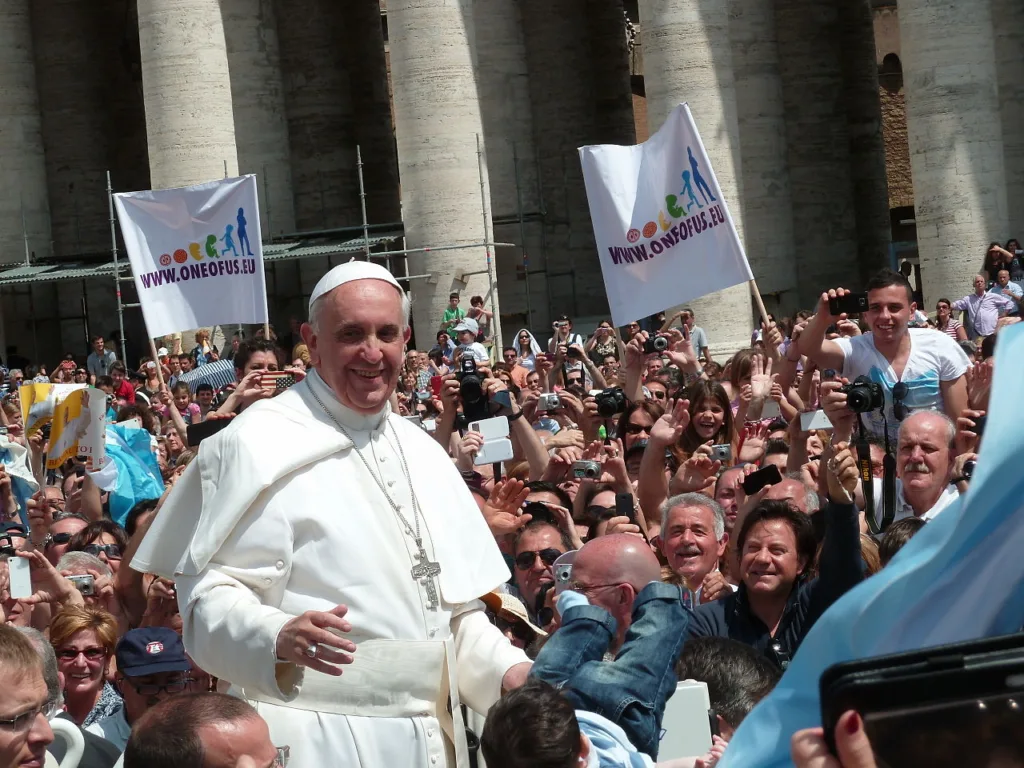
Under Pope Francis, this perspective has changed. He is of course perceived as a liberal Pope who is adapting the church to Western social preferences. His new statement on blessing same-sex couples does not change Catholic teaching about marriage and chastity (sex only between husband and wife). But it does create confusion in public perceptions. His moving the church away from Just War teaching, definitive rejection of capital punishment even in theory, and his 2015 Laudato Si’ encyclical’s environmentalist and economically statist themes have solidified his progressive reputation with conservative critics.
Many U.S. conservative Catholics, who are typically cultural allies to conservative Protestants, increasingly disdain the Pope. Protestants are surprised to hear Catholic friends speak about schism, question Francis’s legitimacy as pontiff, or even pray for his earthly departure. Many Protestants, in their caricature of Catholics, have imagined that the papacy, with its “infallible” authority on faith and morals, is sacrosanct and immune from critique.
Some Protestants, during the JPII and Benedict years, at times inwardly bristled at triumphalist conservative Catholics who cited the reliability of their magisterium versus Protestant perambulations. At times, it seemed to some Protestants that there was an air of spiritual superiority from some conservative Catholics, for whom the planets seemed to align. Still, conservative Protestants could rejoice with conservative Catholics that under JPII and Benedict, liberal trends in the U.S. Catholic Church had reversed. Progressive priests of the 1960s and 1970s were replaced by new generations of more conservative priests. This trend paralleled a Protestant shift as Evangelicals demographically replaced declining, liberal Mainline Protestantism.
The collapse of U.S. Mainline Protestantism also included a collapse in Protestant confidence, intellectual life, and public influence. Modern Evangelicalism lacked the institutions and traditions of centuries-old Mainline groups. They typically could not compete directly with vigorous Catholic intellectual life. And so rising Evangelicalism often relied on Catholic intellectual resources to make needed public arguments.
This vision was incarnated in Lutheran pastor turned Catholic priest Richard John Neuhaus, the public intellectual who co-founded IRD in 1981 and founded First Things magazine a decade later. Neuhaus, among others, believed that Catholic arguments, rooted in natural law, could supply the intellectual armor needed by evangelicals. Catholic thinkers would provide the intellectual leadership for the more numerous evangelical spear carriers. With evangelicals, Catholics could potentially create a political majority for social conservatism. It was a more sophisticated version of Jerry Falwell’s late 1970s Moral Majority, which sought politically to coalesce traditionalists of all religious traditions, but especially evangelicals and Catholics.
These arguments and assumptions shaped much of IRD’s history across 40 years. We rightly celebrated increased collaboration between Protestants and Catholics, and the decline of old prejudices that previously had divided them. Pope Francis has disrupted this narrative. Will parts of Western Catholicism now shift towards the liberalism of Mainline Protestantism? Is it now fair to compare Francis to an Episcopal Church bishop?
No, that comparison is not fair. The Catholic Church remains rooted in its historic teachings in ways not true for much of Mainline Protestantism. Catholicism’s centuries of history, and its universality, prevent its full accommodation to contemporary Western culture. But the spirit behind much of the Francis pontificate has persuaded many conservative Protestants that the Catholic Church is no longer a reliable guide and partner on key moral issues that had been true under the two previous popes.
It would be unfortunate, if in reaction to Francis, historic anti-Catholic prejudice reemerged among many conservative American Protestants. Even at its worse, Catholicism offers a treasury of ethical and spiritual resources that are indispensable to global Christianity. Protestantism, least of all U.S. evangelicalism, cannot alone offer what is needed spiritually and ethically in our world today. And half of global Christianity is Roman Catholic. The leadership of those hundreds of millions will always be very important for global Christianity and for the world as a whole.
But it’s also true that Protestants, if they were ever tempted so, cannot expect that the Catholic Church, unlike Protestantism, is monolithically immune to cultural trends. Although its institutional unity of course continues under its bishops and pontiff, Catholicism is increasingly divided like Protestants between north and south. Francis pursues the preferences of European Catholicism, supported by some Americans and Latins. Africa and other areas of the non-West firmly reject that direction. The Global South church for Catholics, as for Protestants, grows, while the Western church declines. It seems unlikely, under this trend, that the aspirations of progressive Western Catholics, who have money but not so many people, can be fulfilled long-term.
There is also a lesson here about the human condition, from which no branch of Christianity is ever immune. No human institution, not even churches dedicated to God, can escape venality and egotism, cupidity, or decay. No human institution, not even what is ordained by God, can be idealized this side of the Eschaton. Reinhold Niebuhr, an Augustinian who stressed human sinfulness, lamented that Augustine had overly idealized the church.
Protestants obviously have a different understanding of church and authority than do Catholics. Both can trust that the Holy Spirit will always ensure the Gospel’s propagation. And neither should exaggerate the moral reliability of their ecclesial structures or leaders. Even sanctified saints at their best can be confused and, at times, highly unreliable. At best, and with time, the collective’s wisdom will providentially overcome the mistakes of the particular.
Neither Catholics nor Protestants can adopt any attitude of superiority over the other or against other groups. Instead, we can only stand at the Cross, giving thanks for mercy, and praying for guidance.



Comment by David on January 4, 2024 at 5:32 pm
Are Evangelical churches really growing?
https://www.linkedin.com/pulse/precipitous-decline-american-evangelical-church-biblical-smith-
Comment by Mark Smith on January 4, 2024 at 9:57 pm
Well written and well reasoned, as is typical of Mark Tooley. In the effort to get geographic diversity the Catholic Church has gotten a Pope who is a weak theologian and a cultural accommodationist. Gone are the deeply reasoned and spiritually rich edicts of Pope Paul and Benedict. Now the old criticisms of orthodox Protestants are returning with renewed credibility. Orthodox believers, whether Catholic or Protestant, look forward to a change in the papacy since the Pope’s words and actions, rightly or wrongly, carry much worldwide influence in both secular and sacred culture.
Comment by Tim on January 5, 2024 at 8:04 am
Pope Francis does not want another schism started in Germany. (Luther) So he is playcating them and encouraging them not to leave. Dangling a way to bless what should not be blessed. Now that a foot is in the door so to speak, look into the future for more to come.
Comment by David S. on January 5, 2024 at 9:17 am
David,
Bless your heart. As always, you seem to only look at half the picture and why. As has been documented on the pages of this site and others, yes, historically orthodox, confessional Protestant and Evangelical churches are growing as long as they adhere to the historic doctrines of the faith.
The main reason why Evangelical churches in aggregate seem to have plateaued and started to decline is once again, as a church or a denomination, starts accommodating the world, be it through capitulating to the culture in the manner of the institutional mainline and many of their congregations have done, or in the manner that many a evangelical congregation has done by following the seeker sensitive model and toning down the faithful preaching and teaching of the gospel and faith, once received, eventually people will leave. Either those who are Christians leave to go to where they will be fed with sound preaching, teaching, and administration of the sacraments/ordinances, or those leaving never were Christians to begin with and leave for any number of reasons, including being confronted with what sound preaching or teaching that is not watered down that occurs, or some sort of adversity as the parable of the good and stoney soil teaches.
Comment by Different Steve on January 5, 2024 at 10:28 am
“The practical challenge arising from any analysis of evangelical Protestants in the U.S. is finding a reliable and valid way to measure the group. Much of the data about evangelicals comes from surveys, creating the need for a lucid and straightforward measure that can be easily incorporated into questionnaires.
In recent decades, this challenge has more often than not been met by using the question, “Would you describe yourself as ‘born-again’ or evangelical?”
Gallup began incorporating this question into its surveys in the summer of 1986, primarily as a way of understanding political issues.”
The Thorny Challenge of Defining Evangelicals
By Frank Newport
https://news.gallup.com/opinion/polling-matters/507062/thorny-challenge-defining-evangelicals.aspx
Comment by Different Steve on January 5, 2024 at 10:36 am
“Within Protestantism, evangelicals continue to outnumber those who are not evangelical. Currently, 60% of Protestants say “yes” when asked whether they think of themselves as a “born-again or evangelical Christian,” while 40% say “no” or decline to answer the question.
This pattern exists among both White and Black Protestants. Among White Protestants, 58% now say “yes” when asked whether they think of themselves as born-again or evangelical Christians, compared with 42% who say “no” (or decline to answer the question). Among Black Protestants, evangelicals outnumber non-evangelicals by two-to-one (66% vs. 33%).
Overall, both evangelical and non-evangelical Protestants have seen their shares of the population decline as the percentage of U.S. adults who identity with Protestantism has dropped. Today, 24% of U.S. adults describe themselves as born-again or evangelical Protestants, down 6 percentage points since 2007. During the same period, there also has been a 6-point decline in the share of adults who are Protestant but not born-again or evangelical (from 22% to 16%).”
https://www.pewresearch.org/religion/2021/12/14/about-three-in-ten-u-s-adults-are-now-religiously-unaffiliated/
Comment by Different Steve on January 5, 2024 at 10:56 am
The only fact alleged in the Linkedin article is:
“The percentage of Americans identifying as evangelical Christians declined from 23% in 2006 to 14% in 2020”
No link for this claim is provided, but the article does reference Christianity Today in the prior paragraph.
The stats reported by Pew are way higher. It appears to me that CT’s 14% (assuming they actually claimed that) could easily be explained if their pollster asked if a person was evangelical, leaving out the usual “or born-again” part.
Gotta love how the author of the Linkedin article describes himself: “Assistant Professor, Historian, Philosopher of the Human Condition, Academic Coach”.
First time I’ve ever seen a Linkedin article of any kind, much less one offered as authority for anything.
Comment by John N Kenyon on January 5, 2024 at 12:28 pm
C-. The history of the Roman Catholic Church from Jerusalem to Pope Francis is no straight line of ecclesiastical fidelity to the Gospel of Jesus Christ, but “good enough” to sustain for 2,000 years to be the largest Christian denomination in the world today. One reason for your consideration? Pope Francis just condemned Nicaragua’s persecution of the Catholic Church; that is, the RCs do not drive a wedge between “the personal” gospel and “the social gospel”.
Comment by Mark Smith on January 5, 2024 at 2:24 pm
One additional observation: when any leader of the Christian community, be they Catholic or Protestant, gets more favorable coverage from The New York Times and NPR you can rest assured they have embraced cultural accommodation. I distinctly remember how these left-wing news outlets wasted no opportunity to discuss the Catholic sex scandals in articles about Paul and Benedict…with Francis, not so much.
Comment by Anna on January 6, 2024 at 8:02 pm
I wonder why in these types of articles Eastern Orthodoxy is completely ignored, since when you talk about a treasury of ethical and spiritual resources it is the Orthodox church who is the true preserver of this treasury. We do not have a pope as the center and definer of our doctrine and practice, (despite what the current Ecumenical Patriarch is trying to say about himself) but rather Tradition itself as passed down by the Saints and Fathers of the Church. The Great Schism is the beginning of the West’s fall down the rabbit hole.
Comment by M McL on January 6, 2024 at 9:25 pm
Protestantism has promoted Zionism for 200 years. At the end of those 200 years we’ve got a secular Zionist state that won’t join sanctions against Russia.
Comment by Morris Hawkins on January 8, 2024 at 7:32 pm
Catholicism and Protestantism will never be agreeable on Christian beliefs. Catholicism is a cult like Mormonism, and the rest. There are beliefs that cannot be compromised.
1. Christ, can forgive sin.
Catholicism gives the Priest the power to forgive sin through works. Hail Mary’s won’t work.
2.. Salvation is free.
No large donations or, again, the Hail Mary’s.
3. Christ does not require elaborate structures to worship him.
Catholicism requires huge cathedrals with gold covered interiors.
The Pope is not an infallible being. He is a man like the rest of us. God help us to stand true to our Lord and Savior.
3.
Comment by Thomas on January 18, 2024 at 9:05 am
What Morris Hawkins states is nonsense and typical anti-Catholic bigotry. Roman Catholicism has nothing to do with Mormonism, who rejects Trinity and believes in a post-Biblical revelation. All Protestants accept the first four ecumenical councils and draw lots of inspiration from the early Church Fathers, like St. Augustine. The pope is only infalible when he issues “ex-cathedra” pronoucements, which he rarely does. There is no place for anti-Catholic bigotry in realignment denominations like the Anglican Church in North America and the Global Methodist Church. He must be illiterate to write stuff like that:” 3. Christ does not require elaborate structures to worship him./ Catholicism requires huge cathedrals with gold covered interiors.” Most Catholic churches aren`t cathedrals, for a start. Does he knows about the magnificent Eastern Orthodox, Anglican and other denominations cathedrals? He must oppose Christianity as an organized religion to write nonsense like that.