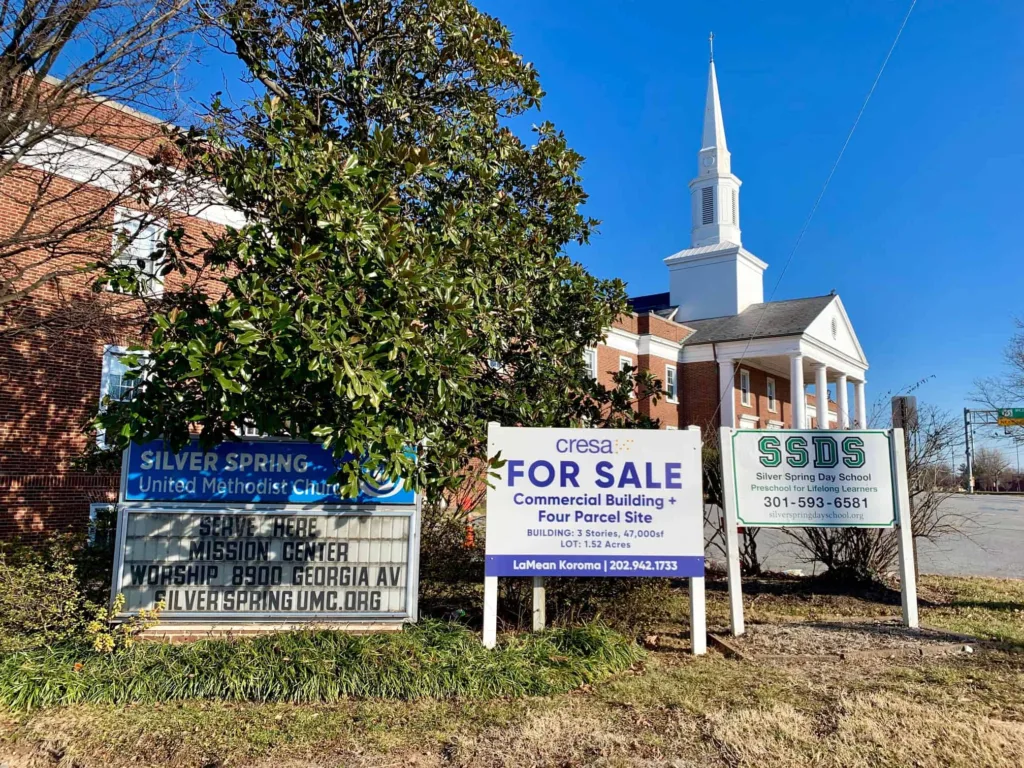

A clergy friend recently shared about his Anglican church plant’s rental of worship space hosted by a former United Methodist congregation. That congregation successfully completed the disaffiliation process and joined the Global Methodist Church. It’s a partnership reflective of what I call an “ecumenism of the trenches” between local ministries that seek to be a faithful, biblically orthodox witness in the same community.
Another Methodist church near the same town did not disaffiliate, leaving behind about two dozen people, a challenging number to sustain upkeep of a building. If the UMC annual conference opts to shutter the church and list the property, which has already been done elsewhere in the conference, area congregations experiencing growth are looking to buy.
This account evidences something that I earlier had gotten wrong: with the sunsetting of the United Methodist Discipline’s paragraph 2553 allowing congregational disaffiliation with property, I predicted a firesale of United Methodist properties in 3-5 years after an influx of disaffiliation payments was exhausted.
I was wrong. That firesale is, in several annual conferences, already well underway.
The recent disaffiliation season and its aftermath may be an example of what is known in economics as creative destruction, the dismantling of long-standing things in order to make way for innovation.
More than a few technological gains in the past decade came as companies snapped up infrastructure on the cheap following the financial crisis, including server farms and network trunk lines.
We may soon see something equivalent in the American religious landscape.
As the second largest Protestant denomination in the United States rapidly declines, vibrant Evangelical and Pentecostal churches – many of whom minister among new immigrant populations – are eager to lease or purchase worship spaces. They may be in a better position to steward these properties and to reach people groups that mainline Protestantism could not.
There are at least three ways this is taking shape.
First, what I term the “disaffiliation shuffle”. As has been widely reported, more than one-quarter of congregations have successfully completed the disaffiliation process, but it is still unclear how many congregants have departed – we have anecdotal evidence of local transfers between congregations, but hard data isn’t yet available. People vote with their feet and exit congregations that either failed to reach the required two-thirds supermajority or never held votes. What they leave behind are church congregations reduced in size, meaning less apportionment money for the annual conference that must be generated elsewhere, potentially through property sales.
These church buildings will sooner or later hit the market, and newer congregations meeting in shared spaces like theaters or schools (or at less than ideal times outside of Sunday morning) will jump at the chance to buy these houses of worship.
Second, as my colleague UMAction Director John Lomperis has documented, the rate of disaffiliation has been uneven across the United Methodist denomination. Conferences that closed large numbers of churches before exits – including the North Georgia Annual Conference – saw a massive influx of assets to their bank accounts even as their budgets were scaled back.
The financial impact of exits remains to be seen. Presumably, there will be a short-term gain from exit fees. Conferences with expensive suburbs, like Virginia, eventually could make substantial money selling church properties even as they lose income from congregations (a large United Methodist property near me, home to what was once the largest UMC congregation in Arlington, Virginia, is an example of this, selling for $5.5 million and scheduled for demolition in order to make way for a retirement facility).
Meanwhile, conferences that erected formidable roadblocks to disaffiliation, including the Baltimore-Washington Conference, have not received the same financial influx. These (mostly more theologically revisionist) conferences have been merging congregations and shuttering churches for years. In some cases, this is done under the “exigent circumstances” clause of The United Methodist Book of Discipline, as it was in the Oregon-Idaho conference this past November (where only 11 congregations successfully completed disaffiliation). Nearly all shuttered properties have quickly been listed on the commercial market.
Third, United Methodism simply has too many buildings. Some were constructed in an era with more agrarian communities. Additionally, a series of mergers between the Methodist Episcopal Church, Methodist Episcopal Church South, and the Evangelical United Brethren resulted in charges with multiple geographically proximate churches that aren’t efficiently distributed. Even if there hadn’t been a disaffiliation shuffle or a merging of congregations, the market forces of aging demographics and building upkeep costs would likely result in many of these properties becoming available to others.
The United Methodist Church had more than 30,543 churches as of 2019 when the disaffiliation language was implemented. With 7,660 exited and apparently more than 500 closed since that time, presumably there are about 22,000 at present.
Each of these three scenarios is manifesting across different parts of United Methodism, but as one of the most geographically widespread denominations in the United States, chances are that a formerly United Methodist church building is about to become available near you. Join me in praying for healthy, vibrant congregations of different Christian traditions to move into these spaces and share the gospel with their neighbors.



Comment by Pastor Mike on January 3, 2024 at 6:56 am
“Conferences that closed large numbers of churches before exits – including the North Georgia Annual Conference – saw a massive influx of assets to their bank accounts even as their budgets were scaled back.”
Apparently, the Virginia Annual Conference has also experienced a “massive influx of assets” since Bishop Sue Haupert-Johnson will leave on a 12-night “pilgrimage” through England in September and immediately following this trip, will embark on a 9-night round trip “Journeys of Paul” cruise aboard the Odyssey of the Seas from Rome, Italy. Another “wise” use of collected assets and apportionment dollars.
Comment by John N Kenyon on January 3, 2024 at 10:58 am
For the record, I wholly side with the direction of the GMC. Could you publish a series of articles on what it clearly means “to be a faithful, biblically orthodox witness in the same community.” And what it means to be a global church in our era of worldwide Christianity?
Comment by David on January 3, 2024 at 11:58 am
It is instructive to look at real estate websites such as below and note the prices. It does give me pause to see places selling for less than my modest apartment. Of course, some are in decayed urban centers.
https://www.crexi.com/properties/Religious-Buildings-and-Churches
Comment by Bruce Strampe on January 3, 2024 at 2:48 pm
Our church disaffiliated early in the process and have joined the Global Methodist Church. The question that I have had all along has not been answered. The UMC closes every church that they feel has broken the “Trust Clause”. Trust clauses usually protect both parties. What does the UMC have to do to break the trust clause allowing churches to withdraw without penalty? It may be a bigger question after the 2024 UMC General Conference.
Comment by Josías on January 3, 2024 at 5:42 pm
4th- of the 22000 buidings that are left, 40 percent are dilapidated and in need of a higher influx of money and repair than they are worth. So, are we purchasing the UMC’s headache properties?
Comment by Mikeb on January 3, 2024 at 8:51 pm
Josías, I’m sure every disaffiliating Church thought this through. I would not be surprised if a number of congregations decided that they could buy/rent a new building and start a fresh plant for far cheaper than buying their old building in dire need of repairs.
Comment by Gordon Hackman on January 5, 2024 at 11:26 pm
The UMC church where I used to live, in the village of Westmont, IL became a mosque sometime in the last few years.