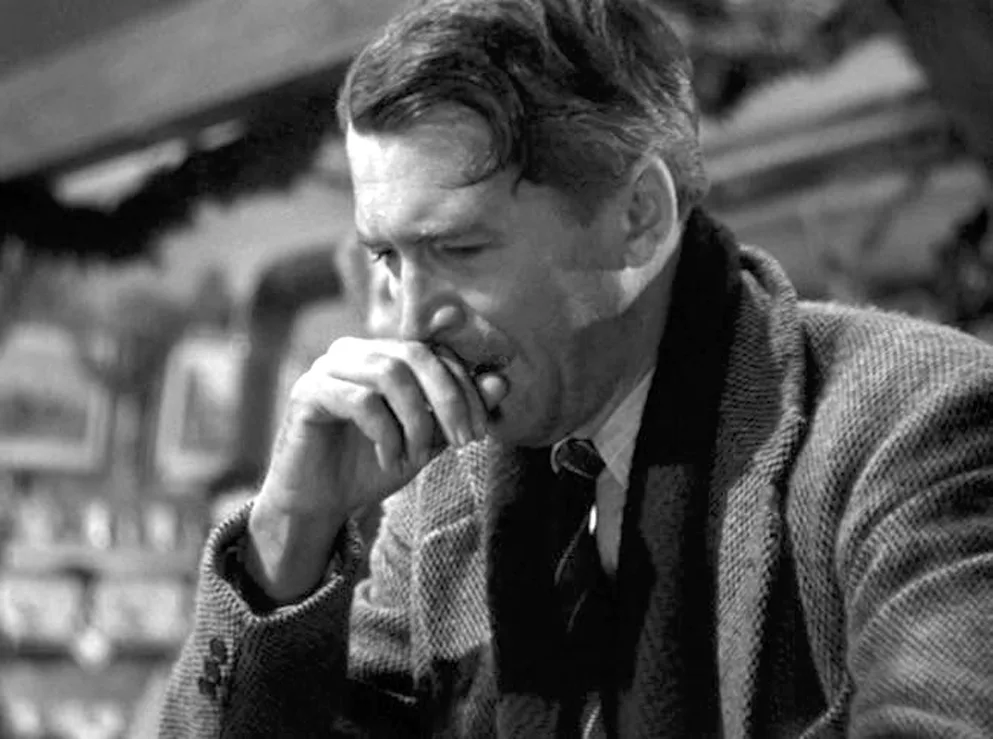

Frank Capra’s cinematic triumph “It’s A Wonderful Life” reminds us that all life is valuable, “no man is a failure who has friends,” and “all that you have is that which you give away.”
One of its best messages is often overlooked. In writing about It’s a Wonderful Life, Capra stated, “There are just two things that are important. One is to strengthen the individual’s belief in himself, and the other, even more important right now, is to combat a modern trend toward atheism.”
The film’s slow opening is easily overlooked in contrast to its famous climax, but is the essential moment making the conclusion possible. All of Bedford Falls prays for “a man named George Bailey” and the angels respond to those prayers. The audience, along with Clarence, the angel assigned to George, will learn of George’s life, how he has sacrificed for friends and family, and how he has come to the brink of suicide believing that his life has amounted to nothing. His building and loan business is short $8,000, and he is facing arrest. In the midst of this, his friends and neighbors pray for George, unbeknownst to him.
George’s redemption is set in motion by the brief prayers given at the beginning of the film. It is easy to forget that these have taken place, they remain always in the background as the subtle but essential plot catalyst. The movie’s climax and resolution do not occur because George is a good man, although he is, or because he is especially deserving. They come through patient, simple prayer.
That there is a God, who hears our prayers and responds to them, and who often works through ordinary means and ordinary persons is an essential message of the movie. Also, important is the recognition that those answers may take much longer than we expect.
Despite the happy ending and the popular characterization of Capra’s movies as “Capra Corn”, It’s a Wonderful Life is, at times, one of his darkest pictures. In his moment of desperation, George, frantic and hopeless in a bar, utters a prayer for God’s help. “Dear Father in heaven, I’m not a praying man but if you’re up there and you can hear me show me the way. I’m at the end of my rope. Show me the way.”
But George is not shown the way. Instead, as he looks up expecting a miracle to happen, he is punched in the face.
“That’s what you get for praying,” George says. This scene was essential to Capra, writing in the New Orleans Review, “It’s a short prayer, but we believe it. He’s desperate and has nowhere to turn. If we showed him on his knees in a church or in a private corner, the audience wouldn’t take to it. But in a bar, right after gulping down a shot of whiskey, we are inclined to believe it. Then, a man recognizes him as the one who told off his schoolteacher wife on the phone and socks him. That’s what he gets for praying. That’s natural. Someone expects help and look what happens.” The audience can identify with this, they undoubtedly have prayed and felt as though God was silent.
What the audience knows, which George does not, is that heaven is already at work on his behalf. Before he prayed, before he began to contemplate suicide in Martini’s Bar, angels were responding to the prayers of George’s family and neighbors.
His salvation approaches, but for George, like most of us, it is not the salvation he anticipated. The missing $8,000 seems insurmountable to George, and our present concerns often seem insurmountable to us, but it is not insurmountable to God, and it is not the primary way in which George’s prayer is answered. God, it seems, is more focused on George’s transformation, his recognition that his life has value and meaning, and his gratitude for it despite its hardships and disappointments.
The $8,000 is taken care of in two minutes, it is George’s transformation that takes much longer, but that is what George really needs and what we all need, a heart changed and restored by encountering God.
Profound change takes hold within George before his problem’s resolution. His famous run through the main streets of Bedford Falls transpires before one cent is collected on his behalf. He cheerfully pronounces upon entering his home, “I’ll bet it’s a warrant for my arrest. Isn’t it wonderful? I’m going to jail! Merry Christmas!”
At the end of the movie, George’s friends and family help to pay off the $8,000 dollars, giving us a final reflection on prayer. Often our prayers aren’t answered through angelic appearance but rather by God working through ordinary means and people around us. And sometimes we are the people He works through to answer the prayers of our loved ones as well.
Frank Capra directed It’s A Wonderful Life because the modern world saw God as more distant, or perhaps nonexistent, and he reminds us that He is much closer than we often realize.




Comment by Dan W on December 20, 2023 at 2:33 pm
Thanks for the wonderful article Sarah! It would not seem like Christmas without watching this beloved classic. Merry Christmas : )
Comment by David on December 20, 2023 at 5:47 pm
“The Life of Brian ” movie sheds a different light on matters.
Comment by Dan W on December 20, 2023 at 8:02 pm
One of my favorite new Christmas traditions – the appearance of the Christmas Troll.
David, you forgot to say “Bah, humbug!” and “If they would rather die, they had better do it, and decrease the surplus population.”
Merry Christmas, and have a very blessed New Year!
Comment by David on December 21, 2023 at 7:30 am
Some people realized early on that Christmas celebrations were essentially pagan in origin.
“For preventing disorders arising in several places within this jurisdiction, by reason of some still observing such festivals as were superstitiously kept in other countries, to the great dishonor of God and offence of others, it is therefore ordered by this Court and the authority thereof, that whosoever shall be found observing any such day as Christmas or the like, either by forbearing of labor, feasting, or any other way, upon such accounts as aforesaid, every such person so offending shall pay for every such offence five shillings, as a fine to the country.”—MA Bay Colony, 1659
Comment by Tim Ware on December 21, 2023 at 11:44 am
Calvinists did not celebrate any religious holidays, not just Christmas. This was due to its rejection of Catholcism, which had many religious holidays.
Comment by Ted on December 22, 2023 at 8:38 pm
Merry Christmas to our own litttle troll, David, who wallows and rejoices in his own misery of rejection, always hoping to bring others down to his level of misery. Remember the old adage, “Misery loves company” and always reject David’s effort to destroy your happiness. Jesus is the TRUTH, the LIGHT and the ONLY WAY to eternal happiness.
Comment by Kerry on December 23, 2023 at 10:32 am
Another subtle yet theologically important moment happens when George comes back to the bridge and yells “I want to live again!” When he says “Clarence!” Nothing happens. But when he says, “Please God, let me live again,” THAT’S when the snow resumes falling, his lip starts bleeding and Zuzu’s petals are back in his pocket.
Angels can’t save, only God does!
Comment by George on December 23, 2023 at 11:22 am
Thanks Ted. And you didn’t even have to mention “switches and coal”. Merry Christmas everyone.
Comment by David on December 24, 2023 at 8:34 am
Turning to Hollywood films for confirmation of religious beliefs is a bit silly. My citation of “The Life of Brian” was to show this. I also do not see how atheism enters into the film mentioned.
As most know, Christmas customs derive from celebrations found in many cultures for the winter solstice. The Romans had Saturnalia which included gift-giving and the decoration of outdoor trees, though this was not the origin of the modern tree custom.
So Christians are the only ones who can be happy. There are no happy Jews, Hindus, Buddhists, Muslims, pagans, etc? I think you will find happy people even in the most impoverished parts of the world. We would not be happy there, but humans are adaptable to their situations.
“Eternal happiness” depends on which part of the Bible (AKA God’s Word) you choose to believe.
“As a cloud fades away and vanishes, so the one who goes down to Sheol will never rise again.”—Job 7:9
“Then the Sadducees, who say there is no resurrection, came to him with a question.”—Mark 12:18
The Sadducees, also known as the “priests and scribes,” the scriptural authorities and religious traditionalists of their time, rejected the notion of the afterlife. It is curious to see the objection to the changing of traditional doctrines in these pages in light of this. People feel free to believe whatever they wish even when it is contrary to their own scriptures.
Io Saturnalia to all.
Comment by Dan W on December 24, 2023 at 5:55 pm
It’s a Wonderful Life (1946) is a Christmas film, but not really a Christian film. The same for How the Grinch Stole Christmas! (1966) or A Charlie Brown Christmas (1965.) I enjoy these partly for the nostalgia, but also for the simple, yet powerful stories of redemption. I love the various adaptations of Dickens’ A Christmas Carol for the same reason. At this time of the year it’s good to be reminded we need redemption. We can all be a little grinchy, or scroogey at times. We are in need of a Savior.
Luke 2:10-11 KJV And the angel said unto them, Fear not: for, behold, I bring you good tidings of great joy, which shall be to all people. For unto you is born this day in the city of David a Savior, which is Christ the Lord.
Comment by Pastor Mike on December 25, 2023 at 2:58 pm
David, my prayer is that you will one day accept Jesus Christ as your Lord and Savior. Merry Christmas and a blessed New Year.
Comment by Td on December 26, 2023 at 2:27 pm
We must remember that David presents us with the “truth” of today’s conventional wisdom. But if really want to analyze the supposedly pagan origins of Christmas, you might listen to this on the podcast Shameless Popery.
Shameless Popery | #04 Does Christmas Have Pagan Origins? – Joe Heschmeyer on Podbean, check it out! https://www.podbean.com/ea/dir-edm37-16026a0a