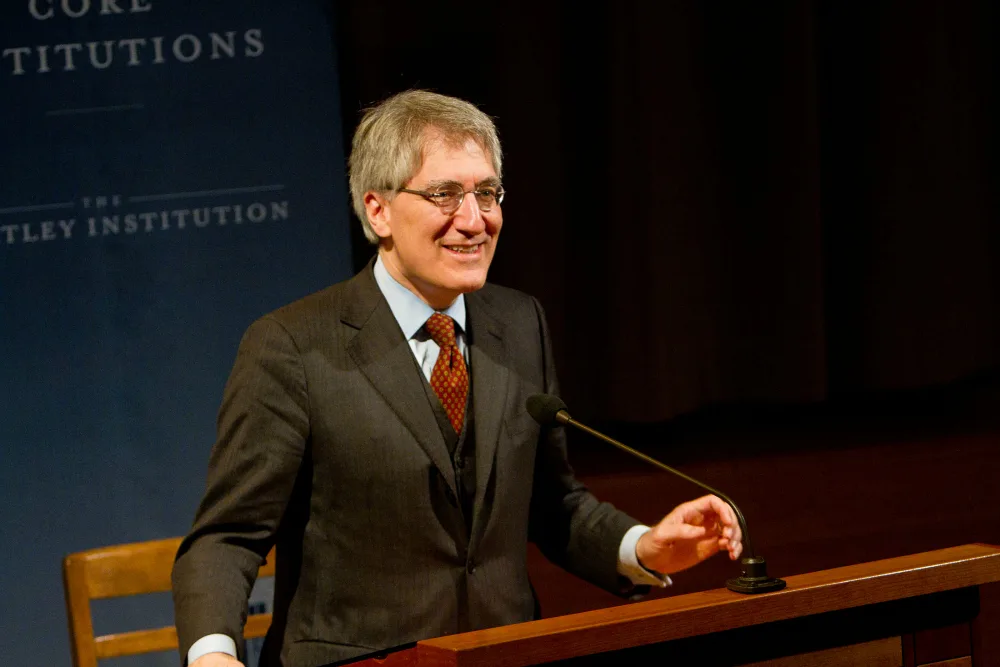
The Thomistic Institute presented a lecture by Robert George, McCormick Professor of Jurisprudence at Princeton University to discuss why religious freedom is a human right at Georgetown University on September 28. He emphasized that the right to religious freedom is a universal right, knowable by reason alone to people of any faith or no faith, wherever they are in the world.
George began with abstract reasoning and moved to concrete reality in making his points. He said that
“The starting points of all ethical reflection are those fundamental and irreducible aspects of human wellbeing and fulfillment that some philosophers, I and others, refers to as ‘basic human goods.’ These goods, friendship, knowledge, aesthetic beauty, justice, and so forth as more than merely instrumental ends or purposes, things we intelligibility want, not merely as means to other ends, but for their own sakes, are the subjects of the very first principles of practical reasoning that control all rational thinking with a view to action. By practical reasoning, I am now referring not to pragmatic thinking, but to practical and Aristotle’s aesthetic ‘reasoning with a view to action.’”
These principles of practical reason direct us to judgments about the proper course of action to take in life, whether or not the judgments are correct. People must have some view of human flourishing in mind to make judgments about right and wrong, George maintained. Our judgments are made on the basis of what we think is “rationally desirable because humanly fulfilling, and therefore intelligibly available to choice.” We are also directed “away from the privations of those things.”
As an example of this directedness, George said, we are directed against the privation of health. We are directed toward “going to the doctor when we’re sick, stopping smoking, going on a diet, getting some exercise,” etc. “In the end,” he said, “it’s the integral directedness of these first principles of practical reasoning (again, the principles of directing our choice and action towards what’s humanly fulfilling, towards actions for our well-being and fulfillment, not just as means to other ends but as ends in themselves) that provides the criterion or right belief that provides the set of criteria or moral laws by which it’s possible to distinguish right from wrong, that is, what’s morally good from morally bad action, including just action from unjust action. Morally good choices that are choices that are in line with the various fundamental aspects of human well-being and fulfillment, integrally conceived. Morally bad choices, are choices that are not.”
A Concrete Example General Moral Reasoning about Law
From this abstract moral reasoning, George then proceeded to explicate moral reasoning about human law. He cited Martin Luther King’s Letter from Birmingham Jail as an example of moral reasoning in common language. This discusses “just and unjust laws.” It says that “just laws are laws that honor people’s rights, and unjust laws are laws that violate them.” He said that King answered the question “how can you, Dr. King, engage in willful lawbreaking, when you yourself have stressed the importance of obedience to law in demanding that the officials of the southern states conform to the Supreme Court’s desegregation ruling in the case of Brown vs. the Board of Education just a few years earlier?” King responded that
“the answer lies in the fact that there are two types of laws, just and unjust. I would be the first to advocate obeying just laws. One has not only a legal but a moral obligation to obey just laws. Conversely, one has a moral responsibility to disobey unjust laws. I would agree with St. Augustine that the unjust law is no law at all. Now what is the difference between the two, how does one determine whether a law is just or unjust? A just law is a man-made code that squares with the moral law, or the law of God. An unjust law is a code that is out of harmony with the moral law. To put it in terms of St. Thomas Aquinas, an unjust law is a human law that is not rooted in eternal law and natural law. Any law that uplifts human personality is just, any law that degrades human personality is unjust. All segregation statutes are unjust, because segregation distorts the soul and damages the personality. It gives the segregator a false sense of superiority, and the segregated a false sense of inferiority.”
“So,” George said, “just laws elevate and ennoble the human personality, and what King in other contexts refer to as the human spirit, unjust laws … debase and degrade. Now, King’s point about the morality or immorality of laws is a good reminder that what is true of what is sometimes called personal morality is also true of political morality. That is, the actions not just of individual persons (you and me) but the actions of political bodies, governments. The choices of actions of political institutions at every level and the choices and actions of individuals can be right or wrong.” Often, the failure is a failure of justice, a “failure to honor people’s equal worth and dignity.”
But George said that “contrary to the teaching of the late, and very great Harvard philosopher John Rawls, and the extraordinary influential stream of contemporary liberal thought of which he was the leading exponent … the good, that is, the human good is prior to the right.” Rawls, on the other hand, argued that “the right is prior to the good.” Modern legal philosophy, Rawls thought, must figure out what human rights are independent of the human good, because what is good is “something that people disagree about.” Laws cannot justly be made on the basis of controversial judgments “of what makes for or detracts from a valuable or morally worthy way of life.” This denial, George said “is what I’m challenging.”
He said that “to be sure human rights … are among the moral principles that demand respect from all of us, including governments and international institutions which are morally bound not only to respect human rights, but also to protect them.” But he said that “all human rights, including the right to religious liberty, are shaped and given content, precisely by the human good they protect.” He said that contrary to Rawls “I’m arguing that the only way we can understand what rights people have is to figure out what the human good is.” The good is, for George, heavily dependent on people being obviously “rational animals.” The human good is based most fundamentally on the most basic of all human rights, the right to life. This right, he said, is violated not only when one directly plans another’s death, but when it is foreseen and unfairly accepted “as a side effect of one’s actions in pursuit of certain ends.” Thus, the “human organism is no mere instrumental good but is itself an intrinsic aspect of ourselves as human beings. It’s intrinsic to who we are.” Being alive is a more basic good than having a happy life. But we “can flourish or fail to flourish in respect of many, many, many different things, because we’re complex creatures.”
Religious Freedom as a Human Right
Among the things that are important to human flourishing, George claimed, is religion. To the immediate response from atheists that “religion is bad,” George clarified that what he means by “religion” is that most basically “in its fullest and most robust sense, religion is the human person’s being in right relation to all of the wider reality, whatever that in fact is, including pre-eminently, supernatural reality or the divine, assuming that there is such a thing.” One should be “in line with whatever are the ultimate sources of meaning and value.” Some have a fuller knowledge of truth than others, and thus a greater duty to conform to it, but all humans have a duty to pursue a right relation to reality uncoerced by mere human authority. Assuming provisionally the truth of theism, one can see that in a perfect apprehension of reality willingly received, one would relate to God exactly as he wants.
But there are competing ideas of what is ultimately true. Buddhism, he said, has a very different understanding of reality and how human fulfillment can be achieved than does Christianity or Islam. George said that, in his view, reason should play a very large role in answering ultimate questions. He contrasted that with the view that religious commitments are entirely a matter of faith. Yet even here, one’s apprehension of ultimate reality, even if wrong, must be understood as a human good, because we are creatures that have a natural inclination to know ultimate reality. This apprehension “will play an instrumental role in the whole of his or her life, even in what appear to be, from an outsider’s perspective, the secular dimensions of life.” Whenever one begins to strive for “more than the merely human sources of meaning and value,” one is on a religious quest, and such quest is an irreducible human good, not merely instrumental to other things, George maintained. One should endeavor to “order one’s life and mind according to one’s best judgment, whatever it turns out to be.”
George said that if he is right, then “the existential raising of religious questions … about the more than merely human source of meaning, of value, where did we come from, where are we going, what is possible for us, are we merely material creatures, can we transcend the merely material, the raising of those questions,” and what one “sincerely believes to be one’s duties in light of those answers, are all part of this human good I’m calling religion.” He said that “you cannot be a fully flourishing human being if you don’t raise those questions, answer them as honestly as you can, live your life with authenticity and integrity in light of your best answers, whatever those answers are.”
He believes that there are three critical elements to religion: 1) the raising of ultimate questions, 2) the “honest effort to answer the questions,” and 3) “living with authenticity and integrity in light” of the answers that one has found. Even atheists, George maintained, should be able to see that such integrity must be respected. It is a good in itself.
Religious Aspiration as Part of Human Nature
One conclusion to be drawn from George’s analysis is that “man is, as Seamus Hasson puts it, intrinsically and by nature a religious being.” Just as “we are moral beings, that is, we are responsible for our actions, just as we are physical beings, just as we are social beings, able to enter into relationships with others … we are also religious beings.” On this view, even an atheist, like Albert Camus, was “a textbook case of a seeker and a searcher, fulfilling his own nature, realizing the good of inquiring into these questions …. [and] trying to live a life of integrity in line with his answers.” This requires, then, freedom in one’s “religious quest.”
George referred to the late Czech President Vaclav Havel’s story of a greengrocer in a communist Czechoslovakia. The Czech government required all shopkeepers to put a sign in their windows which read “workers of the world, unite.” The greengrocer did not believe communist doctrine, nevertheless he put up the sign, violating his personal integrity. People are forced to live a lie. But George said that “if we respect the person, in all his dimensions of being, including his person as a seeker of religious truth, we’re going to have to respect the person’s liberty to make up his own mind about where the truth lies, and to live in conformity to this, to the extent that we can, using our best judgments.”
Religious Freedom and Catholic Teaching
This then is a rational basis for religious freedom. Religious freedom is a fundamental human right “because it protects a fundamental human good,” the good of seeking the ultimate truth and living one’s life in accordance with it. George said that this is in contrast to the ultimately theological justification offered in Dignitatis Humanae, the Vatican II document that inaugurated religious freedom as official Catholic teaching. He conceded that “in times past,” and even today in certain parts of the world, it is regard “for persons’ spiritual well-being that has been the premise and motivating factor for denying religious liberty or conceiving of it in a cramped or restricted way.” This is still true of such places as Iran or Saudi Arabia. Pre-Vatican II Catholics often rejected religious freedom “on the theory that ‘only the truth has rights.’” If conditions are favorable, non-Catholic opinion should be suppressed, it was thought, for fear of leading souls astray. The premise of this policy, that “religion is a great human good” was “fine.” Also correct is the judgment that “the truer the religion, the better for the religious fulfillment of the believer.” The error was in depending on the state to protect the correct religion. In rejecting this, the Second Vatican Council “did not embrace the idea that error has rights. They noticed, rather, that people have rights, and they have rights even when they are in error.” Thus, based on human nature as a truth-seeking nature, people have a right to advocate religious beliefs that “are less than fully sound, and even if they are false.”
Closely related to the religious liberty doctrine proclaimed in Dignitatis Humanae is another Vatican II document, Nostra Aetate. This document attempts to map out and justify a relationship between the Catholic Church and non-Christian religions. While importantly concerned with the church’s relationship to Jews and Judaism (it observes the church’s origin in Judaism and denies the Jews’ collective guilt for the death of Christ), it is also concerned with non-Christian religions in general. It professes respect for “all that is true and holy” in non-Chrisitan religions. It especially recognized value in the monotheistic religions of Judaism and Islam. They are held to fulfill the human person, although the greatest fulfillment will be found in the true religion, which acknowledges the incarnation of Jesus Christ.
George went on to say that “the Catholic Church does not have a monopoly on the natural law,” the universal law by which he defended religious freedom. The church is opposed to fideism (faith independent of reason) and holds that faith and reason are both necessary to human flourishing and advance. Arguments for religious freedom must be available to “all men and women of good will.” These arguments should appeal to “common human reason.” He quoted from Nostra Aetate to show how this could be done. Basically there is an appeal to the value of the religious quest for ultimate truth, and the need for a sincere embrace of the truth. Often this results in the recognition of a power behind human events and the course of nature, and even a supreme being. Nostra Aetate recognizes that there are very precise and elaborate formulations in various religions and complex religious life develops from them. Christians should enter into dialog “in prudence and charity” with practitioners of other religions. Yet the same document says that the church “is duty bound to proclaim Christ, who is the way, the truth, and the life.” It is “in Christ that men find the fulness of their religious life.”
Applying Religious Freedom
Although the Catholic Church (like orthodox Protestants) and (commonly) adherents of other religions hold that the fulness of truth is found only in its own doctrine, yet those who deny it in whole or in part retain religious freedom to pursue another path in life according to their apprehension of ultimate truth, even if that apprehension is atheism, George said. Faith is not faith if it is coerced.
George conceded that “gross evil and grave injustices have been committed by sincere people for the sake of religion.” Such people certainly “thought they were doing the right thing.” He noted that the people who killed Socrates sincerely believed that he was harming the city “by denying the gods and corrupting the youth of Athens.” Religious freedom must be “broad,” George said, “but it can’t be unlimited.” But to limit religious freedom, the state ought to meet “a heavy burden.” In the United States, the standard of the Religious Freedom Restoration Act of 1993 is used, which requires that the state show that requiring the violation of religious precepts is necessary to secure a “compelling state interest, exercised in the least restrictive way.” The question of what is a compelling state interest then becomes the key question. Under the Supreme Court’s Sherbert vs. Verner (1963) decision, judges decide if the standard for burdening religious liberty has been met. Under Employment Division vs. Smith (1990), legislatures grant religious exemptions to generally applicable law. The Supreme Court now seems to be moving again toward the Sherbert regime, enabling religious defendants to appeal to religious freedom in support of their cases. But whatever standard for religious freedom is finally decided, George said, it “should be something non-controversial,” because it ought to be acknowledged “by our common human reason.”
Concluding Observations
This writer believes that one of George’s most important points was that the “human organism is no mere instrumental good but is itself an intrinsic aspect of ourselves as human beings. It’s intrinsic to who we are.” One’s own happiness does not justify the death of another, as happens in abortion, nor does it determine one’s sexual nature, as LGBT liberation insists. As the priority of happiness works itself out, “what I want” overrides morality, resulting in the killing of innocents and the destruction of sex (conceptually, in distinguishing male and female, and also physically, in sexual mutilation).
Further, and most importantly, religious duty by its very nature takes priority over human law, as this writer has often pointed out that James Madison, the author of the First Amendment said in the Memorial and Remonstrance against Religious Assessments. While the greatest prudence is certainly called for, as well as consultation, if possible, with other believers, in any conflict between divine and human law, one must, as Acts 5:27-29 clearly states “obey God rather than men.” We might note in response to any claims of fanaticism in this connection that the atheist dictatorships of the last century and this certainly believed that the good of the perfect society justified many acts common sense would see as evil. But even if that were not the case, there is still an absolute duty to obey God.
Finally, it should be pointed out that the right of conscience should have priority in questions of religious freedom. It is obviously wrong to take an action believed evil, and the objector should not take such action, regardless of the penalty. We must, as far as possible, strive for a righteous life, because, as the Scripture says, “what does not proceed from faith is sin.” (Rom. 14:22-23).



Comment by robert Landbeck on October 7, 2023 at 3:06 pm
A Biblical ‘righteous life’ is not possible because human nature does not allow for it! That is to say that theology and philosophy have grossly misundertood ‘natural law’. It offers no insight as a moral guide to human conduct, but in fact only perpetuates the Original ‘sin’, better understood as primary moral error of mind, body and perception, which is embedded within human nature itself and will not be corrected by any existing religious conception. Given the corruptions of natural law that are self evident today and slowly bankrupting the church, the claims and pretentions of existing ‘natural law’ thinking are looking more and more like the emperors new clothes.