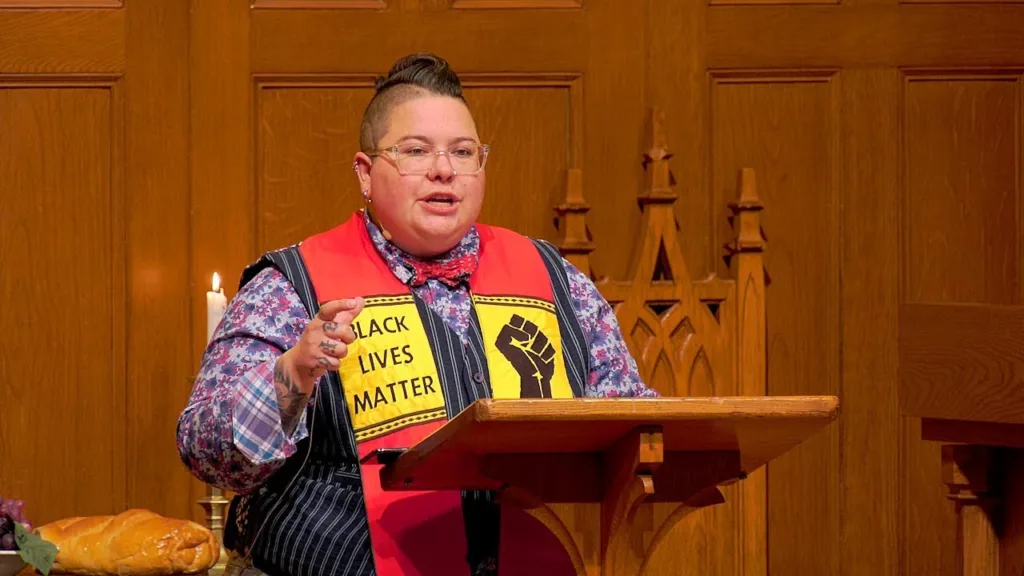
Ordained Baptist Dr. Roberto Che Espinoza, a visiting professor at United Methodism’s Duke Divinity School, is quickly gaining popularity among progressive Christian theologians and activists. Identifying as “a non-binary transqueer Latinx” who goes by “they” and “he,” Espinoza is scheduled to speak in July at the annual Wild Goose Festival in North Carolina. Wild Goose is a prominent Religious Left event featuring speakers such as Diana Butler Bass, David Gushee and Brian McLaren.
The founder of The Activist Theology Project, Espinoza specializes in advocating for social justice both in the church and academia. As a theologian, Espinoza self-classifies as a liberationist. As a scholar, Espinoza focuses on queer theory, theology, and the intersection of ethics and religion. These specialities, as well as a plethora of publications, is what has enabled Espinoza to gain popularity in academic circles. Espinoza’s rising popularity is evidenced by a TEDx in August 2022 on the danger of separating the mind from the body, an argument against Rene Descartes’ mind-body dualism.
Formerly known as Robyn Henderson-Espinoza before transitioning, Espinoza was born and raised in Texas in a home with two distinct cultures, shaped by a Hispanic mother and an Anglo father. This dual-culture household would be the starting foundation for Espinoza’s exploration into intersectionality. Espinoza grew up in the Baptist tradition and found theology interesting in high school but was disappointed in the church’s exclusionary posture towards LGBTQ+ individuals. Espinoza attended Hardin-Simmons University in Abilene, Texas, originally majoring in music and eventually switching to theology.
After graduating from Hardin-Simmons, Espinoza worked several odd jobs before entering the field of clinical pastoral education in 2005. In 2006, Espinoza graduated from Garrett-Evangelical Theological Seminary in Evanston, Illinois with a master’s degree in theological studies. There, Espinoza worked with Dr. Nancy Bedford, whose speciality was in feminist thought and studies. Espinoza, during this time, also came out as queer and gender non-conforming, followed by the beginning of the transitioning process. Espinoza’ master’s thesis focused on the topic of ecclesial feminism in the context of the theology of Dr. María Pilar Aquino, a professor of theology at the University of San Diego.
After graduate school, Espinoza entered the world of government and politics, working for Lisa Madigan, the then-Illinois Attorney General, to analyze the crime rates and policies in Illinois. After working in the Illinois Attorney General’s office, Espinoza returned to academia by enrolling in the University of Denver School of Theology’s Ph.D. program. Espinoza obtained a Ph.D. in Theology in 2015, primarily concentrating in Constructive Philosophical Theology. Espinoza’s secondary doctoral concentration was on queer theory and Latinx studies. To graduate from the program, Espinoza completed a doctoral thesis titled “Anzaldúan Materiality as the Entanglement of Bodily Knowing: Matter, Meaning, and Interrelatedness.”
After obtaining a Ph.D from United Methodism’s Iliff School of Theology at the University of Denver, Espinoza has taught classes at Iliff, Chicago Theological Seminary, Vanderbilt’s School of Divinity, McCormick Theological Seminary, and currently, Duke University’s School of Divinity. Some classes that Espinoza has taught include “Queer Theory and Theology,” “Introduction to Christian Social Ethics,” “The Ethics of Liberation,” and “Queer Theory and Religious Ethics.” In addition to teaching, Espinoza has published two books, with Activist Theology in 2019 and A Path to Our Liberation in 2022. Espinoza has also participated in numerous conferences, symposiums, and published several academic articles and book reviews.
Espinoza is not only a scholar by trade but also a theologian and social activist. An ordained minister in the Fellow of Affirming Ministries, Espinoza presides over a small inter-spiritual community named Our Collective Becoming. The community meets over Substack, an online platform where Espinoza has published various articles and podcasts. Espinoza is also the founder of the Activist Theology Project. The organization defines itself as a coalition of “politicized theologians and healers, social change agents, and strategy-minded people situated in the hybrid space of church, social change, and the academy.”
This past April, Wen Stephenson of The Nation interviewed Espinoza in Nashville, which is where Espinoza currently resides. The interview came one day after the atrocious Covenant School shooting in the Nashville suburb of Green Hills. During the interview, the pair talked about transgenderism, Christianity, politics, and healing from the sudden tragedy. Espinoza also elaborated on several theological positions, helping clarify important distinctions.
One of the opening questions Stephenson asked where Espinoza falls on the theological spectrum of “theologically conservative” and “theologically progressive.” For Espinoza, “progressive Christianity” is too lukewarm. It does not go far enough in liberating marginalized people groups from the norms of what Espinoza calls “whiteness.” Espinoza contends that progressive Christianity is flawed because it has been overly influenced by 19th-century liberalism and individualism, which leaves marginalized groups at a disadvantage. As a result, Espinoza identifies as a “liberationist” both in politics and theology.
Espinoza then pivoted to elaborating on what Christians should primarily focus on, arguing that the priority of Christians should be cultivating relationships. Espinoza dismisses doctrine and dogma if they impede the formation and improvement of relationships between fellow Christians or between Christians and non-believers. Espinoza alludes to “the Way” as the ideal route that Christians should take, a route defined by practicing kindness and compassion to others. With the first principle that relationships are supreme, Espinoza objects to the argument that it is important to preserve the institutional church, explicitly stating, “I’m not an institutionalist…and I’m not here to preserve the institutional church.” Arguing that the institutional church perpetuates violence against minority groups, Espinoza believes it a better route for Christians to “follow Jesus, be on the Way, and to make little moves against destructiveness.”
The critique of the institutional church that Espinoza offered came as a response to Stephenson’s question on how being transgender affects being a Christian and vice versa. Espinoza focused the second half of the response by saying Scripture is not clear on issues of sexuality and specifically, LGBTQ issues. Moreover, Espinoza believes that the Bible only offers a clear position on how we should approach money, reminding us that we ought to give our money away to aid the poor.
The interview concludes with Espinoza reminding the audience that Christians are a body, also analogizing Christendom as an ecosystem. The theologian argues that the ecosystem of Christianity is currently being poisoned by the disease of intolerance and violence. To remedy such disease, Espinoza proposes that we recover the lost art of relationship with each other. Introducing the Spanish phrase en conjunto, roughly translated to English as “togetherness,” Espinoza argues that only when Christians master this will Christendom at large heal from the disease Espinoza identifies as violence and dogmatism.
Last year Espinoza debated conservative Free Church of England cleric Calvin Robinson on woke theology, which can be viewed here.
Espinoza has taught at Duke Divinity School since 2019 and serves at its Hispanic House of Studies.



Comment by Stephanie Jenkins on June 12, 2023 at 2:22 pm
This person needs a psychiatrist and a regular job.
Comment by JoeR on June 12, 2023 at 2:24 pm
Nothing that goes against scripture here. Way to go Duke University. Sad how far from what you used to be.
Comment by David Miller on June 12, 2023 at 5:06 pm
This nonsense is happening too often. Worse there is little or no condemnation from so called conservative theogians. Very troubling.
Comment by Tom on June 12, 2023 at 5:33 pm
“Espinoza then pivoted to elaborating on what Christians should primarily focus on, arguing that the priority of Christians should be cultivating relationships.”
Great Commission? What Great Commission?
First great commandment? What first great commandment?
Comment by Douglas Ehrhardt on June 13, 2023 at 3:40 am
Victimism 101, and BLM as a kicker.
Comment by Ted on June 13, 2023 at 11:15 pm
It’s obvious she/he/it is one completely mixed up individual who is doing the devil’s work.
Comment by Mike on June 14, 2023 at 12:46 pm
It seems strange that this person is billed as a “theologian” when he/she/it shows no sign of actually knowing God.
Comment by David Gingrich on June 15, 2023 at 5:59 am
Nothing is too upside-down for Duke University.
Comment by Jeff on June 24, 2023 at 12:32 am
Two thumbs up to “Guest Writer” for not referring to her by one of her phony “pronouns” — not even once.
Born a female, will always be a female. Her pronouns are she and her.
Sad that the UMC has bought into this rank heresy and promotes heretics like this one.
Disaffiliate while you can, Methodists of sound mind!