
Two earlier articles reviewed the increasingly hostile educational environment in which Christians find themselves in the early twenty-first century, as discussed at the recent L’Abri conference in Rochester, Minnesota. But historically, education was aimed at conveying truth, not propaganda, as Peter Merz, a worker at L’Abri in Southborough, Massachusetts discussed on February 17.
Quoting G.K. Chesterton, Merz said that “education is simply something being passed on.” Even if it is “something very bad,” it is still education. But education should bring people “closer to reality.” Education indicates “what society thinks life is about, and what a person is and who God is.”
He began by discussing C.S. Lewis’ “Abolition of Man.” Lewis said that in the pre-modern world, cultures all over the world saw education as a way of teaching people to conform to an external, objective reality. If people were shaped in conformity to objective reality, they could be expected to flourish. Lewis quoted Aristotle saying “the aim of education is to make man like and dislike what he ought.” People should “be taught to respond correctly to what’s really there in front of them.” But in Lewis’ day (the first half and middle of the twentieth century), it was popular to “debunk” the idea that our affections reflect the value of things in themselves. They are simply subjective reactions to things. This debunking was a rejection of “the doctrine of objective value,” which holds that certain moral and aesthetic judgments “are really true.” Lewis said that where “the old education initiated, the new merely conditions.” People are not made to conform to reality, but to the wishes of the conditioners. In reality, the conditioners likely shape people to conform to “some ideological purpose.” Whereas the old education was aimed at instruction to make people proper human beings, the new education is merely “propaganda.” Merz then proposed to analyze “what we pass on.” He did this by looking at three eras of history.
Education for Life in the Real World
In the classical period, education was intended to train people to learn and “love what is good, to reject what is evil,” and this would lead to human flourishing. In the Greco-Roman period, “there was an emphasis on eloquent and persuasive speech.” Citizens of city-states were expected “to participate in the government of the state.” People “also needed to fight for their city-state.” Heroic virtues of courage, temperance, etc. were greatly valued. Homer and his poems served as “the core of their educational system.” His poems were memorized. The idea was clearly conformity to “reason and the good.” It was believed that the universe was perfectly reasonable and rational, and people should try to conform to that. “Reason” was “conforming to the shape of reality, error is when you’re not.” Suffering, the Greeks believed, was the result of error. “Urbane, elite males” should be formed to guide society.
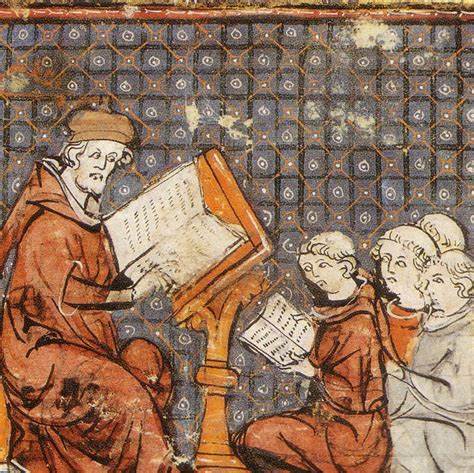
Secondly, there was the medieval period. Here, Merz quoted Indian Christian philosopher and social commentator Vishal Mangalwadi to say that in the Middle Ages people recognized “the unity of knowledge under Christ.” He pointed to the rose windows of medieval cathedrals. They symbolized truth radiating out from the center, which is Christ. Christ “holds everything together, and therefore you can explore reality, which is unified” under Christ. Monks in monasteries studied “because the Bible asked them to seek the knowledge of truth.” He said that “information turns into meaningful knowledge and wisdom.” Truth was understood as “fact plus meaning.” Augustine maintained that pagan knowledge was useful if seen in the light of Christ and his truth. Merz said it was “unusual” for one civilization to retain and use the knowledge of another civilization. Revelation (the Bible) and creation (nature) were the two books of knowledge God had revealed. The Trivium (grammar, rhetoric, and logic) and the quadrivium (arithmetic, geometry, astronomy, and music) were taught.
Thus, there was “an attempted synthesis of Judeo-Christian and Greco-Roman” thought. Monasteries and cathedral schools were the first educational institutions after the fall of the Roman Empire. The latter developed into universities. The purpose for the medieval educational world was “to explore and communicate the knowledge of God in the two books, nature and revelation.” Merz noted that Dante described souls in hell as beings that “had lost the good of intellect.” They are eternally separated from God. “To explore and communicate the knowledge of God brings glory to him” was the moving force in medieval education. Part of this as well was to “form Christlike people.”
The third era discussed was the modern period, which has involved several different movements over time, all of which involved acquiring and developing knowledge independent of the medieval synthesis. The first of these, the Renaissance, involved, among other things, the recovery of Greek learning which had been lost during the Middle Ages. During the Renaissance, scholars were “somewhat heady” with the knowledge and culture that had been recovered. This led to “a growing humanism” in which thought was increasingly centered on man.
The next stage of the modern era was the Reformation, which put the Bible at the center of thought, but also involved a move “from church to state education.” Luther called on the German princes to help with education. There was also an emphasis on “ordinary people” reading the Bible in their native language. This improved literacy in many countries. Truth would be discovered individually, directly from the Bible. Vocational training and manual work received more respect after the Reformation, since work in the common life was to the glory of God. Education “was about forming again God’s image in humanity.”
Education to Change the World
A much stronger humanism than had been known since antiquity appeared in the next stage, the Enlightenment. This divided the West between those who looked to Scripture and tradition for truth, and “those who trusted reason alone.” This led to a rise in “deism, agnosticism, and atheism.” There were calls at this point for a “secular, state-run education.” For the Enlightenment generally, “good morals were still seen as essential, but they’re inculcated without reference to religion.” The morals themselves were “essentially Christian, but have no foundation.” There was a great emphasis on science, technology, and utilitarianism. The valuing of reason was not completely different from the Middle Ages, the Renaissance, and the Reformation, but in those periods “the ultimate trust was not in human reason.” But in the Enlightenment, it was believed that pure reason, unshackled by revelation, would lead to a “better society.”
A problem with the Enlightenment is that “autonomous reason will undermine the unity of knowledge.” A transcendent meaning is needed to maintain the unity of knowledge.
The nineteenth century saw the “industrial age.” This involved a dramatic expansion of science, technology, engineering, and mathematics (STEM). Vocational education continued to be important. But elites were still receiving classical education. There was a vision to make a better world by “mastering nature.” Ordinary people were educated with the understanding that many would be factory workers.
Merz then spoke of “modernism,” referring to the late modern period (the twentieth century and on). In this period, in which we are still in considerable measure living today, it was realized that a unity of knowledge cannot be achieved on the basis of reason alone. Relativism became very important. The logic of antithesis (that contradictory statements cannot both be true) was violated. The separation of fact and value is another consequence of the loss of the unity of meaning, Merz said. People turned to non-rational sources of meaning (drugs, Eastern mysticism were given as examples). He referred to Francis Schaeffer’s “line of despair” (below which there is a surrender of finding ultimate meaning in any kind of knowledge). All knowledge is now below this line as far as the secular world is concerned, and thus all disciplines are independent of one another, and not pointing to a common truth. In line with Schaeffer, Merz said that the “telos” of this time is “personal peace and affluence.” The important thing about education became getting a business or professional job.
Modernism was followed by post-modernism. Here there is “a loss of certainty and absolutes.” Skepticism of “metanarratives” (worldviews) became common. “Identity becomes less rooted outside of the self.” There is a strong emphasis on “self-esteem,” and a diminished regard for “dry fact.” Power structures are to be attacked. The “telos” of this era is “freedom from oppression.” However, Merz said that much of the ethos of this era is a “loss of meaning.”
Merz identified two follow-ons to postmodernism. One is globalism, which involves the idea of a “global conscious citizenry.” This has happened because of the interconnectedness of the world. There is an idea that there should be “international global ethics” which everyone should adopt. “There is an emphasis of international knowledge,” global problems, and environmentalism. Projects are more important than the acquisition of knowledge. The telos of globalism is “a globally conscious citizen who pursues human flourishing, and justice, through awareness and problem solving.” This in some measure turns away from the cynicism of late modernism and postmodernism.
Secondly, there is the “contemporary expressivist” movement. Activism is part of this. “Radical individual autonomy” is the telos of this movement. The “affective revolution” is also part of this, in which feeling is more important than thought. Life is therapeutically focused, with individual “well-being” crucial. Institutions “become platforms of self-expression, rather than a formative body.” This (ironically) leads to “de-platforming,” since views contrary to one’s own self-expression imperil own’s own performance. In the case of the institution of marriage, the focus shifts from the discipline and service involved in building a family, to one’s own personal satisfaction with the marriage. Public “virtue signaling” is valued over “personal character.” There is also a rejection of “logical coherence and consistency” as part of “white male oppression.” Expressivists strive for “a complete freedom from any givenness.” There is a desire to “transgress and subvert traditional norms.” Activists continually call out systemic injustice, with no vision of what society should be or an “end point” of all oppression. There is an “elevation of fairness and compassion” to members of oppressed groups. “Institutions are used to enforce this ideology.”
Overall, Merz said that there has been a “shift” from “the older paradigms” in which education was supposed to be formative, to the liberation of self-expression, and intolerance of anything that contradicts it.
Preserving a Christian Worldview
Merz said that in the Christian view of education, we believe the words of Jesus that truth sets us free. Increasingly, he said, just as was the case in the Soviet Union, “there are certain conclusions that you are not allowed to come to in your research.” People are made to reach the conclusion that supports the ideology. But the ideology itself is above criticism. Achieving some particular “liberation” is the overriding concern, regardless of how it may bear on anything else we know.
A questioner asked “what is coming next?” Merz observed that “things are moving more quickly than they used to,” but wasn’t really sure. He said “it remains to be seen what the West will do, whether it will reclaim its amazing heritage, the Judeo-Christian heritage, or whether it will just continue to decline and deteriorate.” He suggested that Europe “may become Islamic over time.”
Another questioner asked what tools for education from earlier eras have been lost that could be recovered to help Christians educate and form “a godly man.” Merz suggested that the family was an important agent of education in the past, and has a diminished influence now. Indeed, many people do not have a “strong family structure” to shape children and young people. This includes particularly “absent fathers, broken families.” We also now see cases of “schools overriding parents.” There is also the option of “small study groups” in a church. Small groups were the way education was begun again after the end of the Roman Empire.
Christians today certainly need a strong educational system, whether in the form of private educational institutions, families, churches, study groups, or Christian associations (ministries, study centers, or small groups) in public institutions. It is also crucial to shun the degraded popular culture that comes through mass media. But it may be helpful to consider the formation some of the earliest Christian educational institutions—the medieval universities. That was also considered at the L’Abri conference, and will be the topic of a subsequent article.
It can be viewed here.
No comments yet




Leave a Reply