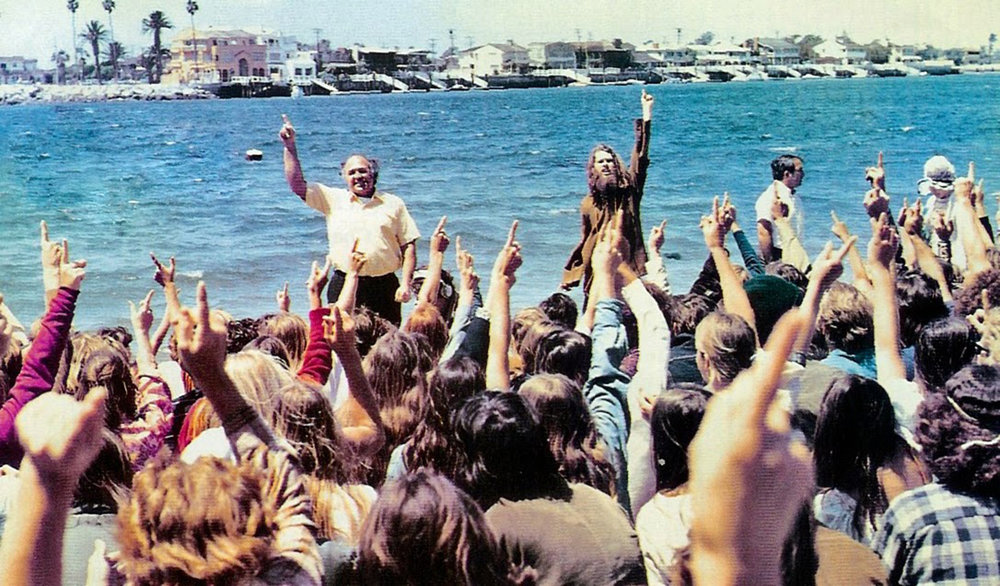

A friend told me I should see the film Jesus Revolution. He wept, he told me, when he saw it because he lived through the Jesus Revolution. I lived through those days also, though in Indiana instead of California.
I can’t say I wept, but tears came to my eyes as I viewed the film. I was so moved. I wish to share some memories about the Jesus Revolution of some years ago, and relate those to memories about Methodist youth ministry, and to what I have referred to as “The GAP”, the disconnect between United Methodist leadership and ordinary people in the pew.
In 1967 I was appointed to Calvary church, Elkhart, where, after the Methodist-Evangelical United Brethren merger, a city of 45,000 supported 14 United Methodist Churches. It was also supporting race riots, drug problems and other upheavals brought on by the social revolution of the late 1960s.
When the Jesus Revolution hit, it came to the church I was serving. Doug, a member, had been in the Navy where he had washed out because of drugs among other things. But he had been marvelously converted through the Jesus People in California, and brought his new-found faith back home and to our church.
The church was ready. One of the classes had already committed to serving the least, the last and the lost and was investing itself in a low-income housing project. Suddenly we dealt with all kinds of people different from our otherwise typical Methodist congregation: hippies, poor people, couples living together without marriage, inter-racial couples, prostitutes, the homeless.
Jesus People, our new-found friends, were soon helping with this. One Sunday we had a motorcycle gang come to church. They came back in the evening to one of our groups. Our youth were excited; their parents and other adults not nearly as much. It was probably the only time in my ministry when parents complained of the church making their children “too religious.”
Our whole community was caught up in the excitement. Two big Jesus People assemblies were blossoming: the Glory Barn and the Gladiola Warehouse (no traditional names like “Trinity” or “St. Stephen’s”), with Mennonites a major part of the Gladiola Warehouse group.
It is not unrelated, I think, that the great Asbury Revival of 1970 took place at the same time. To make things even more exciting, the Catholic charismatic movement was exploding at Notre Dame, less than 20 miles from our church. I took several carloads to Christ the King Catholic Church in South Bend. Some of our people were so excited I thought that they might leave Methodism for Catholicism. I also became acquainted with Kevin Ranahan and the charismatic community he was leading (the same group the present Supreme Court Justice Amy Coney Barrett has been a part of). I have memories of a Holy Spirit Conference where nuns were carrying Bibles and guitars.
The revival spilled over into our conference camp program. It helped that our North Indiana Methodist Conference camp program already had its own version of revival. The highlight of our senior high Institutes was always Commitment Night, complete with altar calls and pledges. Our more liberal friends were part of this, though they gave poor altar calls. It was a similar story with our junior high program for which I was a camp director for 14 years. Thousands trace their conversion and/or Christian calling to those programs, including at least two recent bishops from Indiana, Mike Coyner and Frank Beard.
In the 1950s and 60s our senior high program would average nearly 3,000 campers a summer and our junior high program 1,800 (we held 10 camps of 180 campers each and had to limit enrollment). We wrote our own curriculum in junior high. Our programs even published our own song book, “Epworth Sings.” Keep in mind that our North Indiana Methodist Conference was just one of the five conferences (two EUB and three Methodist) that through mergers now make up the Indiana Conference of the United Methodist Church.
Of course, the Jesus Revolution was much bigger nationwide and worldwide. Billy Graham Crusades were being held not just in the United States but overseas. Colleges were affected. One day I asked our Wesley Foundation director at Purdue how the Methodists were doing. He replied, “Fine, but we have a lot of competition.” He went on to say they had identified 80 different organized or informal Christian groups operating on campus. When I attended the Intervarsity Missionary Conference at Urbana in 1955, they were thrilled to enroll 5,000. By 1970 they were enrolling 17,000 and limiting registrations. Campus Crusade attracted 120,000 to Dallas stadium in the early 1970s.
Official Methodism, on the other hand, was going in a different direction. A major faction of its leadership was obsessed with being relevant and letting the world set the agenda. The agenda? I remember in the mid-1950s when I represented my college at the National Students’ Association (NSA) conference. The major concern was academic freedom, especially as it related to professors having the right to advocate for Communism. This was to take precedence, even in church-related schools, over religion-inspired confessions of faith, which were seen as limiting to academic freedom.
By the 1960s this kind of activism had spread to a number of colleges (and seminaries). According to this activism we—the church and the nation—were at war with racism, sexism, capitalism, war mongering and other things. All this spawned new caucuses and identity groups. It appeared, as one person commented, that instead of professors instructing students, students were instructing professors as to how irrelevant and outdated their teachings had become. My own seminary, Garrett Biblical, was experiencing such rancor that the school basically shut down and ceased to have classes for a while in 1970.
I was serving as Conference Coordinator of Youth Ministries at the time. As part of the changing cultural climate, Youth Ministry, as it was known in the Methodist Church, was being told to keep up with the times.
The Methodist Youth Fellowship (MYF), with its banners, handbooks, official benediction, and programs, was declared, as I heard one church leader explain, “Mickey Mouse.” Youth, so we were told, did not want to be told what to do by adults. They wanted to speak their own voice on the social issues of the times as well as on other things.
At the General Conferences of 1968, 1970 and 1972, “youth,” which were mostly 20-year olds or thereabouts, demonstrated. Liberal establishment Methodism, which at that time seemed devoid of any moderating influences, and which seemed never to encounter a demonstration it did not like, capitulated to every demand. Thus was formed NYMO, National Youth Ministry Organization, a semi-autonomous agency of the church, run by “youth” (really young adults), for “youth.” NYMO did almost nothing to relate to the spiritual development of local church teenagers. It operated with a mandated quota system (50 percent of all delegates to delegated events must be ethnic minority), to the extent that several conferences were unable to participate in national events because they could not meet the quotas. Youth Service Fund, a missions fund supported by MYFs, imploded. I pointed out to one national staff person that of $38,000 dispersed only 6.5 percent of the funds were channeled through church organizations. A fair amount of the money had been given to gay and lesbian causes.
If there was a Jesus Revolution going on it was never noted by NYMO, nor for that matter, by the Board of Discipleship, not by the church leadership.
At the General Conference of 1976, NYMO was voted out of existence but the youth ministry never recovered. In late September of 1976 an informational meeting for conference and district youth coordinators was held in Nashville sponsored by the Board of Discipleship. Here was some of the information shared: in 1967 (just before the 1968 General Conference), there were 13 staff persons in youth ministry on the national level under the old Methodist Board of Education, with 15 secretaries; there were 52 full-time annual conference directors and 1,200,000 pieces of curriculum material circulated per quarter. Within 10 years (and after “reforms” and restructuring designed to make the youth ministry relevant), there were three staff members with one secretary, and 400,000 pieces of curriculum circulated per quarter (not sure of the number of full-time conference staff).
This story is told to illustrate the GAP, the disconnect between denominational leadership and the people in the pew. How different things might have been if institutional leaders had been more open to the influences of its evangelical constituency. Or, for that matter, if we had been more sensitive to the concerns of persons in the pew.
Today, the UMC has the lowest percentage of members under the age of 40 of any major denomination. For those committed to the future of the United Methodist Church—time for change.




Comment by Dan W on March 29, 2023 at 8:43 am
I had not heard of this movie. I’ll have to check it out.
I was too young to remember much of the Jesus Revolution. Our church youth group/choir did perform a couple of the Kurt Kaiser musicals, “Tell it Like it Is” being the most memorable. It seems that when a ministry starts at the grassroots level and begins to grow, the UMC tries to “manage” it. This usually doesn’t turn out well.
Comment by James on March 29, 2023 at 9:33 am
I’ve only seen the “trailer” of the movie, but when it is available for old koots like me, I will purchase it and watch it.
In regard to Riley B. Case’s comment in regard to methodist literature: my youngest son was probably 5 or 6 years old. His Sunday school lesson one Sunday taught those kids the proper way to cross the street as opposed to the Good News of Jesus the Christ. Soon after that, our little congregation changed to “William C. Cook” Sunday school material.
Pew sitters in the umc are mostly taxed without representation……………
Comment by Steve on March 29, 2023 at 11:01 am
Um, it was the Jesus Movement that also planted the seed of our modern-day divide in the church. Lonnie Frisbee, a significant player in that movement and is in the above picture, is touted (fairly or not) by the inclusion crowd as the poster child for gay inclusion (he engaged in homosexual behavior off and on during his life and died of AIDS). I know they addressed it lightly in the film but the Jesus Movement clearly opened the door and fanned the flames of todays conflict in the church.
Comment by Gary Bebop on March 29, 2023 at 12:35 pm
This is one of Riley’s best historical cameos. His revelations of personal connections with the historical moment contribute authenticity, insight, and campfire intimacy to his account. It’s clear Riley was there in the moment, not a remote, indifferent spectator. Just down the road from Elkhart is Winona Lake, Indiana. Now there’s a storied name! No evangelical living in Northern Indiana was unaware of its splendid, colorful, turbulent past. But by 1967, the glory had departed though the glints remained.
Comment by E C on March 29, 2023 at 1:43 pm
The more things change, the more they stay the same, apparently. It is time for a fresh start!
Comment by Leon Kircher on April 3, 2023 at 4:35 pm
The United Methodist denomination has lost its way to a corrupt immoral society.