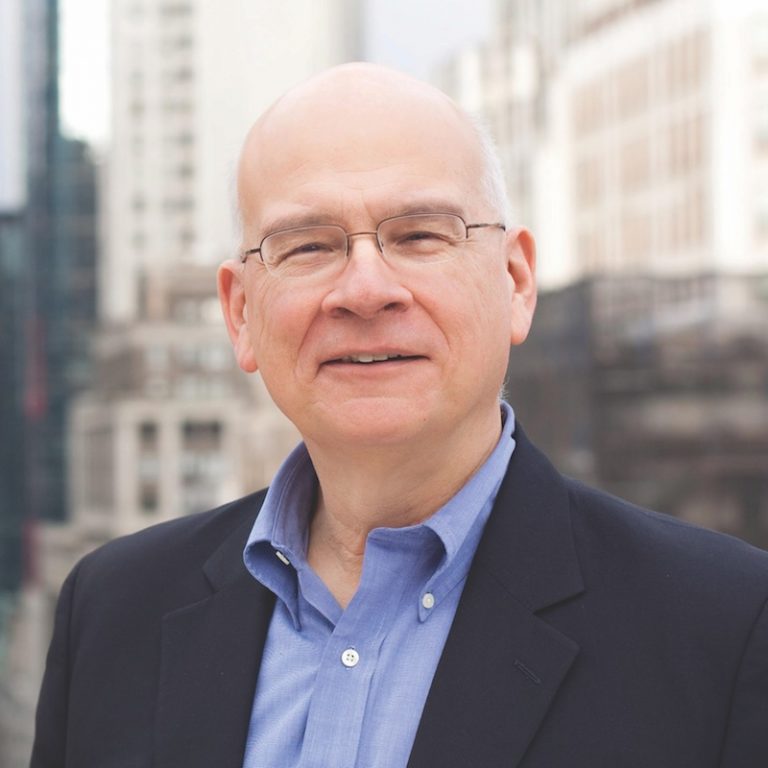
Editor’s Note: Tim Keller passed away the morning of May 19, 2023. We’re bumping this February post now as we mark the end of his earthly life. We also commend this September interview of Keller with IRD’s Mark Tooley about his new book Forgive: Why Should I and How Can I.
Tim Keller is one of those Baby Boomers who lived through the rise of the Jesus Movement to become one of the most influential American pastors of the postsecular age.
As one who became a Christian in 1968, Keller says that he also feels akin to the youth today who believe that they are coming of age in a time of momentous social, political, and religious change.
Keller is known for his winsome, urbane style in conveying orthodox Christianity. To New Yorkers, he was a surprise, undermining crude stereotypes of evangelicals.
His message was the medium in which his Redeemer Presbyterian Church’s outreach was propelled. He spent an immense amount of time preparing his sermons. His rhetoric was orthodox Christianity told in a fresh way, a New York intellectual way. His sermons felt transparent with no hidden agenda or money-grabbing appeals. They were compassionate, but they were unsentimental without emotional exploitation, nuanced with intellectual depth but humble.
A new biography by Collin Hansen, Tim Keller: His Spiritual and Intellectual Formation, profiles the New York City pastor through his expanding bookshelf. “To understand Keller,” Hansen claims, “is to read his books’ footnotes.” He makes a good case for understanding Keller in this way. The book is also suffused with interesting and previously unknown personal anecdotes from Keller’s life and in a clear, well-written style.
After a stints as a pastor in a blue-collar church in Virginia and a professor at a Philadelphia seminary, Keller went to New York where he founded Redeemer in 1989. When he stepped back in 2017 from lead pastor duties, the church had grown to more than 5,000 attenders. Keller is one of America’s most influential pastors, the founder of a large non-profit, Hope for New York, that funnels aid to comforters of the poor and downtrodden, and of the highly successful church-planting organization Redeemer City to City. It reports helping to plant 978 churches and training 79,149 church leaders around the world. Keller has also published over two dozen books.

However, now there is quite a bit of debate over whether Keller’s vision of America and the world is still relevant. The book is a well-timed contribution.
The key question is, what is the nature of our age? Is it a time of a triumphant rise of a new secularism? Or simply an era of the nonreligious? Is America now or is becoming a post-Christian society? Or is it a messier era of the “negative world” whose culture presses Christians to forsake their faith or, at least, their public voice unless they engage in a mighty culture war? Once you have defined the situation of your world in a certain way,
We have had epochal definitional wars before. It was commonly believed in the 1960s-1970s that New York City was the quintessential secular city that was leading the way to global secularization. But the river of history did not flow that way. For several decades now, the city has been a bog of vociferous secularists covered by a joyous flood of religionists. Consequently in New York City, we call this a postsecular society, because the secularists have, at least momentarily, lost the argument about the future, but the religionists can’t assuredly promise the rising of a new Jerusalem, Mecca or other sacred firmament out the confusion. Neither side is very happy hanging with each other in this liminal state.
The postsecular era has now stretched over several generations and multiple waves of immigration. So, the upheaval of generations and migrations becomes a special part of the religious scene.
To critics who say that Keller’s winsome intellectual style was only effective in that bygone age when Christians were treated benignly as debating partners, Keller says that idea is a misreading of recent history. He notes that he felt plenty of pushback when he arrived in New York City to plant a church in 1989.
However, the New York pastor does admit that times have changed enough so that he needs to retool.
Keller comes to New York City
Redeemer Presbyterian Church was launched on April 9th in 1989, two Sundays after Easter. The worship service started with almost no one showing up, but in a fashionably late way, about fifty finally flowed into the auditorium. There were different reactions to Keller and the new church. There was some excitement from supporters around the city and in Manhattan: some really liked Keller’s vision and theology; and some thought he was a good speaker. Others said that Keller wasn’t that good of a speaker, a little cool interpersonally, objected to some Christian belief that he held, and wondered if the enterprise could sustain itself.
The church quickly grew to over 150 people. And grew more. And more.
After Keller published his finely-reasoned outreach book The Reason for God in 2008, he became more widely known to Americans as a whole.
Subsequently however, the pastor sensed a change in mood toward religion as a whole. Hansen reports that Keller wrote, “When I first came to New York City nearly twenty years ago, I more often heard the objection that all religions are equally true. Now, I’m more likely to be told that all religions are equally false.” Hansen connects this change to the rise of the so-called “New Atheists.”
Keller encountered more angry people than doubters seeking truth. For the first time, Keller also started to experience himself as an outsider to the modern culture rather than an intelligent insider offering critique and self-reflection.
Now, he was more often seen as a “spokesman” for evangelical Christianity, not an accessible visitor with the secular tribe. His outsiderness was emphasized by the fact that he included not a single chapter on sexuality, capitalism, and race. He became more popular among Christians but maybe less so among American progressives who were already in motion toward extreme hostility to people not of their tribe. “As soon as Tim Keller published his bestseller apologetic book, he knew it was already obsolete,” Hansen writes.
Ever since that time, Keller has been playing catch up with the changing social mores and cultural imperatives. .
Still, successful spiritual change in New York City continued. With the powerful and deft support of Redeemer’s church-planting center, the number of evangelical churches in Manhattan continued to grow.

The pastors of the Postsecular City
Keller is a lot like Pope Francis in being a religious leader who is modeling a winsome way to live in and sustain the postsecular society against both the extreme secularists and religionists. As sociologist Michelle Dillon has noted, Pope Francis is the leader of a “postsecular Catholicism,” which relishes a dialogue with the seculars without building walls based on a psychological defensiveness. It seems Keller has charted a similar path.
So, is Keller’s winsome reasoning the right approach for the current era or should everyone hop into culture war armor or retreat to monastic fortresses?
In May 2020, the Kellers’ world narrowed down into their rooms. The pandemic threw them into an isolation unlike anything that they had experienced. Tim was also battling illness for pancreatic cancer.
The pandemic time-out has allowed Keller to read more than ever. He is also trying to figure out how to reconnect with younger leaders. He went back to the basics of Christianity and life. This pathway lead him to City of God by the early church father Augustine. This is the saint whom President Joe Biden referred to in his inaugural address. Perhaps, this book provides the exemplar of what is needed now. As a step in this direction, Keller encouraged philosopher David Watkin to complete his massive Biblical Critical Theory, published in 2022. Now, an announcement has come about the launching of The Keller Center for Cultural Apologetics.
Charles Mathews of the University of Virginia noted in The Hedgehog Review, published by James Davison Hunter, that Augustine is crucial for understanding the deeper contexts of our modernity. Augustine “was the last major antique writer who knew what it was to be both not a Christian and a Christian–one of the last, and arguably the greatest, of the “native speakers” of both those rival idioms–and he thought about that difference in all he wrote. He embodied this transition… He was the first great thinker to struggle self-consciously with ambivalence about his transitional time. His reflections on the experience of his own transition deeply informed his efforts to shape the Christian transition for his own community, and later generations as well.”
Keller should appreciate the sentiment that Augustine shared in one of his sermons, “The Emperor has been converted, but the devil has not.” There is more work to be done. To paraphrase Mathews, Keller’s deepening appreciation of Augustine’s project can be of great value for helping us understand how to live in our new “postsecular understanding.”
Tony Carnes is known as the foremost expert on religions in New York City. The New York Times says, “Nobody else is looking so methodically for religion in New York.” He has also worked on church planting strategy with Tim Keller. Carnes is editor and publisher of A Journey through NYC religions and host of its the network television news magazine program. He is also co-editor of New York Glory. Religions in the City and Asian American Religions. Their changing borders and boundaries (both published by New York University Press).



Comment by The Rev. Dr. Lee Cary (retired UMC clergy) on February 14, 2023 at 2:55 pm
“The key question is, what is the nature of our age? Is it a time of a triumphant rise of a new secularism? Or simply an era of the nonreligious? Is America now or is becoming a post-Christian society? Or is it a messier era of the “negative world” whose culture presses Christians to forsake their faith or, at least, their public voice unless they engage in a mighty culture war?”
The answer to “the key question” is none of the above. It’s hidden in the title: “Tim Keller: Pastor for the Postsecular [sic] City”.
When was the last time you watched greenfield construction of a new church building – of any flavor – being erected in any big US city? The land is too expensive!
Once large congregations in many American inner cities are dead or dying. [Same is true in more than one Western European country.]
In America, free-standing, independent, non-denominational congregations are sprouting up like wildflowers outside semi-rural, post-secular cities.
Meanwhile, many denominational congregations in medium-to-large cities, particularly where the population is expanding into near suburbs, are emptying out. Not all. But many. Why? Because, to credit Bob Dylan: “The times, they are a changin’.”
Comment by David on February 14, 2023 at 5:46 pm
Many urban churches found themselves to be White congregations in Black cities and declined with the population change.
“Manhattan Center City” is not a term commonly used. I suppose it might mean Midtown, but many parts of this are non-residential. There was a northern migration of residential areas in Manhattan and some churches found themselves without a local congregation. Several moved once or twice to the newer residential areas.
The only new church construction I have noticed in decades was that of the Mormons who had moved from an old Methodist building. This was sold to a Korean congregation. Locally, Buddhist, Hindu, and Sikh temples, and Mosques are as common as churches. Synagogues have largely disappeared as that population moved on.