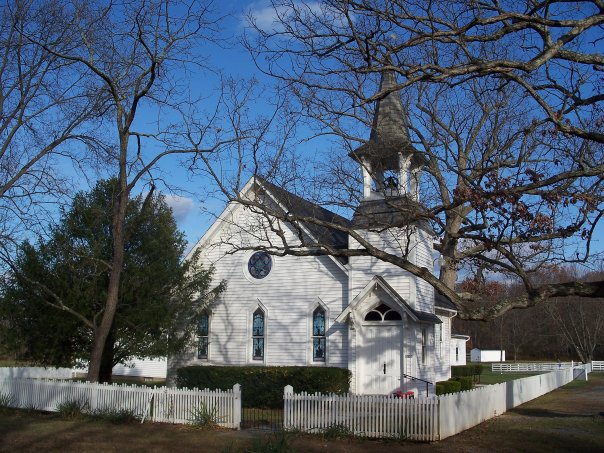

The United Methodist Virginia Annual Conference approved the exit of 10 traditional churches from the liberalizing denomination on Saturday, October 29, while 125 more plan to leave. Presumably many more will join that number before next year’s deadline. Virginia has 1,121 churches, which means 12 percent of churches are exiting so far as part of United Methodism’s global schism involving thousands of churches.
One church approved for exit is Crums Church in rural northern Virginia in Clarke County between Berryville and Winchester. It’s a beautiful white clapboard church whose history dates to 1792. I visited there in 2016 for a Christmas candlelight concert. Yesterday I talked with its pastor since 2019, David Graves, who shared their congregation’s journey to exit.
Crums Church has about 100 worshippers on Sunday. That number previously would have deemed it a small to medium sized rural church. But with the ongoing collapse of United Methodist participation accelerating since the pandemic, Crums Church is now the fourth largest in attendance in its Shenandoah River District of 156 churches. Even in suburban Northern Virginia, many United Methodist churches that once had hundreds of worshippers now have only a few dozen, especially after prolonged pandemic closures.
Before the pandemic, Crums Church had about 80 regular worshippers. But it reopened in June 2020 for outdoor worship, far earlier than many other United Methodist churches. Graves estimates that 90 percent of the pre-pandemic worshippers have returned, with additions. Crums has two worship services, contemporary and traditional, with the former more popular, including 8-15 children in worship, and another 5 or 6 in the nursery.
After United Methodism’s governing General Conference was again postponed in March, Virginia Bishop Sharma Lewis announced a pathway for churches to depart under United Methodist Book of Discipline Paragraph 2553, which requires payment of two years of apportionments and pension liabilities. This amount for Crums Church was nearly $160,000. Graves recounted the church had six congregational meetings to discuss exit, with about 30 people attending the early meetings, and from the beginning there was wide agreement. The church council was unanimous for exit, and the congregational vote was 81 percent. Fifty-six church members voted for exit and 13 against. Paragraph 2553 requires a two-thirds congregational vote for exit.
Graves recounted that a couple opponents thought Crums Church would be homophobic by exiting. A few thought the church should wait and hope for a better financial offer. And a few thought Crums could continue as a traditional church even in a liberalizing denomination. Several church members had been involved in splits of other denominations, such as the Presbyterian Church U.S.A. and Christian Church (Disciples of Christ), and they shared how their congregations had survived.
Since Crums Church’s exit vote, one church member has stopped attending, and four additional people have started regularly attending. There had been a “sense of angst” before the vote, Graves noted, but now there is a sense of relief and looking forward. The church will wait another six months before deciding whether to affiliate with a denomination like the Global Methodist Church.
Graves said he has only heard from a few other local churches interested in their exit process. He is surprised how little many clergy know about the logistics of exit. Even though church attendance for most United Methodists churches has plummeted, and the denomination expects dramatic spending cuts, including church closures, Graves said most clergy seem comfortable and unaware. He speculated that many congregations don’t have the energy to escape their rut, and confronting the current schism is too much for them. His church’s exit was fairly smooth and concluded amicably but consumed time and energy, he admitted. Graves is grateful to serve his current congregation and anticipates a bright future.
The careful tenacity of Crums Church can inspire other churches in Virginia, and elsewhere, to move forward into a new and better future. It’s far easier to do nothing, and remain, accepting the demise of United Methodism stoically. As a lifelong United Methodist in the Virginia Conference, I hope that hundreds of churches will follow the example of Crums Church and revive Methodism in Virginia.




Comment by td on November 1, 2022 at 4:43 pm
Thanks for sharing this story.
Unfortunately, i think it is an outlier. I think most UMC pastors have not acted with integrity concerning the availablity of congregations to exit. It is sad, but i am afraid true, that most pastors have kept their cingregations in the dark about the options available to them.
Comment by David on November 1, 2022 at 6:00 pm
Back in September, the Pew Research people came out with a lengthy study as to the future of Christianity in the US with references to Europe.
https://www.pewresearch.org/religion/2022/09/13/modeling-the-future-of-religion-in-america/
Comment by Dave Miller on November 1, 2022 at 9:43 pm
How did Crums Church pay the $160,000? That seems insurmountable.
Comment by Reynolds on November 2, 2022 at 8:59 am
You get a loan from a bank based on property value and past donations and pledges.
Comment by Pastor Mike on November 2, 2022 at 3:44 pm
Crum’s story sounds very familiar. We started up summer services (outside – in Minnesota) as well in June 2020. Our people loved it, and we had a number of folks from other churches join us because their churches still weren’t having any kind of in-person worship.
Fast forward to today. Even though we’re in a community of under 5,000 people, our worship attendance is in the top two UMC’s in our district – which includes a number of churches in communities of 20K to 50K (we’re averaging 120-140 in worship; last Sunday we had 160). This is so sad, really. But it’s partly the result of Covid, and MOSTLY the result of our Minnesota conference leaders’ decision to keep churches closed for so long.
Our cost for disaffiliation will be around $115-120K; about 70K of that will be the pension liability amount. I consider the rest – regular apportionments – to be money we would have spend anyway over the next 18-24 months. And the Global Methodist Church offers the opportunity to request a stay on paying any apportionments until they hold the convening General Conference of the GMC (sometime in 2024). So, if we decide to disaffiliate (pretty likely), we will bite the bullet and pay the money!
Staying in the UMC is staying for a very dark future – as was said, most clergy have their heads in the sand about what their future will look like in an increasingly woke, progressive, old, shrinking dying church. It will get depressing pretty fast…you know the old saying: “Sooner or later you run out of other people’s money.”
Comment by Dan W on November 3, 2022 at 11:21 am
Pastor Mike, your comment is very encouraging. Thanks, and have a wonderful Thanksgiving and Advent!
Comment by George on November 3, 2022 at 9:01 pm
I’m as interested as anyone about the number of churches revolting (and it is a revolt) against the current United Methodist church. But it will be several years from now before we know just how things shake out. Will the GMC grow and bring more people to Christ?
Will the UMC be able to stop the low or no growth it now is experiencing? I want what is best for both. My only ax to grind is with those bishops who are bleeding those churches who wish to leave. Not very Christian if you ask me.
Comment by jerry pattengale on November 7, 2022 at 5:43 am
Thanks for this thoughtful, irenic, and informative account, and the decision to highlight one church in this process. Perhaps the most revealing is the attendance rank (4th) among all churches in its coalition. On a tangential note, it is of interest that even a church of 100 has a contemporary and traditional option for worship.
Comment by John Smith on November 7, 2022 at 4:41 pm
Even more than the clergy, the members are almost completely uniformed and unaware of what is going to hit them, which to my mind was the intent of the episcopacy. The churches will slowly wither and close the doors rather than fight a losing battle. Many of the people are more attached to their local church and it associations than to christianity or methodism. Those who reverse that priority will now hasten their exits looking for a new home.
As their contributions to the new UMC decline there will probably be a series of agressive closings in an effort to keep the illusion of the UMC as a significant “social force” instead of a pale imitation of the surrounding culture.
Comment by Sal Buonocore on November 8, 2022 at 11:15 am
Why are local congregations banding together in litegation against the denomination for a breach of contract (the Disicpline)? Thousands of churchs in the US are disaffiliating and they are paying millions of dollars in randsom to get out. It the contract is broken, legally, are we not permitted out of said contract without any penalities or payments?
Comment by John Smith on November 9, 2022 at 12:58 pm
Sal
The BOD is not a contract. The Trust clause is separate and legally binding as well as pension law. The only way out without paying off the Bishops and their enforcers is to walk away from your building. If you money in the church’s name spend it, then walk.
Comment by Lee Cary on November 10, 2022 at 7:40 am
Sad to see that the focus on a once great Protestant denomination has degenerated into a debate over the fate of the “Benjamin’s”.
The Church is not a building. And neve has been.
Comment by John Smith on November 11, 2022 at 8:32 pm
Lee,
And yet that is the focus of the UMC, Bishops, Boards and Societies. Let us not forget that many local churches also have positive fund balances that are firmly in the sights of the UMC.
The Church is not a building but that building can be turned into cash and fund a lot bureaucracy and programs to get people to think correct thoughts.